The Fangyan temple fair runs for about fifty days each autumn, and this month I went up with everyone else.
On the way back I stopped at the gate and did what I always do at a gate: read the signature. Two big characters — 方岩, Fangyan — cut into the stone, and beside them a small block of smaller text. I zoomed the photo until it resolved. 任政 — Ren Zheng. And beneath that, 乙丑年秋: autumn of the yichou year.
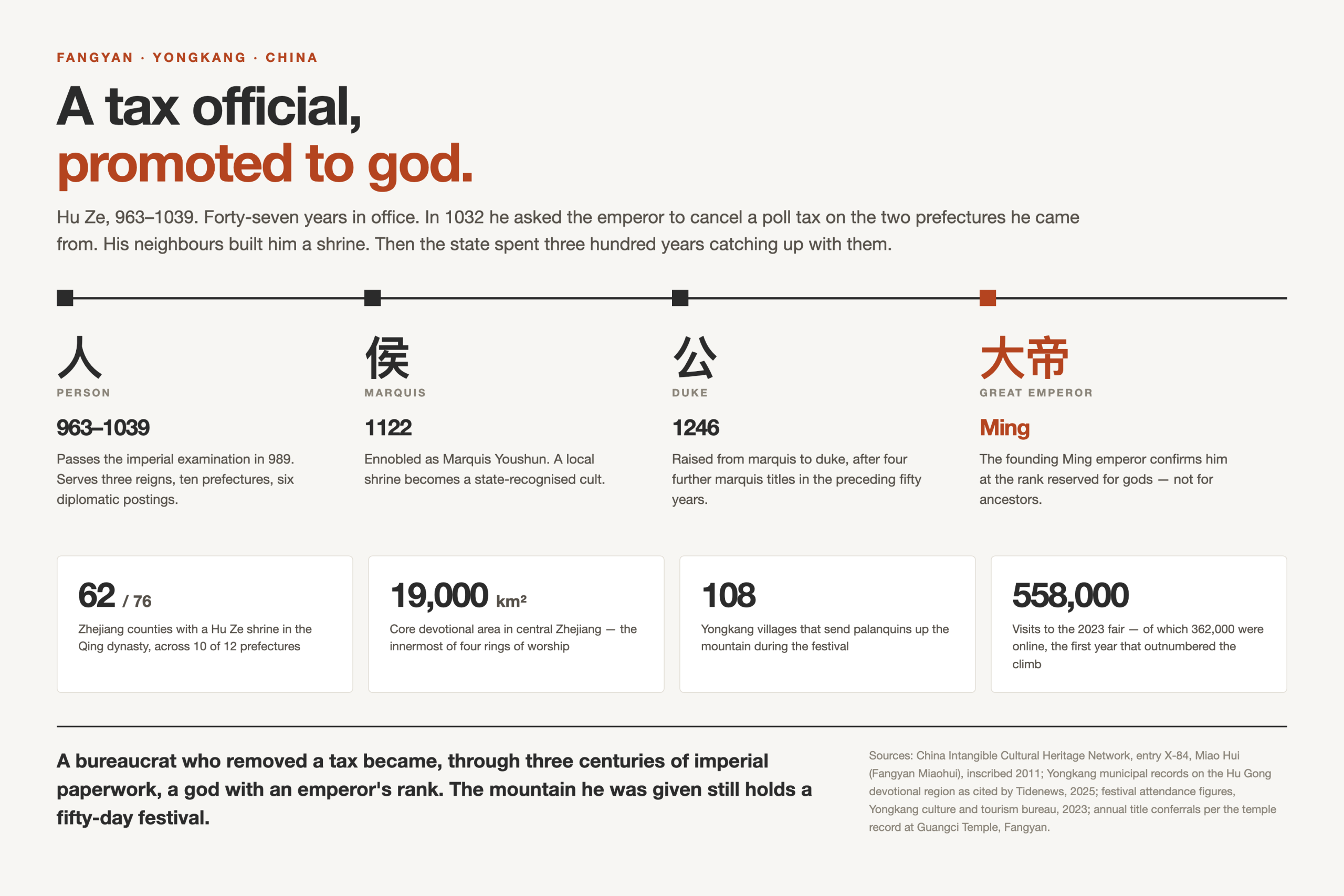
The last yichou year was 1985. So the pair of characters over the entrance to my county’s most famous mountain is forty years old, and it was written by a man from the next prefecture over, who died in 1999.
That should have been the end of it. A name I did not recognise, a date that only means anything if you can do the sexagenary arithmetic in your head. But then I looked him up, and the search results were strange, because I already knew his handwriting. Everyone in China does. It is installed on your computer.
A competition with the names removed
In 1979 the Shanghai Type Foundry had a gap to fill. Chinese newspapers were set in type, and they had a 宋体 and a 黑体 and a 楷体, but nothing in 行书 — the running script, the semi-cursive hand in which Chinese is actually written by people in a hurry. They wanted a standard.
So they did something unusual. They invited more than forty established calligraphers to each submit a specimen of their running script. Then they removed the signatures and put the samples to a public vote.
The winner was Ren Zheng. Second was Liu Xiaoqing. The account of the competition is worth reading because of how unglamorous the prize was: not a prize at all, but a commission to write about seven thousand characters, one at a time, to specification. It took him two years.
Those seven thousand characters became 任政体, the Ren Zheng style. They were adopted by People’s Daily, Wenhui Bao, Xinmin Evening News, the Shenzhen Special Zone Daily, and by CCTV. Then they went into the national character standard, and from there into the font libraries. On a Chinese-language computer the font is called 华文行楷 — Huawen Xingkai — and it shipped with simplified-Chinese editions of Microsoft Office for years.
Which means the following is true, and it is a strange thing to hold in your head:
| The characters on the notice in your office announcing a public holiday | Probably his |
| The banner over a shop opening, the poster for a school sports day, the headline on a red 横幅 strung across a road | Probably his |
| The two characters carved over the gate of a mountain in a county of 1.2 million people | Definitely his, and dated 1985 |
Hundreds of millions of people have read this man’s handwriting today. Almost none of them can name him. A calligrapher’s normal fate is to be admired by a small number of people who own his work. Ren Zheng’s fate was to become infrastructure.
What else he did with the brush
The mountain gate was not an outlier in his career, which is the part I find most surprising. He was not a local signwriter who got lucky.
- In 1972 he wrote the plaques for three of the West Lake scenic sites in Hangzhou — 柳浪闻莺, 曲院风荷, 孤山.
- In 1974 he wrote the signboard for the Shanghai Youth Palace, which made him a household name in that city.
- In 1981 he wrote the inscription for the Huaihai Campaign Memorial.
- In 1994 the national postal service commissioned him to write its standard characters.
A retrospective on his work notes that he has left calligraphy at scenic sites across the country — and that in the 1979 competition he placed first with Liu Xiaoqing second, a detail that only a rival’s obituary would normally record. Born in Huangyan, Zhejiang, in 1916; settled in Shanghai from 1938; worked at the Shanghai post office; spent his last decades as a researcher at the Shanghai Research Institute of Culture and History. He died in August 1999.
So: why would a county in the Zhejiang hills get a man of that standing to write two characters on a rock? Partly because in 1985 that was simply how things were done — a serious public building got a serious hand, and the phone call was made. But partly because Fangyan is not what it looks like from the car park.
The rock
Fangyan is a Danxia landform, which means red sandstone that erodes into cliffs rather than peaks. The county’s own description is unusually good: the mountain rises straight out of flat ground, four walls sheared, and the area at the summit is almost the same as the area at the base — so the whole mass reads as a rectangular column standing in a basin. The main summit is about 384 metres. The scenic area covers 152.8 square kilometres across eight zones, and its centre is 23 kilometres east of the town where I live.
You climb it through a sequence that was clearly designed rather than found. A pavilion built into the rock at mid-height. A flight of steps so steep it has its own name — 百步峻, the hundred-step steep. Then 飞桥, a fifty-metre gallery cut and stacked along a sheer face, cliff on one side and a drop on the other. Then 天门, the Gate of Heaven, built on the巨石 where the rock splits. Past that the ground flattens, and there is a street of vendors — 天街, the heavenly market — before you reach the temple.
That progression is doing something specific. In Chinese mountain shrines the climb is not transport, it is the ritual. Effort is the offering. Which is why the gate at the bottom matters more than a gate normally would: it is where the transaction begins, and it has to look like it was worth a famous hand. The same instinct — put the important thing on top, and make the getting there the point — is behind the small houses people build on the roofs of their own homes a few kilometres from here.
And the reason there is a shrine at all
The temple on top, 广慈寺, was first built in 850, in the Tang dynasty, under a different name. But the thing people actually climb for arrived later, and it is a hall inside the temple compound: 胡公祠, the shrine to a man called Hu Ze.
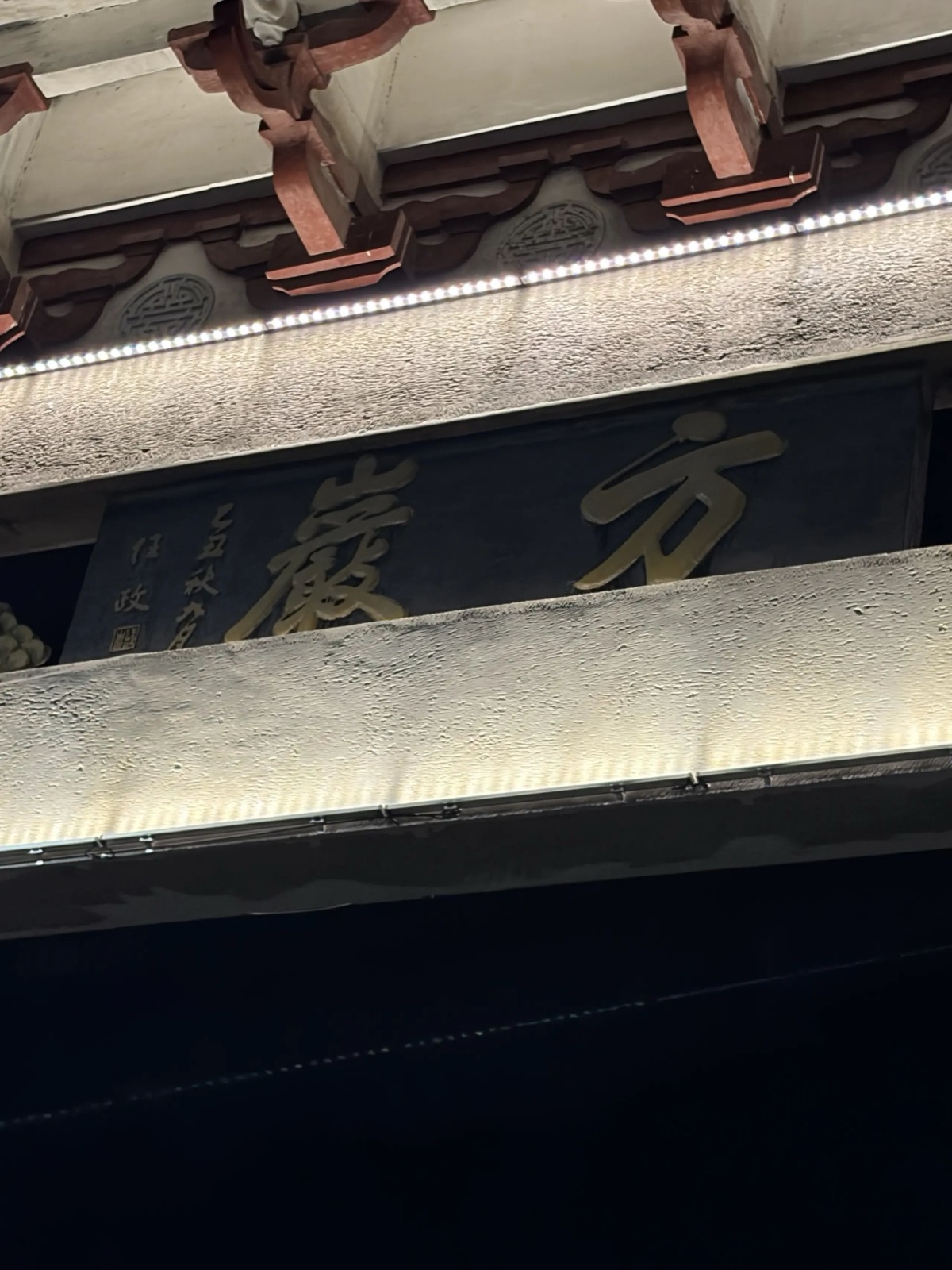
Hu Ze was born in 963 and died in 1039. He was from Yongkang. He passed the imperial examination in 989, at twenty-seven, and then spent forty-seven years in office — three reigns, ten prefectures, six diplomatic postings, across most of the country.
The act he is remembered for happened in 1032. Posted back to the capital, he learned that Jiangnan was in drought and that the two prefectures of Qu and Wu — his home region — were still being charged the shending qian, a poll tax levied on adult males. He petitioned to have it abolished for his own people. It was.
When he died, the people who had been paying that tax built him a shrine on the mountain. Then the state spent two centuries catching up with them:
| Year | What happened |
|---|---|
| 1122 | Ennobled as Marquis Youshun |
| 1152 | Imperial plaque granted, with the title 赫灵 — “manifestly efficacious” |
| 1192–1210 | Elevated twice more, to Marquis Jiaying, then Fuzhe, then Xianling |
| 1246 | Raised from marquis to duke |
| 1253 | Further title added: Zhongyou |
| Ming dynasty | The founding emperor confirms him as a 大帝 — a Great Emperor |
A bureaucrat who removed a tax became, over three hundred years of paperwork, a god with an emperor’s rank. The county’s own record of the festival that grew around him is now on the national intangible heritage list, and the numbers attached to that devotion are not small:
- The core devotional area covers about 19,000 square kilometres of central Zhejiang.
- In the Qing dynasty, shrines to Hu Ze stood in 62 of Zhejiang’s 76 counties, across 10 of its 12 prefectures — nearly 90,000 square kilometres.
- Outside the province, worshippers are recorded in close to twenty provinces and municipalities.
- And there is a diaspora layer: communities in Hong Kong, Macao and Taiwan, in Japan, Singapore and Malaysia, and in the United States and Italy.
Those rings are set out in a study of the devotional region published by the provincial news outlet Tidenews. All of it traces back to one petition about a poll tax.
Fifty days, and a hundred and eight villages
The fair is the mechanism that keeps the shrine alive. It runs from the first day of the eighth lunar month to roughly the Double Ninth festival in the ninth — about fifty days, with two peaks: the thirteenth of the eighth month, Hu Ze’s birthday, and Chongyang.
The core ritual is called 迎案 — carrying the god’s palanquin up the mountain. Each village arrives with a 罗汉班, a troupe of dozens or hundreds of young men who perform martial sets in the courtyard. The county record counts seventy-two troupes going up on the birthday alone, and in Yongkang 108 villages send palanquins. The dance troupes that accompany them — 十八蝴蝶, Eighteen Butterflies, and 九狮图, Nine Lions — are themselves separately protected arts.
The attendance figures for 2023 are the interesting ones: 558,000 visits across the fair, of which 362,000 were online. For the first time, more people watched the festival on a phone than climbed the mountain. A thousand-year-old pilgrimage to a Song dynasty tax official is now partly a livestream, which is either the most natural thing in the world or the strangest, depending on which century you are standing in.
The grid in the cliff I could not explain
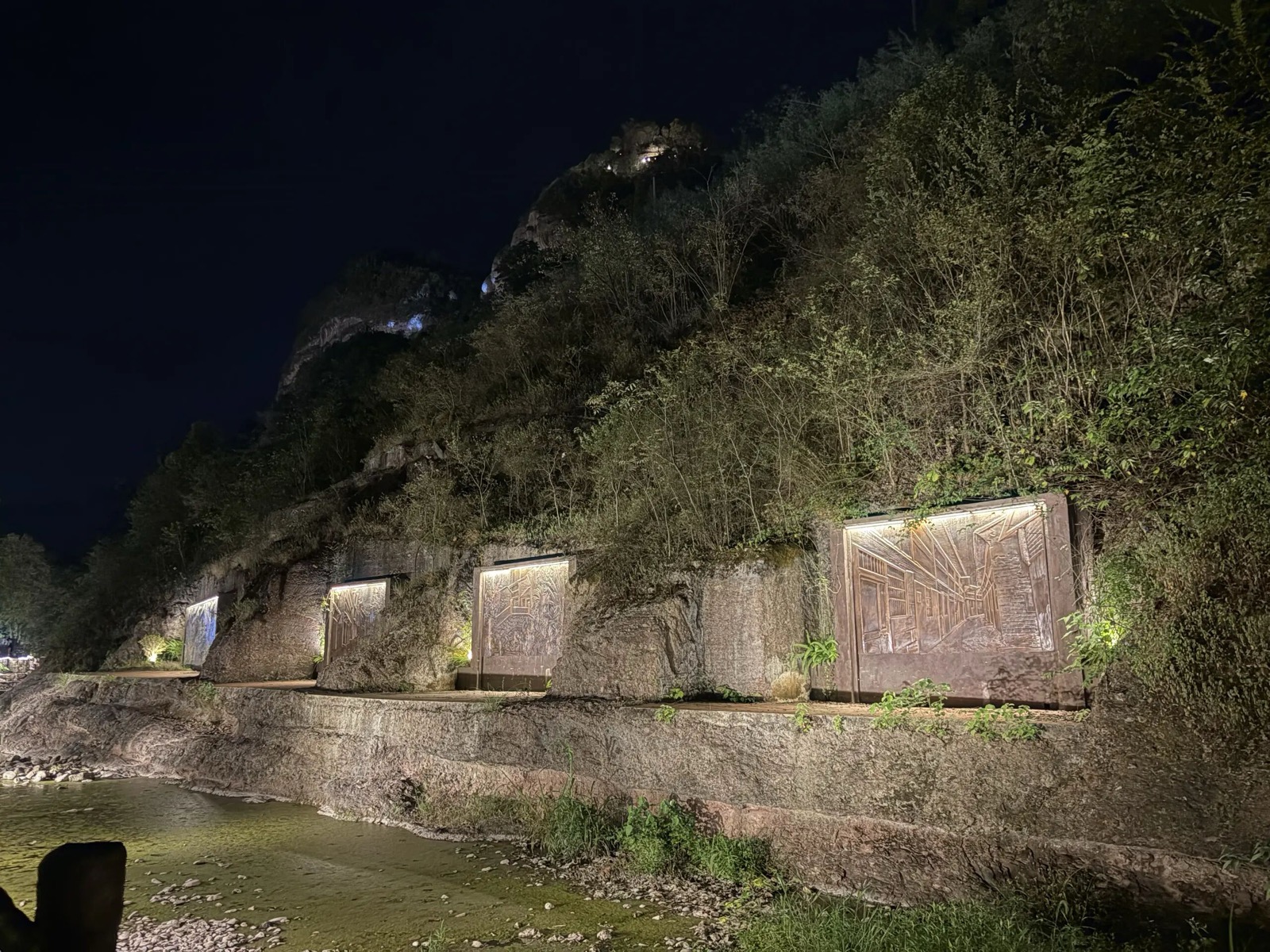
One thing I brought back and could not answer. Along 岩下老街 — the old street at the foot of the mountain, three li long and two or three metres wide, flagstone down the middle with cobbles either side — there are sections of cliff with rectangular recesses cut into them, in rows, like cubbyholes.
The street itself is well documented — most of the detail below comes from a memoir of it in the Yongkang Daily. Its inns were named in a run — Cheng Tongchang, Cheng Yuanchang, Cheng Hongchang, Cheng Longchang, Cheng Qianchang — the way shops in a family town are. One of them, 义丰雅记, was built in 1797. The stone balustrade by the stream is inscribed 香客捐造: donated and built by pilgrims. The little arched bridge at the far end went up in 1897 and was rebuilt in 1940. It is also, like most places in this county that attract a crowd, a food street — the meat-filled wheat cakes and tofu balls I wrote about elsewhere are sold on it.
But the recesses in the rock I have not been able to source. My guess is small shrines, cut by donors the same way the balustrade was paid for — the pattern of pilgrim-funded infrastructure on that street is strong. I am not going to state it as fact, because I do not know, and because a county’s own history is exactly the kind of thing that gets confidently invented online. This is a recurring problem here: I have written before about structures around this town that nobody can explain, and the honest answer is usually that no one has bothered to write it down, not that there is a mystery. If anyone reading this knows what the recesses held, I would like to hear it.
The awkward afterlife of a standard hand
There is a critique of Ren Zheng’s second career that I think is fair, and it comes from calligraphers themselves: that turning a hand into a font destroys the hand. A font requires every instance of a character to be identical in weight, size and posture. Brushwork is the opposite — the same character written twice should differ, because the arm differed. Once 任政体 became the default typeface for festive occasions, his brushwork became something you see on a discount banner and stop seeing.
I understand the complaint. But I think it misses what actually happened. The reason that font reads as warm and slightly old-fashioned to a Chinese reader, the reason it got used for every notice and banner for forty years, is that it is legible as a person. It is not neutral. It has a pulse in it. A country that set its public notices in a dead man’s handwriting was, without intending to, keeping a small amount of handwriting in public life.
FAQ
Who wrote the characters on the Fangyan gate? Ren Zheng (1916–1999), a calligrapher born in Huangyan, Zhejiang, and based in Shanghai. The signature block is dated autumn of the yichou year, which is 1985.
What is Huawen Xingkai? A Chinese running-script computer font, 华文行楷, based on Ren Zheng’s handwriting. It was developed from the 7,000-character specimen he wrote for the Shanghai Type Foundry after winning an anonymous competition in 1979, and was widely distributed with simplified-Chinese editions of Microsoft Office.
Why is there a temple on top of Fangyan? Because a Song dynasty official from Yongkang, Hu Ze (963–1039), successfully petitioned in 1032 to abolish a poll tax on his home prefectures. After his death local people enshrined him on the mountain. Successive dynasties raised his rank from marquis to duke to “Great Emperor”, and the shrine became the centre of a devotional region covering much of Zhejiang.
When is the Fangyan temple fair? From the first day of the eighth lunar month to around the Double Ninth festival in the ninth — roughly fifty days, peaking on the thirteenth of the eighth month (Hu Ze’s birthday) and at Chongyang.
Is Fangyan worth visiting? It is a national 4A scenic area with a ticket around ¥60, 23 km east of Yongkang town. The climb is short but engineered — a cliff gallery and a gate in the rock — and the summit has a working temple and a street of vendors. Go in autumn if you want the fair; go on a weekday if you want the stairs to yourself.
Three layers of one hand
The plaque is forty years old. The calligrapher has been dead for twenty-seven. The font is on a few hundred million machines right now, in the default font list, about a third of the way down, next to fonts nobody has ever chosen on purpose.
Three layers of the same hand, and the one that gets looked at least is the one that gets read most. I went up a mountain to look at two characters over a gate and came back to find them already on my laptop, in a drop-down menu, waiting.
Sources: the plaque itself, photographed at the Fangyan gate, October 2026; The Paper, on Ren Zheng and Huawen Xingkai; Lianyi Bao, “The dignified calligraphy of Ren Zheng”; China Intangible Cultural Heritage Network, entry Ⅹ-84, Miao Hui (Fangyan Miaohui), inscribed 2011; Yongkang municipal records as cited in local reporting on the Hu Gong devotional region; Yongkang Daily, “Remembering Yanxia Old Street”, 2013; scenic-area visitor information, 2026.
Pingback: Why a Chinese County of 620,000 Just Built a $164 Million Hotel - Ying's County Town