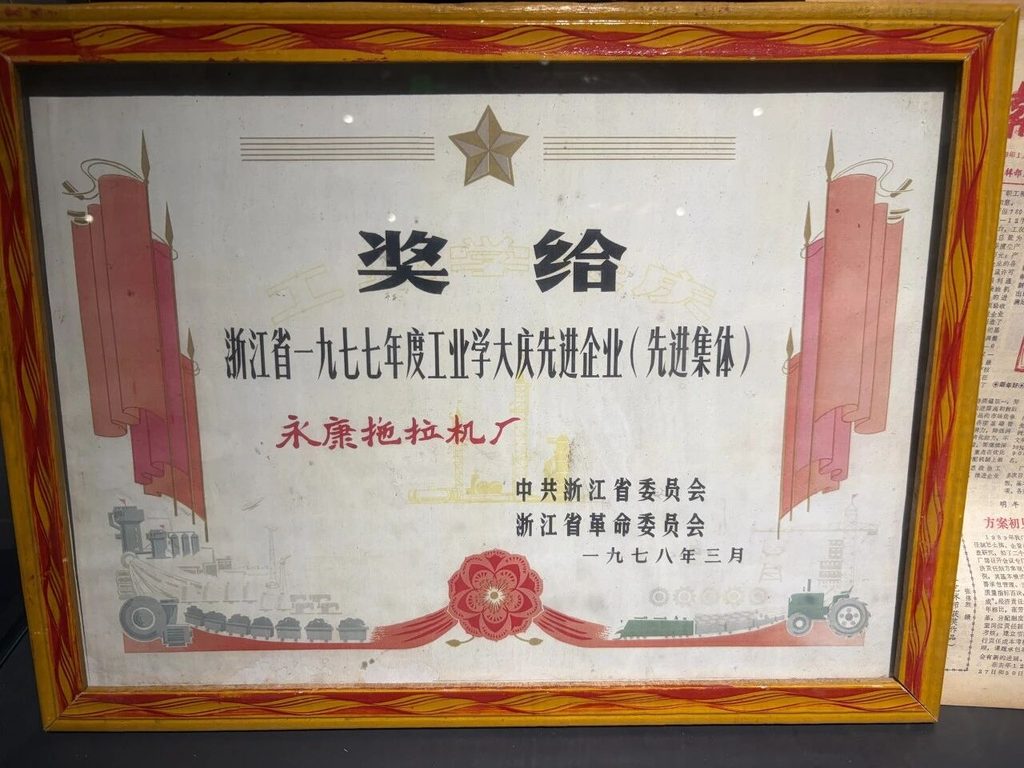
After dinner I walked through the industrial museum here in my hometown — Yongkang, the small city in Zhejiang that supplies a surprising share of China’s hardware. On the wall, behind glass, was a framed certificate from 1978. Yellowed paper, red and gold border, a five-pointed star at the top.
What stopped me was the first line. Two large characters: 奖给.
Awarded to.
Not 奖状 — “certificate of award” — which is what every certificate I have ever been handed says at the top. This one does not name itself at all. It just starts, mid-sentence, with the act of giving.
Short answer: 奖给 is not a title, it is the first half of a sentence. Old Chinese award certificates were written as documents — the top line states the action (“awarded to [whoever]”), the way a formal notice opens with what it is doing. Modern certificates are printed forms, so the top line has to be the name of the object itself: 奖状, certificate of award. Same sheet of paper, two completely different ways of starting.
Once I saw it that way, the rest of the certificate stopped looking like decoration and started looking like grammar.
What This Certificate Actually Says
Here it is, top to bottom:添加到对话
| Line | Chinese | English |
|---|---|---|
| 1 | 奖给 | Awarded to |
| 2 | 浙江省一九七七年度工业学大庆先进企业(先进集体) | Zhejiang Province, 1977, Advanced Enterprise in the Learn-from-Daqing in Industry campaign (advanced collective) |
| 3 | 永康拖拉机厂 | Yongkang Tractor Factory |
| 4 | 中共浙江省委员会 / 浙江省革命委员会 | CPC Zhejiang Provincial Committee / Zhejiang Provincial Revolutionary Committee |
| 5 | 一九七八年三月 | March 1978 |
Line 1 is a verb with nothing to act on yet. Line 2 is the honour. Line 3 is who receives it. Only when you read all three together do you get a complete sentence: “Awarded to Yongkang Tractor Factory: Advanced Enterprise of Zhejiang Province, 1977.”
That is why the top line reads 奖给 and not 奖状. The certificate is not labelling itself. It is announcing something, and an announcement needs a subject.
There is a second clue in the printing itself. Lines 1, 2, 4 and 5 are typeset. Line 3 — the factory name — is handwritten, in a different hand, in red. The template came off a press with everything filled in except who won. You can almost see the clerk sitting at a table with a brush.
Old Awards Were Documents. New Awards Are Forms.
Here is the part I find genuinely interesting: both versions are doing the same job. They just assume a different person is holding them.
The old one is written for a bystander. 奖给 is third person. Nobody walks up to you and says “awarded to”; you say it to a room. A certificate like this was made to hang on a factory wall, where anyone passing could read who won it and who gave it. The reader is the public.
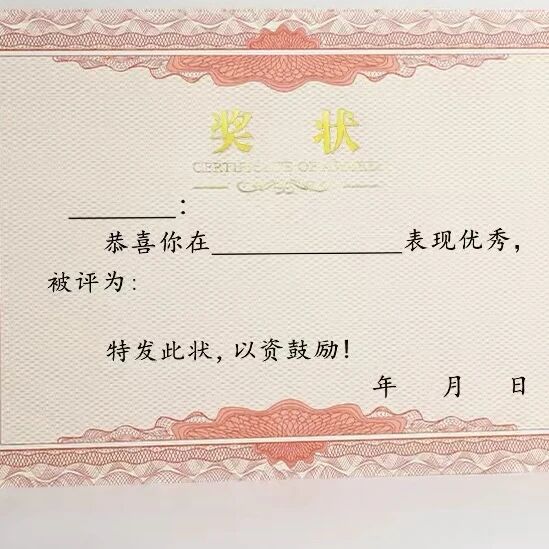
The new one is written for you. Look at a blank certificate printed today: the top says 奖状, and the body says 恭喜你……特发此状,以资鼓励 — “Congratulations, you…… this certificate is presented as encouragement.” That is second person. It only works if the person holding the paper is the person who won it.
And the grammar shifted along with it:
- 奖给 is a verb phrase. It cannot stand alone as a label, so it drags a whole sentence after it.
- 奖状 is a noun. It can stand alone, which is exactly what you need when you are printing one sheet to be used by ten thousand schools.
The boring reason: printing
There is a practical layer on top of the linguistic one.
Old certificates were printed backgrounds with the details written in by hand. That is why this one can afford to be so specific at the top — it names a province, a year, and a political campaign, because a human being was going to fill in the rest anyway.
A universal blank cannot do that. If you are selling certificates by the box to schools, factories and offices, the header has to be true for every single occasion. And the only thing true for every occasion is the name of the document.
So the header stopped describing a particular award and started describing the paper. 奖状 — “award document” — is literally just 奖 (award) plus 状 (document).
The Certificate Is Also a Calendar
The two lines at the bottom date this thing far more precisely than the date does.
浙江省革命委员会 — the Revolutionary Committee
Revolutionary committees were the local government bodies that replaced provincial and municipal people’s governments during the Cultural Revolution, starting in 1967, running government and party affairs as one. As late as 1978 they were still written into the constitution.
In July 1979, the Fifth National People’s Congress amended the constitution and turned every local revolutionary committee back into a people’s government; the change rolled out across the provinces from September that year.
So a certificate dated March 1978 was issued by an institution with roughly sixteen months left to exist. The name on the bottom line is one you cannot find on any document issued after 1979.
一九七七年度工业学大庆 — the 1977 campaign
“Learn from Daqing in Industry” was Mao’s call in January 1964, holding the Daqing oilfield up as the model for how Chinese industry ought to be run. The movement lasted eighteen years, until the Central Committee formally ended it with Document No. 47 in 1981.
But 1977 to 1981 was its last and loudest stretch. A national conference in Daqing and Beijing in April and May 1977 relaunched the campaign, and provinces went back to handing out “Daqing-style enterprise” titles with genuine enthusiasm.
Which is precisely what this is: not just a certificate, but a certificate issued at the moment the campaign was being pushed hardest, by a government body that no longer exists, for a year that had already ended.
And the Factory on the Third Line
永康拖拉机厂 — the Yongkang Tractor Factory — is not a random name on this sheet either.
It was established in 1961, and it was among the first factories in China to build and export walking tractors and single-cylinder diesel engines. In January 1983 its small “Iron Ox” walking tractor made the front page of the People’s Daily under a headline that has stuck with me: “costs about as much as an ox, works like two.” Farmers queued at the factory’s west gate through the night, with trucks from Jiangxi and Anhui waiting in line to load.
In January 1993 the factory was renamed Zhejiang Sifang Group. It is still running, still in this city, still making walking tractors — and by one count its exports account for around 45% of China’s total in that category.
So the certificate on that museum wall is an earlier, stranger chapter of a company that is still operating in the same city today. Same city, same trade, fifty years apart.
FAQ: Old Chinese Award Certificates
What does 奖状 actually mean?
奖 (jiǎng) is “award” or “prize”; 状 (zhuàng) is “document” or “certificate.” So 奖状 is literally “award document” — the name of the paper, not the act of giving it. The term itself is old; earlier Chinese material also used 褒奖张 and 褒状 for the same object.
Why did the wording change at all?
Three things stacking up, as far as I can tell: hand-filled documents becoming mass-printed blanks, certificates moving from public walls into private hands, and plain standardisation — once one template is printed by the million, its header quietly becomes the default everywhere.
Do Western certificates say “awarded to” too?
Yes, and that is the closest English equivalent. “Awarded to [name]” is still standard on military and civilian commendations, and it is the same document grammar: start with the act, then name the recipient. So the older Chinese format is not exotic at all — if anything, it is the more international of the two. What changed in China was that the certificate stopped being a document and became a product.
What was 工业学大庆?
“Learn from Daqing in Industry” — a campaign launched in January 1964 that held the Daqing oilfield up as the model for Chinese industrial organisation, and which ran until the Central Committee ended it in 1981. “Advanced Enterprise” was the standard title awarded to factories that met the campaign’s criteria.
Where I Got This From
- The certificate itself — photographed at our local industrial museum in Yongkang, September 2026. Transcribed from the original.
- “Learn from Daqing” dates, the 1977 national conference and the 1981 Document No. 47 that ended the campaign — People’s Daily party history archive
- Revolutionary committees replaced by people’s governments in July 1979 — National People’s Congress
- Yongkang Tractor Factory history and the 1993 rename — Zhejiang Sifang Group and the Yongkang City Gazetteer
Over to You
Do certificates where you live start with “awarded to,” or do they name themselves at the top? And does anyone know what tipped the change in your country — was it printing, or something else?
I would like to know whether this is a Chinese habit or just a paper habit.
— Ying