I was driving past the edge of town on the ring road when I saw it: a twelve-storey office block with an orange courier logo on the roof, and next to it a long grey warehouse with a sign across the top that said, in Chinese, warehouse, factory space, apartments — for rent.
That combination is the most Yongkang sentence I know. A building for parcels, a building for the things being parcelled, and flats for the people who do the parcelling, all in one lot beside the highway.
I took two photographs through the car window, badly, because you cannot stop on that road.
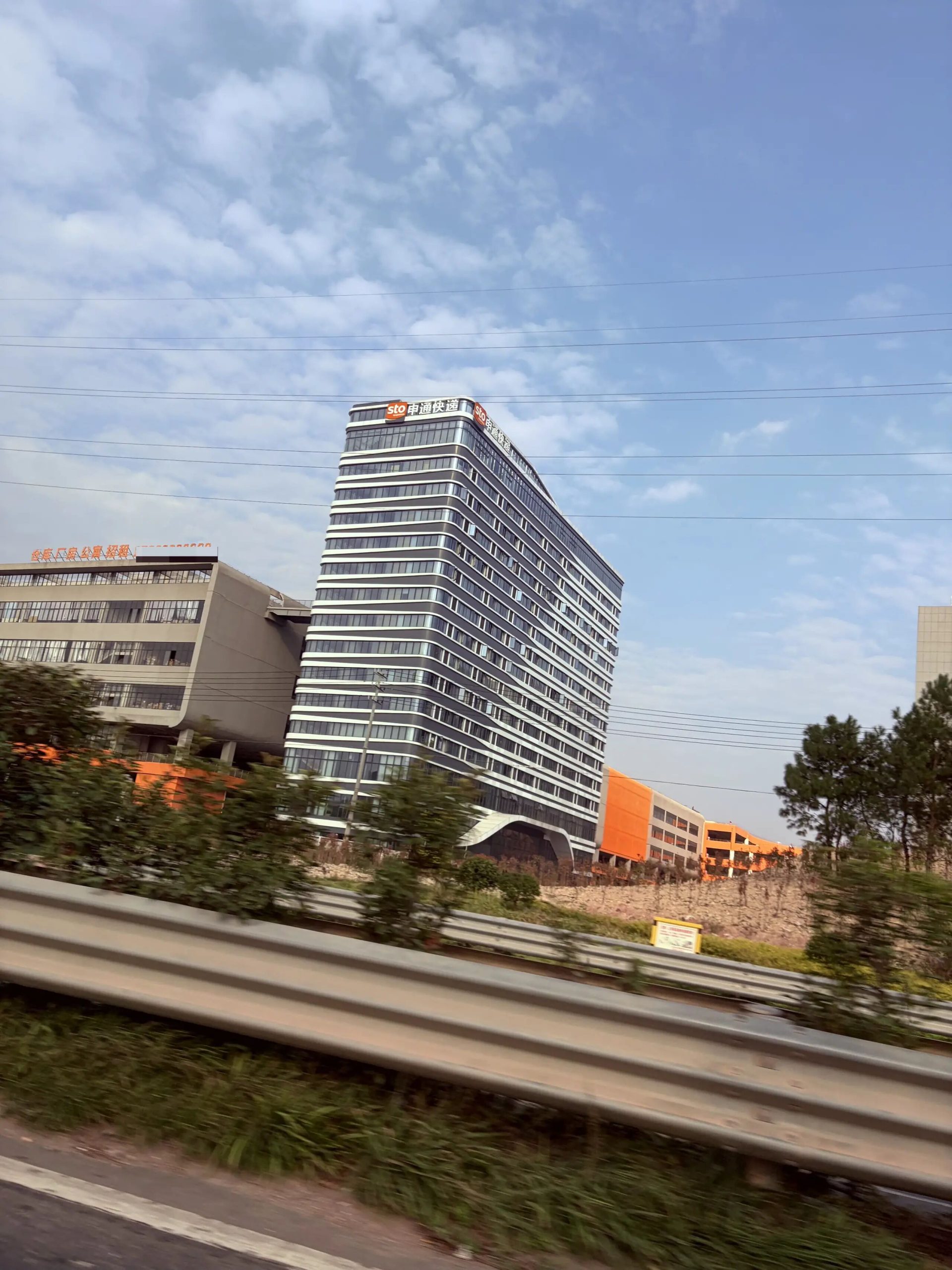
A friend who works nearby told me the joke that locals tell about that yard. Work one night shift in there, he said, and even Ultraman’s chest light would start flashing red. Ultraman, for readers who did not grow up with him, is a Japanese superhero whose colour timer starts blinking when his energy runs out. It is a way of saying: the work will finish you.
I laughed, and then I went and looked up what that yard actually does, and the joke stopped being funny and started being a number.
The numbers nobody puts side by side
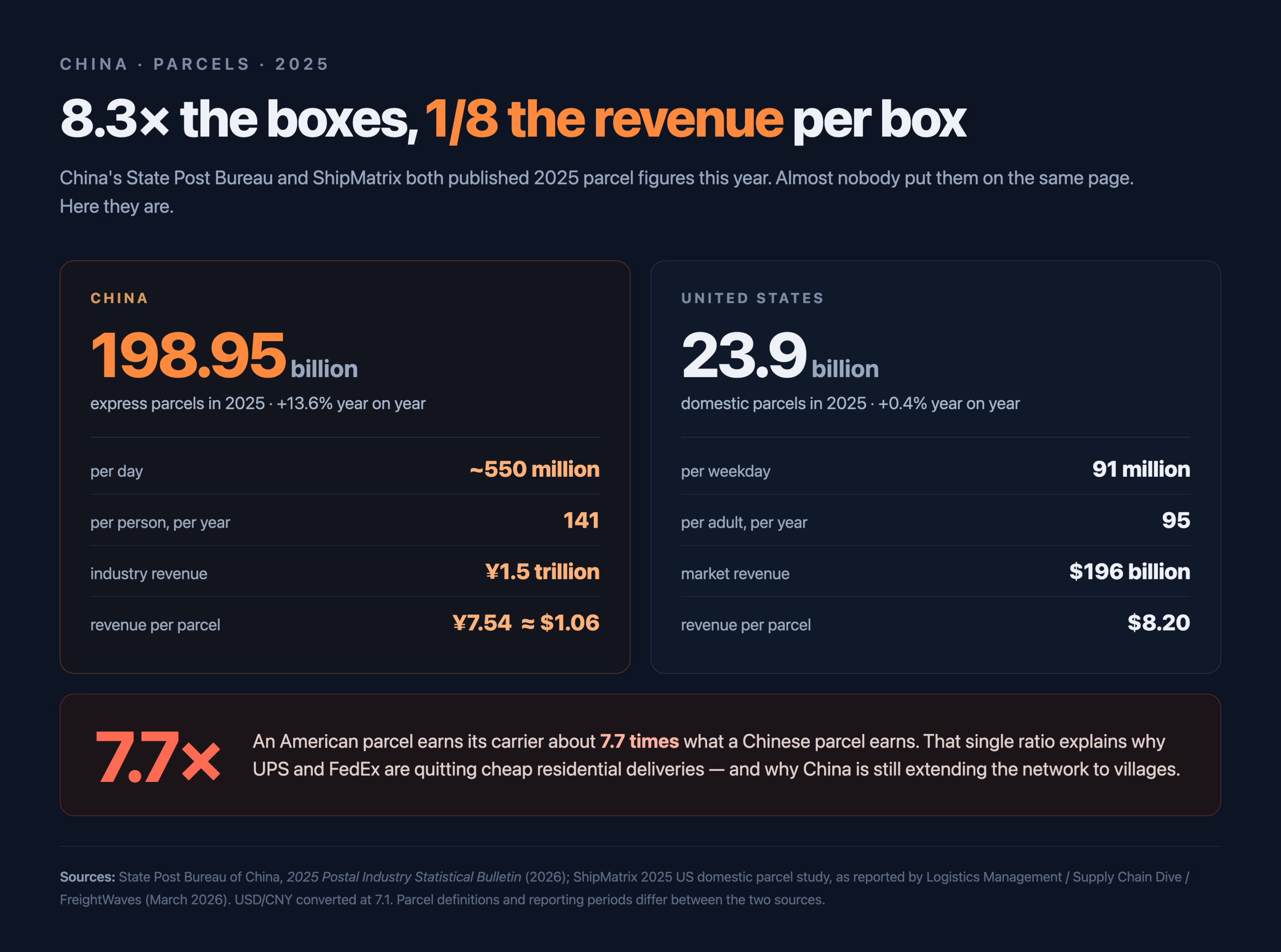
China’s State Post Bureau published its 2025 figures in early 2026. Express delivery volume for the calendar year was 198.95 billion parcels, up 13.6% year on year, with an average of nearly 550 million parcels a day. Postal and express traffic combined — which includes letters and documents, not just parcels — reached 216.5 billion pieces.
The United States, for the same year, moved 23.9 billion parcels domestically, according to ShipMatrix, up 0.4%. Total US parcel revenue was $196 billion.
So: China moves 8.3 times the parcel volume of the United States.
Now put the money next to it. China’s 2025 express delivery revenue was 1.5 trillion yuan, which works out to about 7.54 yuan per parcel — roughly $1.06. The United States generated $8.20 in revenue per parcel, up from $8.00 in 2024.
Divide those two numbers and you get the whole article: the average American parcel earns about 7.7 times what the average Chinese parcel earns, on one-eighth of the volume.
Per person, the picture is just as lopsided in the other direction. The State Post Bureau says annual parcel usage per Chinese resident rose from 59 pieces in 2020 to 141 pieces in 2025. ShipMatrix puts US volume at about 95 parcels per adult per year, or 1.84 parcels per adult per week.
A Chinese person receives half again as many parcels as an American, each of them worth about one-eighth as much to the company carrying it.
That is not a curiosity. That is the entire physical shape of two different retail economies, and it explains why the yard outside my town looks the way it does.
Why one parcel costs $1.06 here and $8.20 there
Three things set that price.
Density. China’s parcels are overwhelmingly domestic and overwhelmingly short-haul: 90.0% of express volume in 2025 was inter-city, and the fastest-growing regions were the middle and west of the country, where volume rose 20.9% and 23.0% in a single year. When a courier van drops thirty parcels on one street instead of three, the cost per drop collapses.
Labour. I will come back to this, because it is the part the joke was about.
What is inside the box. A large share of Chinese parcels are low-value, high-frequency purchases — a phone case, a pair of socks, a bag of dried chillies — bought on platforms where free shipping is the default and the seller absorbs it. In the US, FedEx and UPS have spent the last three years deliberately walking away from exactly this traffic, because a $2 T-shirt shipped to a house in the suburbs loses money on a network built for business freight.
The result is that both countries have a parcel industry. Only one of them has a parcel industry that will happily carry a $2 T-shirt.
The last mile, in a village of 800 people
The part of the Chinese system that genuinely has no American equivalent is not the sorting — it is the geography.
SF Express, the country’s largest integrated logistics provider, reported in 2025 that its agricultural and rural network covered more than 2,800 counties and that it had built over 250,000 village-level pickup points, with county coverage at 99.75% and township coverage at 98.73%. That is not a pilot programme. That is a country where a village of several hundred people, an hour up a mountain road, has somewhere to collect a parcel.
The policy behind it has a name: express delivery into villages (快递进村), written into the State Post Bureau’s annual list of livelihood commitments. The commercial logic is thinner than the political logic — village points are subsidised, bundled with the village supermarket, or run out of somebody’s front room — but it works, and it is why the parcel volume keeps growing in places that have no dense urban market to grow into.
In the US, Amazon began delivering to 4,000 rural communities in 2025 as part of the reason it overtook the Postal Service to become the country’s largest carrier by volume. It is a notable expansion, and it is roughly one-tenth of the number of village points SF alone operates in China.
The 2:30 AM shift
Here is where the two photographs and the joke meet.
When I looked up the logistics park outside town, I found job listings from courier branches operating inside it. One, from a local express company with an address in the second phase of the Chengxi logistics park, advertises for sorting staff with this schedule:
– A shift starting at 02:30 at night, running until that batch of parcels is finished. – A second shift starting at 12:30, running until the midday batch is finished.
They call it a two-headed shift. Pay is a fixed 4,800 yuan a month, plus 200 for full attendance and 200 meal allowance, with dormitory housing included. Call it 5,200 yuan — about $730 a month — for a schedule that splits your night in half.
Other listings around Jinhua, the prefecture my town belongs to, are blunter about the hours. A Deppon (德邦) night shift runs 19:00 to 07:00 with no day shift at all, paying 6,500–7,000 yuan for sorting and 8,000–9,000 for loading trucks, where the physical work is heavier and the pay is by the tonne moved. A separate listing quotes 18 yuan an hour for day work and 19 for nights, converting to 6,500–8,000 a month after probation, with a 20-yuan allowance per night shift.
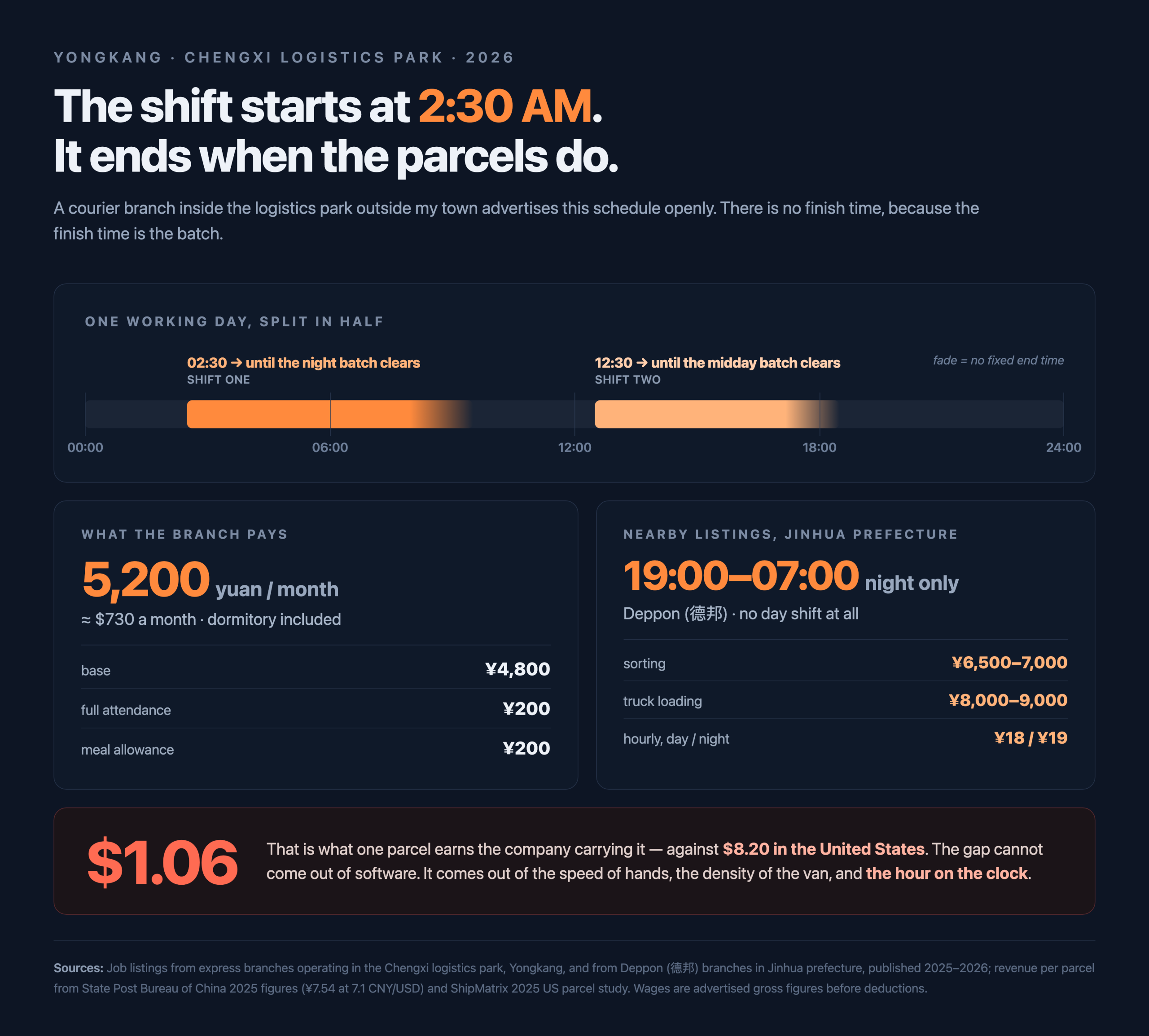
Set that against the $8.20 the average American parcel earns. The Chinese parcel earns $1.06. Somebody has to make up the difference in the only place it can be made up: the speed of hands, the density of the van, and the hour on the clock.
That is what my friend meant. It was not an insult about the work. It was a description of the arithmetic.
Why UPS and FedEx are walking away from this business
In the United States, 2025 was the year the old parcel duopoly visibly stepped back.
ShipMatrix’s annual study found USPS volume down 8.3% to 6.6 billion parcels, and UPS down 8.6% to 4.4 billion. FedEx grew 5.9% to 3.6 billion, and Amazon Logistics grew 9.8% to 6.7 billion, taking the top spot by volume for the first time. Alternative carriers — regional start-ups, retailers’ own networks — grew 13% to 2.6 billion.
The reason UPS and FedEx are shrinking is not that Americans stopped shopping. It is that both companies decided low-value business-to-consumer parcels do not pay for a global integrated network, and moved toward healthcare, business freight and heavier, longer-distance shipments where the revenue per box is worth handling. Business-to-consumer traffic is now 75% of the US market, and they are chasing the 25% that is not, plus the top slice of the 75%.
Read that alongside the Chinese numbers and a strange symmetry appears. The two largest private parcel networks in the world, in the richest parcel market in the world, are concluding that delivering cheap boxes to houses is a bad business. In China it is the largest business in the country by piece count, and it is being extended to villages of 800 people.
Both decisions are rational. They are rational about different things.
What it costs China
I am not going to write four thousand words about efficiency and leave out the bill, because the bill is large and it arrives in three places.
Packaging. China used 159.16 billion metres of tape on parcels in 2025. That is about 159,000 kilometres of tape, or roughly four times around the equator. Packaging waste from parcels runs to about 20 million tonnes a year. On 1 July 2026 the country brought in its first mandatory national standard on excessive packaging, capping ordinary parcels at two layers of wrapping and fragile items at four, and specifying tape width. The measure is real and it is overdue; it also exists because the default behaviour had gotten out of hand.
Bodies. A two-headed shift starting at 02:30 is not a scheduling quirk, it is a way of covering two volume peaks with one workforce. The Ministry of Human Resources and the State Post Bureau have both pushed courier-company labour standards in the past two years, including a pilot monitoring employment practices in 20 cities. When a government publishes guidance on how many hours your sorting staff should work, that is a signal about how many hours they were working.
Price competition. The phrase Chinese regulators used in 2025 was anti-involution (反内卷) — an explicit effort to stop courier companies from competing purely on price, because the price competition was being paid for at the bottom of the wage sheet. Courier revenue per parcel has been thin for years. One and a half trillion yuan sounds enormous until you divide it by 199 billion.
The sign on the empty building
Which brings me back to the second photograph, and the detail I keep thinking about.
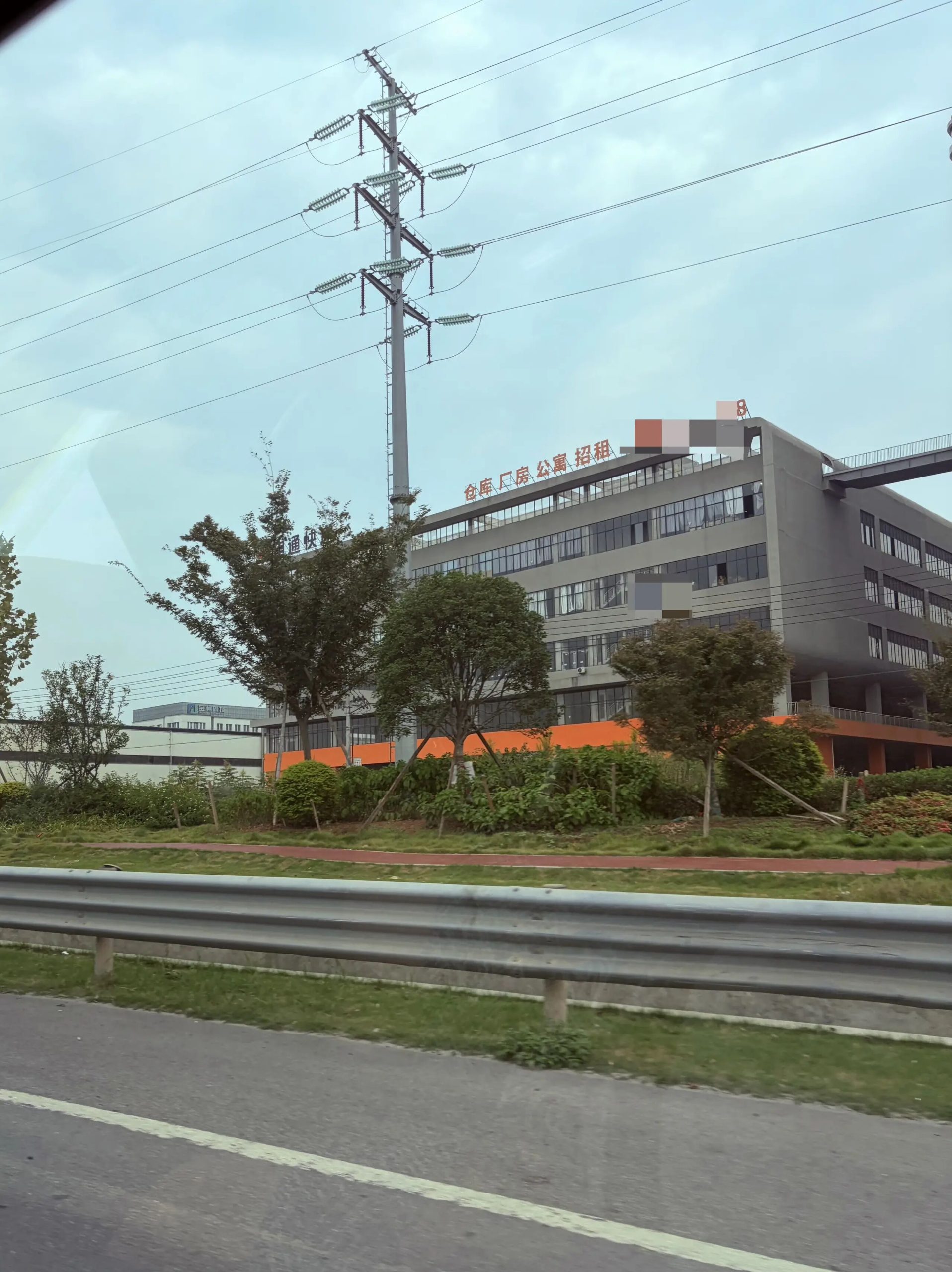
The sign on the building next to the courier tower does not say sorting centre. It says warehouse, factory space, apartments — for rent.
A logistics park that has already built the buildings and is now advertising for tenants is a park that expects more supply than demand. And that is the shape of the industry in 2026: the State Post Bureau expects express volume to reach about 214 billion parcels this year, growth of roughly 8%, which is slower than the 13.6% it just posted. Volume up, growth slowing, and a great deal of concrete already poured.
Every county in Zhejiang has one of these parks now. Most of them were built on the assumption that parcel volume would keep compounding at double digits forever. Some of them are now renting out the spare floors to anyone who wants them — a factory, a warehouse, or a person who needs somewhere to live near the sorting line.
That, to me, is the most honest sentence in the whole story. The system that puts a $2 phone case on your doorstep in three days is not held up by software. It is held up by a two-headed shift, a subsidised village counter, and a building that says for rent on the roof because the projections were a little too confident.
FAQ
How many parcels does China deliver a year? 198.95 billion express parcels in 2025, according to the State Post Bureau, equal to about 550 million a day. Combined postal and express traffic was 216.5 billion pieces. The bureau expects around 214 billion express parcels in 2026.
How many parcels does the US deliver a year? 23.9 billion domestic parcels in 2025, per ShipMatrix, on $196 billion of revenue. China moves 8.3 times the volume.
Why is delivery so cheap in China? Three reasons: parcel density (many drops per street), labour cost, and the fact that Chinese platforms treat free shipping on very low-value goods as the default. Revenue per parcel is about 7.54 yuan (~$1.06) versus $8.20 in the US.
Why are UPS and FedEx delivering fewer parcels? Both are deliberately retreating from low-value residential e-commerce, which they say does not cover the cost of a global integrated network. UPS volume fell 8.6% and USPS 8.3% in 2025, while Amazon Logistics rose 9.8% to 6.7 billion and became the largest US carrier by volume.
Does China deliver to villages? Yes. SF Express reports over 250,000 village-level service points, with county coverage at 99.75% and township coverage at 98.73%. The policy is called express delivery into villages.
How much packaging waste does this create? About 20 million tonnes a year, plus 159.16 billion metres of tape in 2025 alone. A mandatory national standard limiting packaging layers took effect on 1 July 2026.
The thing I keep coming back to
There is a version of this article that is a boast about Chinese infrastructure, and there is a version that is a complaint about American decline. I do not want to write either of them, because both of them are lazy in the same way.
What actually strikes me, standing on the ring road next to a warehouse with a for rent sign, is that these two countries have made opposite bets on the same question: is it worth moving a cheap object a thousand kilometres to a person’s door?
America’s answer, spoken by UPS and FedEx with their volume numbers, is increasingly no. China’s answer, spoken by 199 billion parcels and a 2:30 AM shift and a subsidy for village counters, is yes, at any scale, and we will build the concrete for it before the demand arrives.
One of those answers makes a better margin. The other one puts a bag of dried chillies in a village shop an hour up a mountain road, and charges eleven cents to carry it.
I use both systems. I live in the one that says yes, and I order things from the one that says no, and I notice — every single time I open a box — that the box arrives faster and cheaper than it has any right to. My friend’s joke about Ultraman is the price tag on that convenience. It is worth knowing whose chest light is blinking, and it is worth not pretending the light is not blinking at all.
Sources: State Post Bureau of China, 2025 postal industry statistical bulletin and 2026 national postal work conference; ShipMatrix 2025 US domestic parcel market study as reported by Logistics Management, Supply Chain Dive and FreightWaves; SF Express 2025 rural network figures as reported by Hubei Daily; People’s Daily and China Quality News reporting on the express packaging standard effective 1 July 2026; local job listings from Yongkang and Jinhua, Zhejiang, published 2025–2026.