Last month I walked into the new Yongkang Hotel on a Tuesday afternoon, without a booking, out of nothing but curiosity. Nobody stopped me. I went up the steps, through the doors, and kept walking for a while.
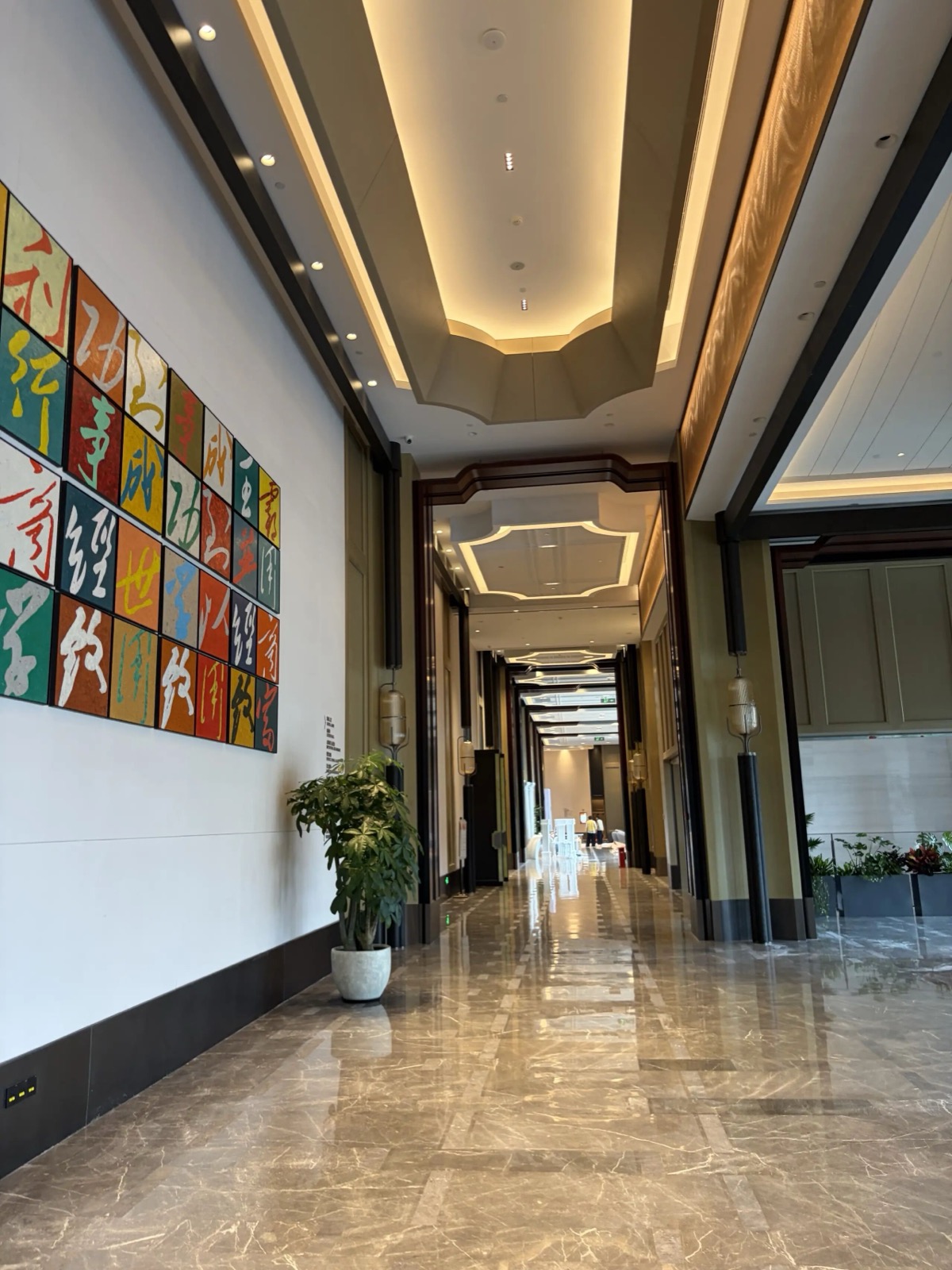
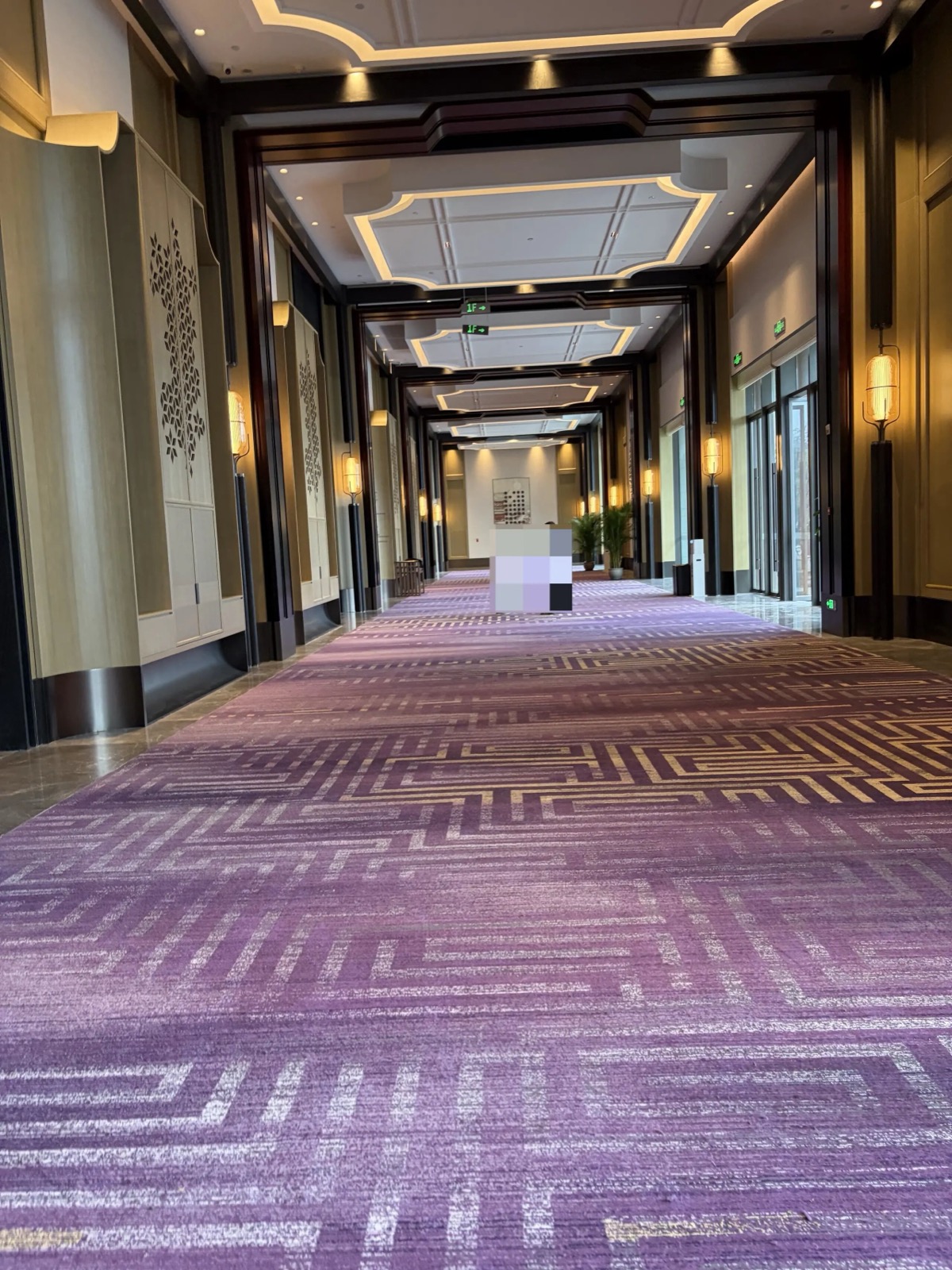
The corridor was eleven metres of marble wide with a coffered ceiling lit from behind the coves, and the floor was polished to the point where the lights doubled themselves in it. On the left wall was a grid of coloured tiles, each one carrying a single character of calligraphy. There was a potted plant I could not have carried alone.
I had come to see a building. What I found was an argument about what a county town is supposed to be.
The old one was a government guesthouse
The hotel I grew up knowing sat on Jiangcheng Road, on the bank of the Huaxi river, in the middle of town. It opened in October 1986, and before that it was the Yongkang county government’s reception house — the place where visiting officials slept and where the county fed people it needed to impress.
It climbed slowly. Two stars in 1995. Three in 1999. Four in December 2005. Along the way it picked up the titles that Chinese restaurants care about: China Catering Famous Brand, five-diamond restaurant, three consecutive China Hotel Golden Star awards.
By the end it had 154 rooms, 232 beds, 36 private dining rooms, nine banquet halls, and nine floors. It occupied about 23,000 square metres. For forty years, it was where this town held weddings.
And it had a problem that everybody in Yongkang knew about: it was too small to move. In the middle of a city block, on a riverbank, with a car park that could not absorb a wedding’s worth of cars, there was no way to add a hall or add a floor. You cannot renovate your way out of a 1986 footprint.
What 1.09 billion yuan buys
So they did not renovate. They moved.
The new building sits at 1088 Jinsheng Road, in a district on the south side of the river called Xixin — the part of town where, as I wrote when I looked at the most expensive flats here, people pay the most per square metre.
The numbers, from the city government’s own project description and the groundbreaking report in the Yongkang Daily:
| Old hotel (1986) | New hotel (2026) | |
|---|---|---|
| Address | Jiangcheng Rd 4, riverside, city centre | Jinsheng Rd 1088, Xixin district |
| Opened | October 1986 | October 2026 |
| Star rating | Four-star (from 2005) | Built to five-star standard |
| Land | 23,333 m² | 66,123 m² |
| Floor area | ~23,000 m² | 80,000 m² |
| Rooms | 154 | 280 |
| Private dining rooms | 36 | 38 |
| Banquet halls | 9 | 1 × 1,600 m², 1 × 1,200 m², 6 multi-function |
| Investment | — | 1.09 billion yuan (about $164 million) |
Ground was broken on 12 October 2023, with a target of a soft opening in December 2025. It actually opened in October 2026 — the hotel’s fortieth anniversary, which is either a coincidence or the kind of detail that only looks like one afterwards.
The construction cost works out to about $584,000 per room, or roughly $2,046 per square metre of floor area. For a hotel in a county-level city of 620,000 registered residents, that is not a normal number.
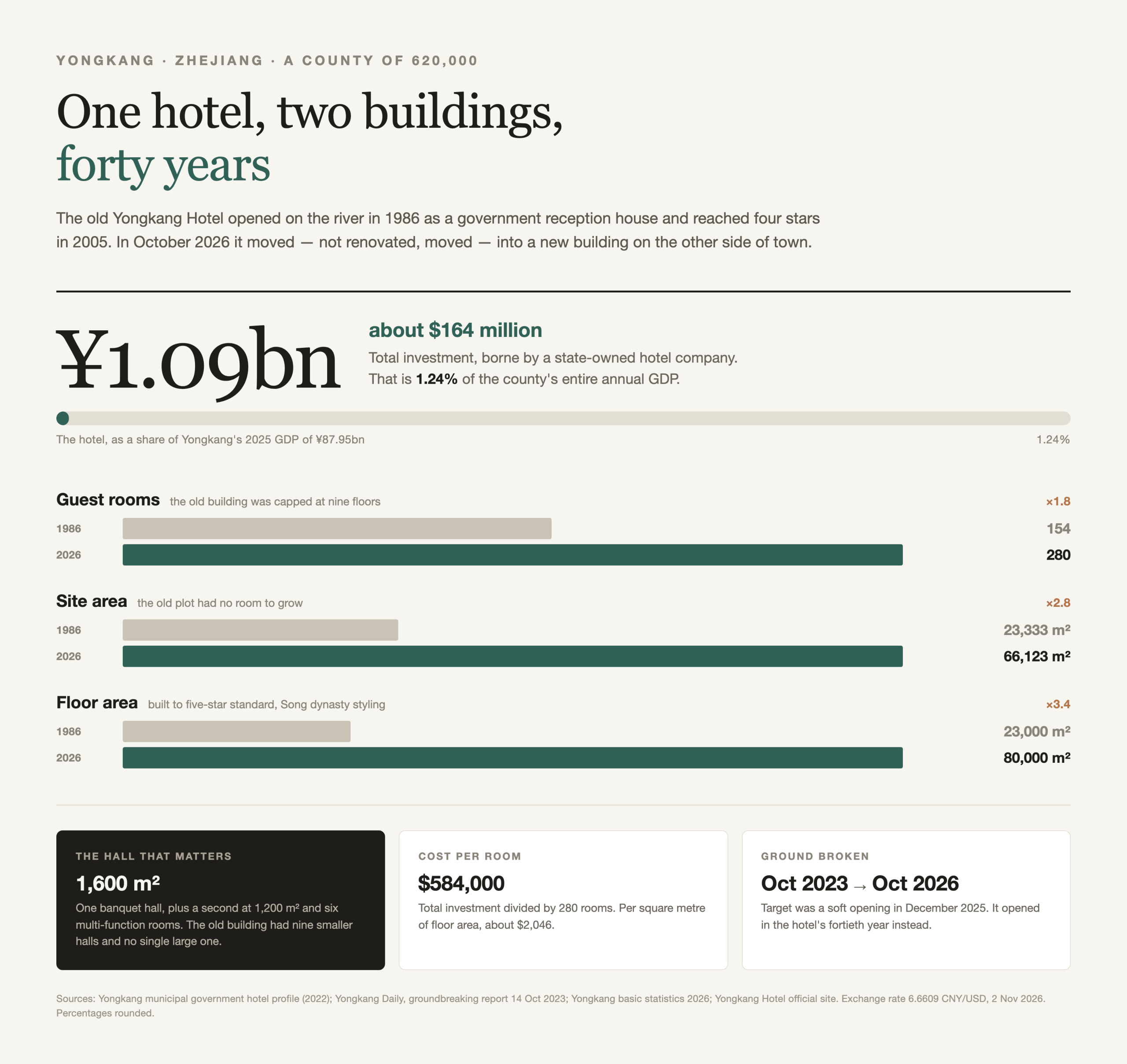
Yongkang’s entire GDP in 2025 was 87.95 billion yuan, about $13.2 billion. So the hotel cost the equivalent of 1.24% of one year’s economic output of the whole county.
It is also, as the government notes without embarrassment, the only state-owned catering enterprise in the city.
The halls are named after the mountains
Inside, the naming is the giveaway that somebody thought about this.
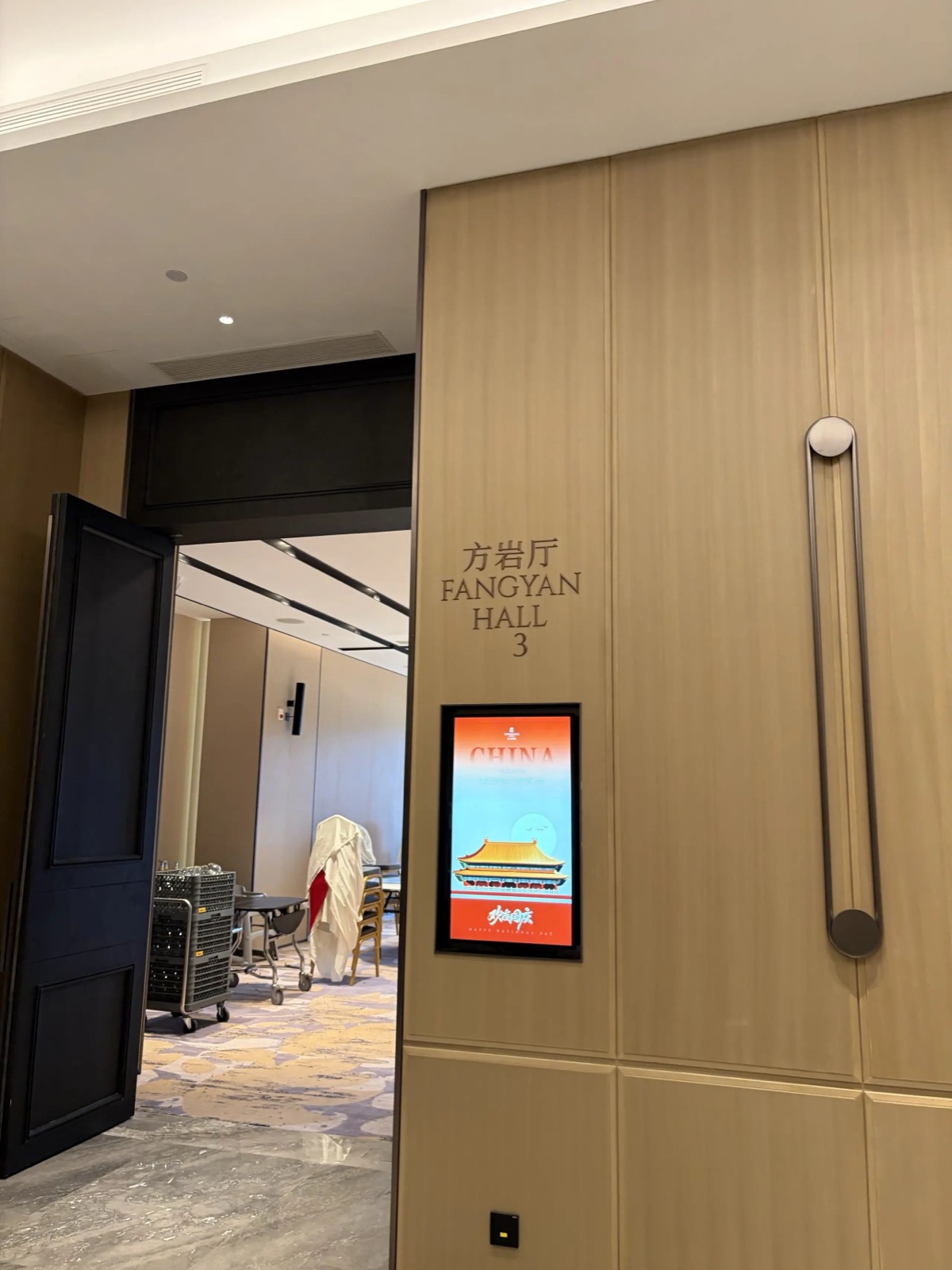
The banquet rooms do not have numbers. The door I stopped at said 方岩厅 — Fangyan Hall — with FANGYAN HALL 3 underneath in English.
Fangyan is the mountain. It is the county’s own landmark, the flat-topped rock about twenty kilometres east of town with a temple on top and a fifty-day fair every autumn. It is also the subject of the article I wrote last month, about the calligrapher who carved the two characters over its gate. A hotel that names its halls after local geography is telling you whose house this is.
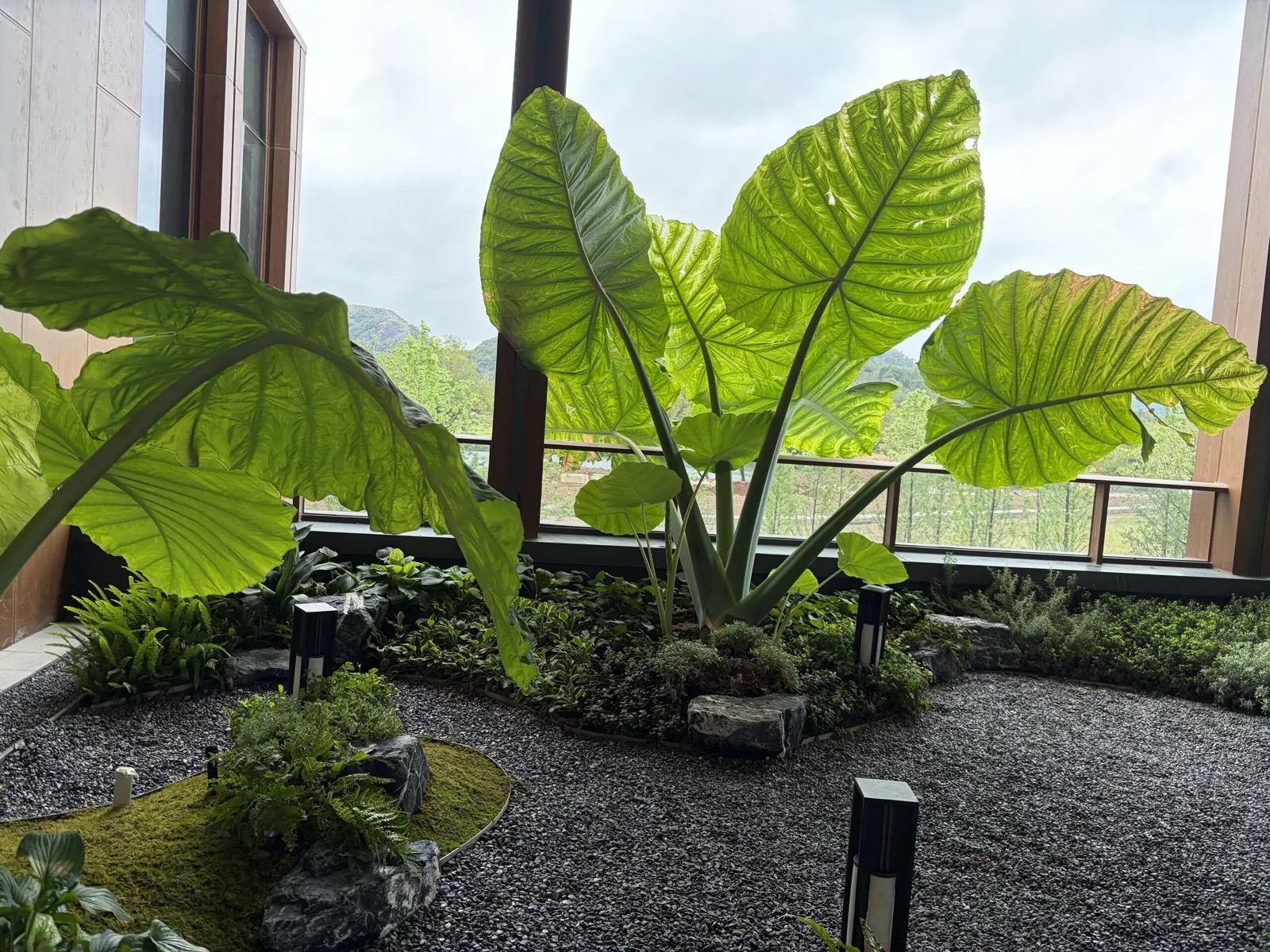
The design brief was 宋韵 — Song dynasty resonance: the restrained, near-monochrome aesthetic that Zhejiang has spent a decade turning into a regional brand. Here it shows up as dark timber, bronze-toned metal, pale stone, and a great deal of empty space. The corridor ceilings repeat a scalloped coffer pattern so that the perspective does the work.
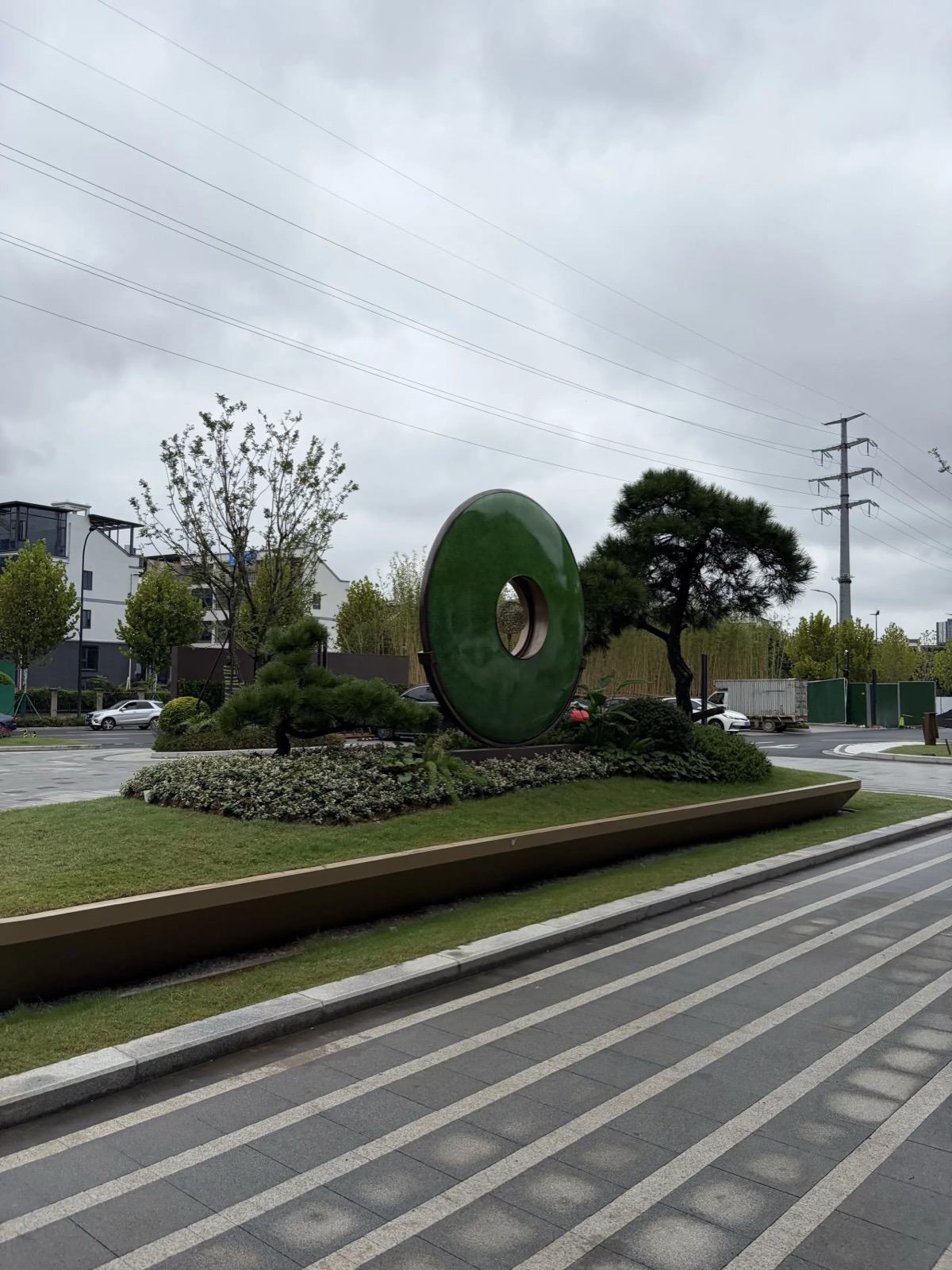
Out at the entrance island, planted on a lawn beside the driveway, is the object that tells you the most about the ambition. It is a green disc about four metres across with a hole in the middle: a 璧, the jade bi disc that Chinese antiquity buried with its dead and handed to its envoys. At this scale, in this material, on a traffic island in a county town, it is not subtle.
The building tells you where the money comes from
Here is the thing I could not stop looking at: the site map.
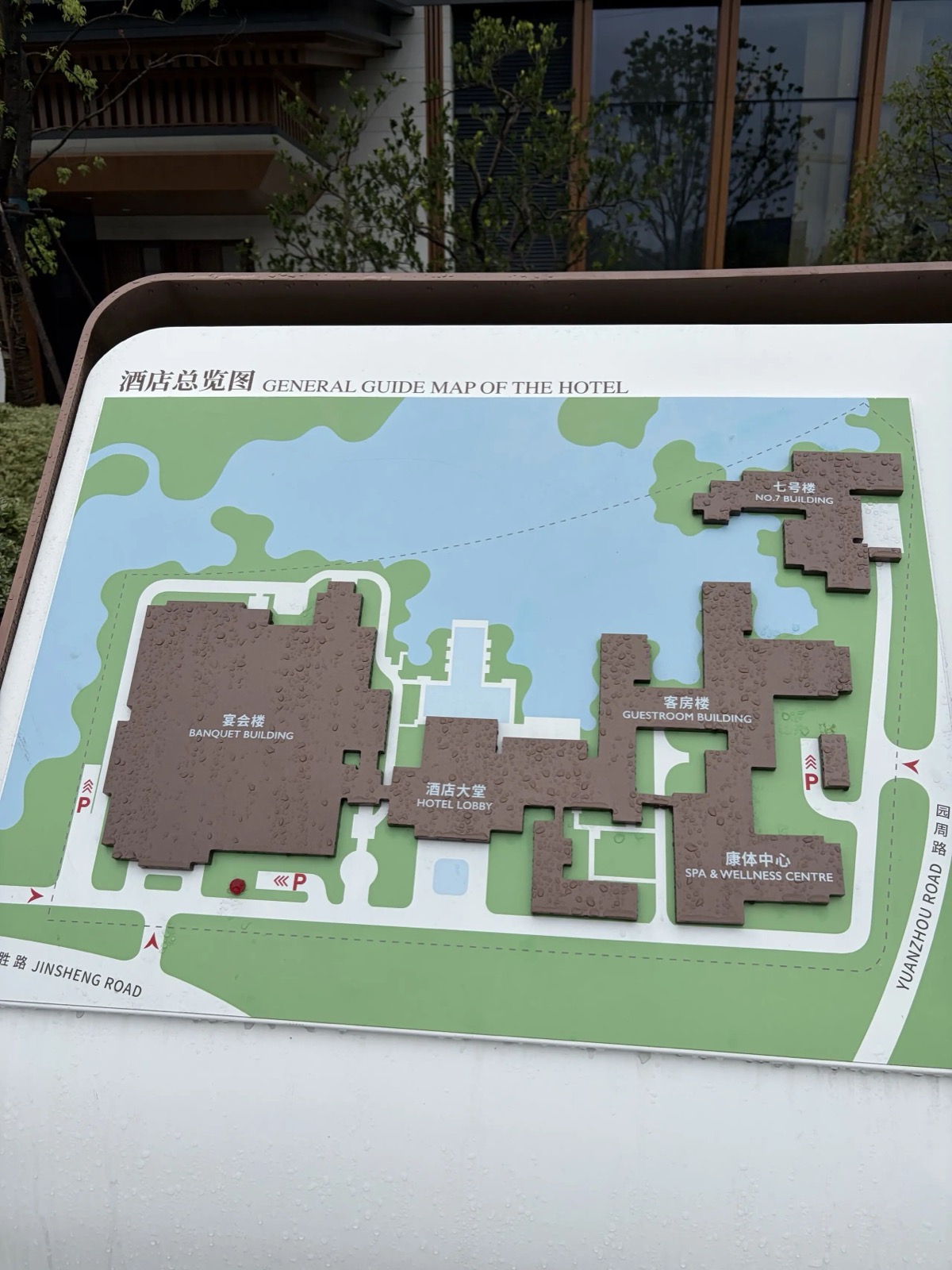
The plan is not a tower with a function room in the basement. It is a campus of separate volumes with roads between them: a banquet building, a lobby building, a guestroom building, a spa and wellness centre, a seventh building off on its own. The banquet building is the largest single mass on the site.
That is not an architectural preference. It is a P&L statement, drawn to scale.
In 2023 the old hotel turned over 111.67 million yuan. Of that, 86.39 million — 77.4% — came from food and beverage. Rooms, and everything else, made up the remaining 22.6%.
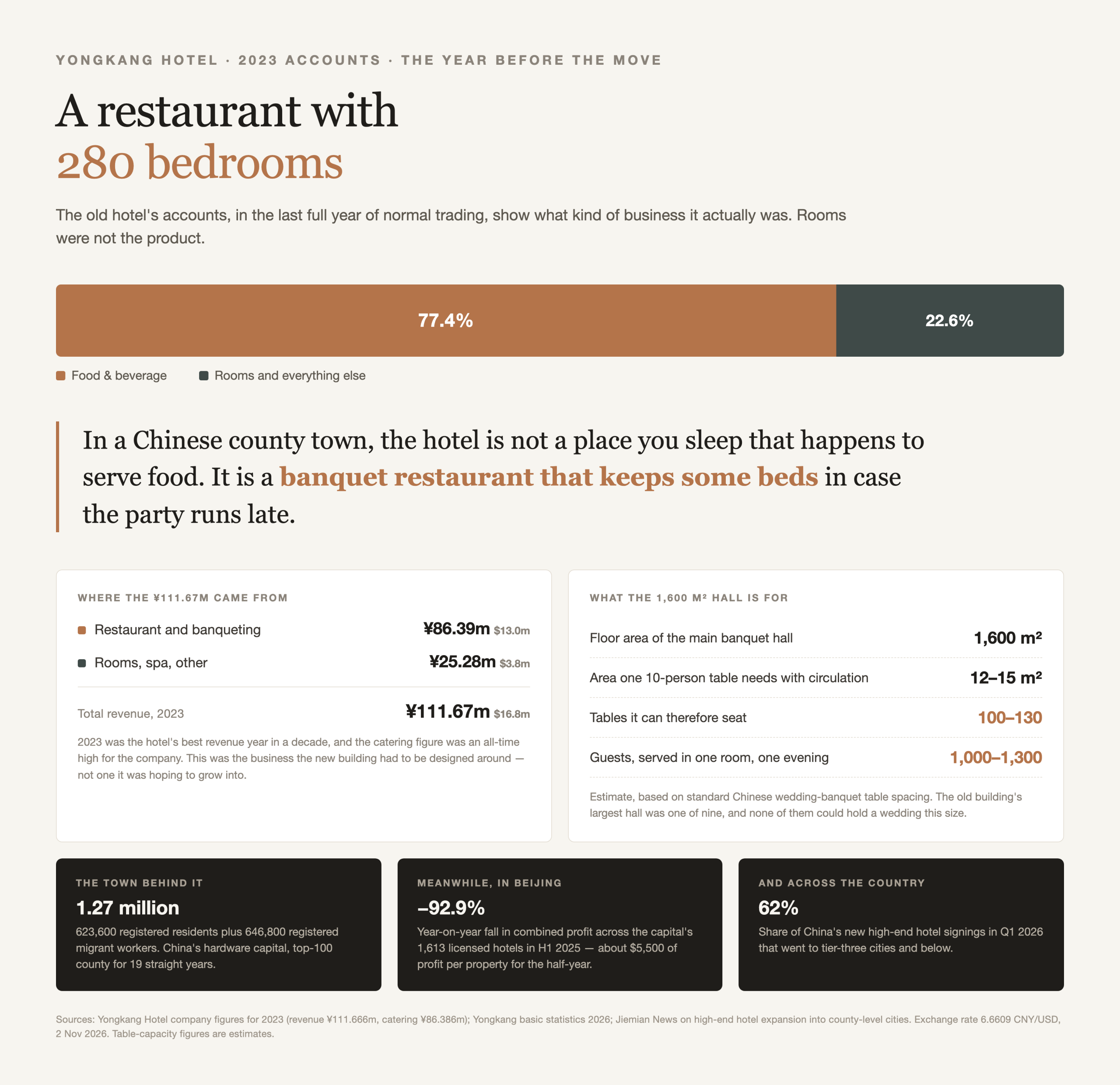
Read that again, because it inverts how a Western reader thinks about hotels. In a Chinese county town, the hotel is not a place you stay that also serves food. It is a restaurant that keeps some beds in case the party runs late.
Which explains the 1,600-square-metre hall. At a standard ten-person round table needing twelve to fifteen square metres with chairs and circulation, that room holds somewhere between a hundred and a hundred and thirty tables. A thousand guests, seated, fed, in one room, with a stage at one end.
When I stood in it I guessed it could seat a hundred tables. The arithmetic says I was, if anything, conservative.
Meanwhile, in Beijing
None of this is happening in a vacuum, and the wider numbers are stranger than the local ones.
In the first quarter of 2026, 62% of all new high-end hotel signings in China were in tier-three cities and below. Marriott opened 30% of its 2024 China pipeline in cities below tier three. Huazhu is running a programme it calls “a Huazhu in every county”. In the 2026 May Day holiday, for the first time, the share of high-star hotel spending in county-level destinations overtook the tier-one cities.
At the same time, in the first half of 2025, the 1,613 licensed accommodation providers in Beijing reported a combined profit of 59.8 million yuan — down 92.9% year on year. That is an average of about 37,000 yuan, or $5,500, of profit per property per half-year. Shanghai went from profit to loss in a single quarter.
The county is building marble corridors while the capital is losing money on beds. That is the actual story here, and it is not really about tourism.
Who is this for?
The honest answer is: three groups, and only one of them is travellers.
Weddings and life events. In Yongkang, as in most of Zhejiang, the banquet is the social unit. Wedding, first-month, one-year, university send-off, housewarming, retirement, the funeral. My own mother says the town never gets tired of eating at this place — 永康人民对永康宾馆是吃不厌的 — and forty years of booking records back her up. A hotel that cannot seat a thousand people cannot host the weddings this town actually holds.
Government and business reception. It is a state-owned enterprise. It was built partly so the city has somewhere to put a delegation, a conference, or a signing ceremony without sending guests to a private competitor across town. The brief says so directly: political reception, business conferences, high-end banquets, leisure.
Returning children. The newest and least obvious market. Hotels in China’s labour-exporting counties saw bookings more than double during the 2026 Spring Festival, because the children who come home for a week increasingly do not want to sleep in their childhood bedroom. A five-star hotel in a county town is, among other things, a very expensive way of giving your adult children somewhere to stay.
What I could not find out
Three things I would want to know before writing a confident verdict, and could not establish:
- Whether it is full. Occupancy data for a state-owned hotel in a county-level city is not published. Anyone who tells you the investment will or will not pay back is guessing.
- What a wedding costs there. I did not ask, and I am not going to invent a number. If the per-table price has gone up with the marble, that is the number that actually matters to a family in this town.
- What happens to the old building. The Jiangcheng Road site has been closed since the move. Its future has not been announced, and the forty-year-old banqueting halls, the fountain out front, the photographs in a hundred thousand family albums, are currently just empty rooms on the river.
I have written before about the Audi dealership in this town that closed after sixteen years. That one was a retreat. This is the opposite motion, by the same town, in the same decade — and I am genuinely unsure which of the two is the more accurate signal about where county China is going.
Both, probably. That is what makes it interesting.
FAQ
Is the new Yongkang Hotel open to ordinary people, or only officials? Open. It is a state-owned commercial hotel with a five-star brief: it takes bookings, sells restaurant tables to the public, and hosts private weddings. The government reception function is one customer among several, not a gate.
How much did the new hotel cost, and who paid? 1.09 billion yuan, about $164 million, funded as a city-level service-industry key project through the state-owned Yongkang Hotel Company. It is 1.24% of the county’s 2025 GDP.
Why does a county of 620,000 need a 1,600 m² banquet hall? Because 77.4% of the old hotel’s revenue came from food and beverage, not rooms. The hall is the business. A hall that seats a thousand is the minimum viable size for the weddings this town holds.
How big is Yongkang? 1,049 km², with 623,600 registered residents and a further 646,800 registered migrant workers — so roughly 1.27 million people actually living here. 2025 GDP was 87.95 billion yuan, and it has been in China’s top-100 counties for nineteen consecutive years.
What is the hotel’s architectural style? It is marketed as 宋韵 — Song dynasty resonance — and built as a garden hotel: separate pavilions, water, planting, and a deliberately restrained palette. The banquet halls are named after local landmarks, including Fangyan, the county’s own mountain.
The new hotel is not a mystery, once you stop reading it as a hotel. It is a very large, very well-lit restaurant with 280 bedrooms attached, built by a town that got rich making hardware and decided it wanted somewhere to sit a thousand of its own people down at once.
Whether that is confidence or vanity depends on a number nobody will publish. But I walked through it on an ordinary Tuesday, and nobody stopped me, and the marble was real.
Sources: Yongkang Hotel official site, Yongkang municipal government hotel profile, Yongkang Daily groundbreaking report, 14 Oct 2023, Yongkang basic statistics 2026, Jiemian: international high-end hotels move into county towns. Exchange rate used: 6.6609 CNY/USD, 2 November 2026.