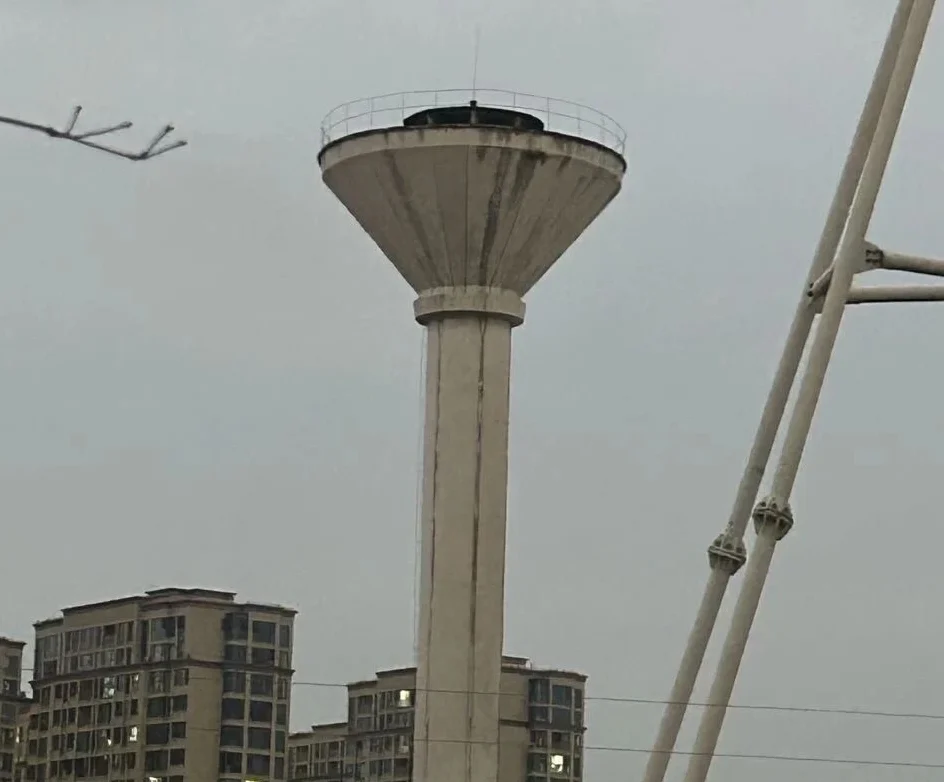
Next to my neighborhood there’s a driving school. And in the middle of the driving school sits a tower that looks exactly like a flying saucer that landed on a concrete stalk.
I’ve seen these towers my whole life. There’s one in almost every Chinese town — an old concrete column with a fat, mushroom-like top that could pass for a UFO. But until this week, I never actually stopped to ask: what is that thing?
Short answer: it’s a water tower — specifically the “inverted-cone water tower” that China built by the thousands in the 1980s and 90s. The flying saucer look isn’t decoration; it’s the water tank itself.
Why It Looks Like a Flying Saucer
The top isn’t a dome you climb inside — it’s a concrete water tank shaped like an upside-down cone (that’s why the style is called 倒锥壳水塔, “inverted-cone water tower” in Chinese).
The shape isn’t for looks. An inverted cone is structurally clever: the weight of the water presses down and inward, which means the concrete can be much thinner than a flat-bottomed tank, using less material and money. It’s pure 1980s Chinese engineering — simple, cheap, and built to last.
Why They Stand Alone in the Weirdest Places
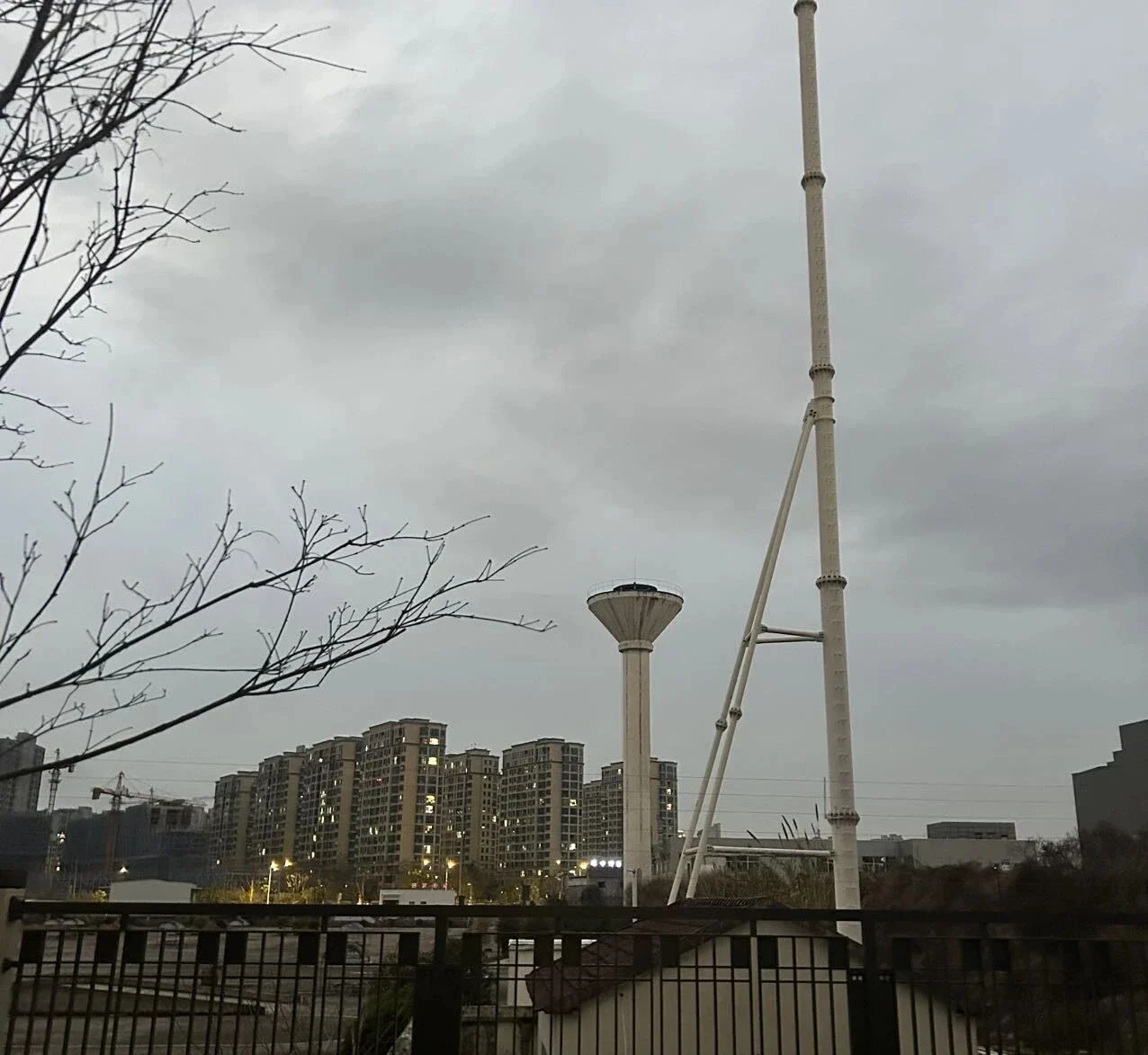
That’s the part I never understood as a kid. Why is there a water tower in the middle of a driving school?
The answer is usually “leftover.” These towers were built as part of factories, institutes, or residential compounds back when city water pressure was too weak to reach upper floors. The tower stored water on top and let gravity do the rest.
When the building around it was demolished — and its land sold off or temporarily repurposed (a driving school needs flat open space, so it’s a favorite in-between use) — the water tower itself often stayed. Why? Because demolishing a thick concrete tower is genuinely expensive, and as long as it’s not in the way, it’s cheaper to just… leave it standing, like a memorial to the building that used to be there.
So you get these surreal scenes all over China: a UFO-shaped tower standing alone in a parking lot, a field, a schoolyard, or next to a driving school.
Why There Are So Many of Them
From the 1980s into the 90s, China’s cities expanded faster than their water systems. Water towers were the stopgap solution — every factory, campus, and apartment block got one. Nobody knows the exact count, but it’s safe to say there were tens of thousands across the country.
By the 2000s, urban water supply caught up, and most of these towers were abandoned. They’re too sturdy to fall on their own and too costly to demolish, so hundreds — maybe thousands — are still standing, quietly becoming the most nostalgic piece of 1980s architecture most people never think about.
FAQ: UFO-Shaped Water Towers in China
What is the UFO-shaped tower in China?
An inverted-cone water tower, built in large numbers in the 1980s–90s. The saucer top is the water tank itself.
Why do Chinese water towers look like UFOs?
The upside-down cone shape lets water pressure push inward, so the concrete can be thinner and cheaper — pure 80s engineering.
Are these water towers still used?
Almost none. Most were abandoned when city water supply improved in the 2000s.
Why is it so expensive to demolish one?
They’re solid reinforced concrete — demolition means heavy machinery, long hours, and careful safety work, so leaving one standing is often the cheaper option.
Over to You
Do you have one of these towers where you live? And for anyone outside China — do your countries have their own weird leftover towers from a past era, or is this a purely Chinese thing?
I’d love to know what yours looks like.
— Ying