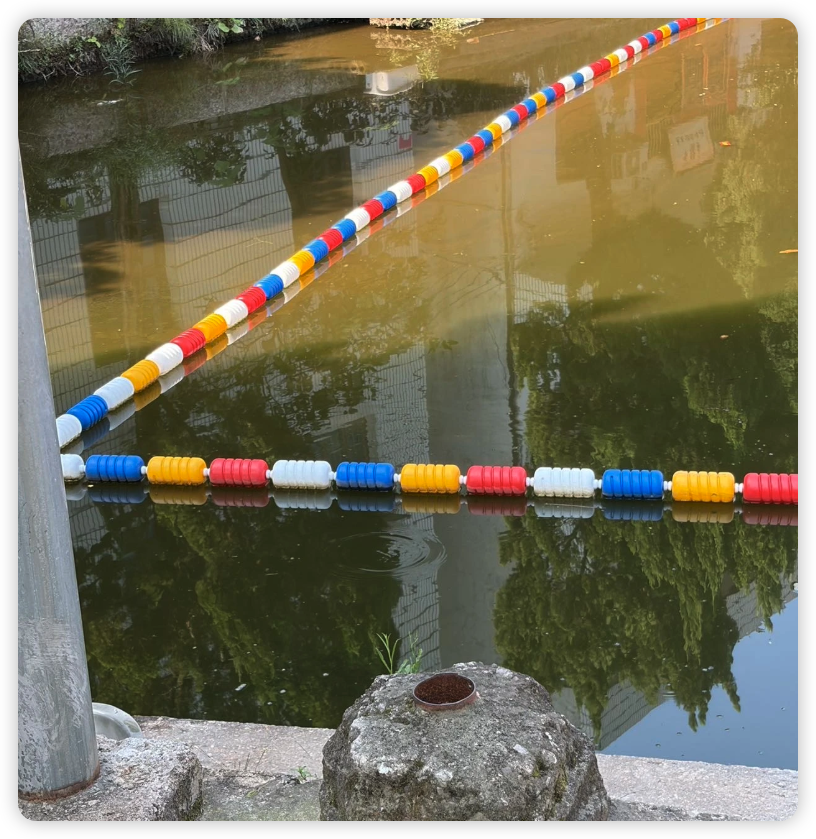
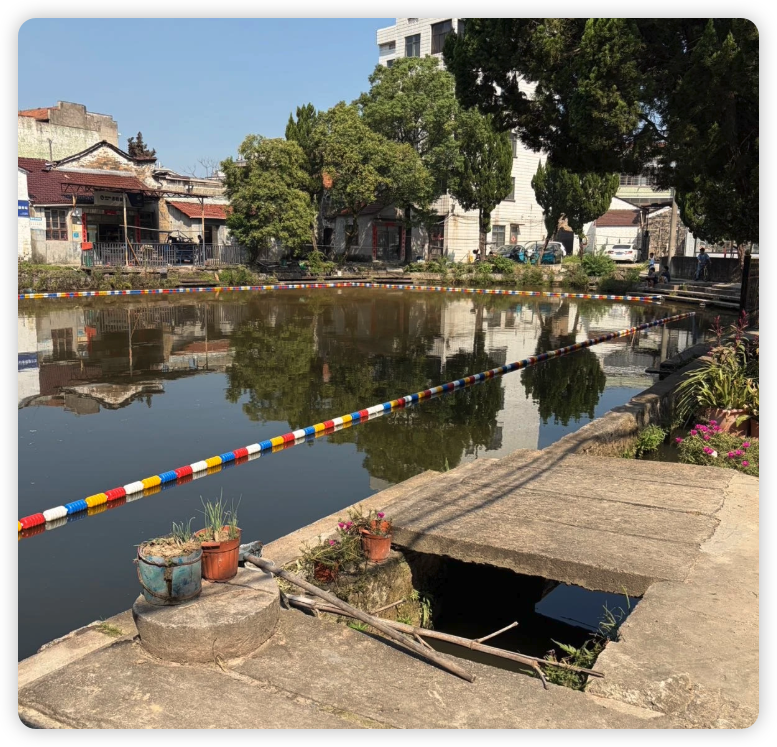
I went back to the village this weekend and noticed something new: every pond now has a line of colorful floats strung around the entire water’s edge, like a necklace around the pond.
They weren’t there last year. So what are they for?
They’re a drowning-prevention lifeline. And there’s a story that shows they actually work.
A Simple Line That Saves Lives
Here’s how it functions: a rope with floats spaced along it is anchored around the pond’s perimeter, sitting right at the water’s surface. If someone falls in — a child playing near the water, most likely — they can grab the line and hold on, even if they can’t swim. That flotation keeps their head above water until someone pulls them out.
The design details matter:
Why colorful? Because it has to be visible in daylight and at night. Bright alternating colors — orange, yellow, red — mean rescuers can spot the line from the bank in poor light, and a person in the water can see where to swim for.
Why all the way around? Because falling in is not a planned event. If someone slips off any bank, anywhere around the pond, there’s a line within reach. A partial safety line would only protect people who fall in the right spot — a full perimeter protects everyone.
It Already Worked
This isn’t a hypothetical measure. Just days before I took these photos, a child in another village in our city (Yongkang) fell into the water. They grabbed the float line and held on long enough for rescuers to reach them. They were pulled out alive.
One child, one cheap rope, one life. That’s the entire cost-benefit analysis.
Why Rural China Is Installing These
The context: drowning has long been one of the leading causes of accidental death for children in China, and summer is the worst season — school’s out, the weather is brutally hot, and village kids swim in ponds and canals where there are no lifeguards and often no barriers.
So local governments started treating it as a public safety problem with physical solutions. In Zhejiang (where I live), that means:
- Float lines around ponds and canals — the measure in this post
- Warning signs and railings at high-risk spots
- Lifebuoys and rescue poles mounted on poles and bridges
- Volunteer river patrols in summer
- School and village education campaigns before the summer holiday
The float line is the cheapest item on that list, and possibly the most effective per yuan spent. It doesn’t need electricity, maintenance, or staffing — it just sits there, waiting, visible and reachable.
For anyone working on child safety or water safety in other countries, it’s worth stealing: a rope, a few floats, and a full perimeter. That’s the whole design.
FAQ: Drowning Prevention in Chinese Villages
What are the floats around Chinese village ponds?
They’re a drowning-prevention lifeline: a floating rope with bright-colored floats installed around the full edge of ponds and canals, so anyone who falls in can grab on and stay above water.
Why are they different colors?
High-visibility colors make the line easy to see in both daylight and at night, helping rescuers locate it quickly and helping anyone in the water find something to grab.
Do the floats actually save lives?
Yes — in Yongkang (Zhejiang) recently, a child who fell into a village pond grabbed the float line and held on until rescuers arrived, surviving the incident.
Why is drowning prevention a priority in rural China?
Drowning has long been among the leading causes of accidental death for children, especially in summer. Rural ponds and canals often lack barriers or supervision, so physical safety measures are a priority.
Over to You
Does your country or region have anything like this around ponds, canals, or lakes? And what’s the simplest piece of public safety infrastructure where you live — the thing that costs almost nothing but saves lives?
I’m curious what cheap safety solutions other places have invented.
— Ying