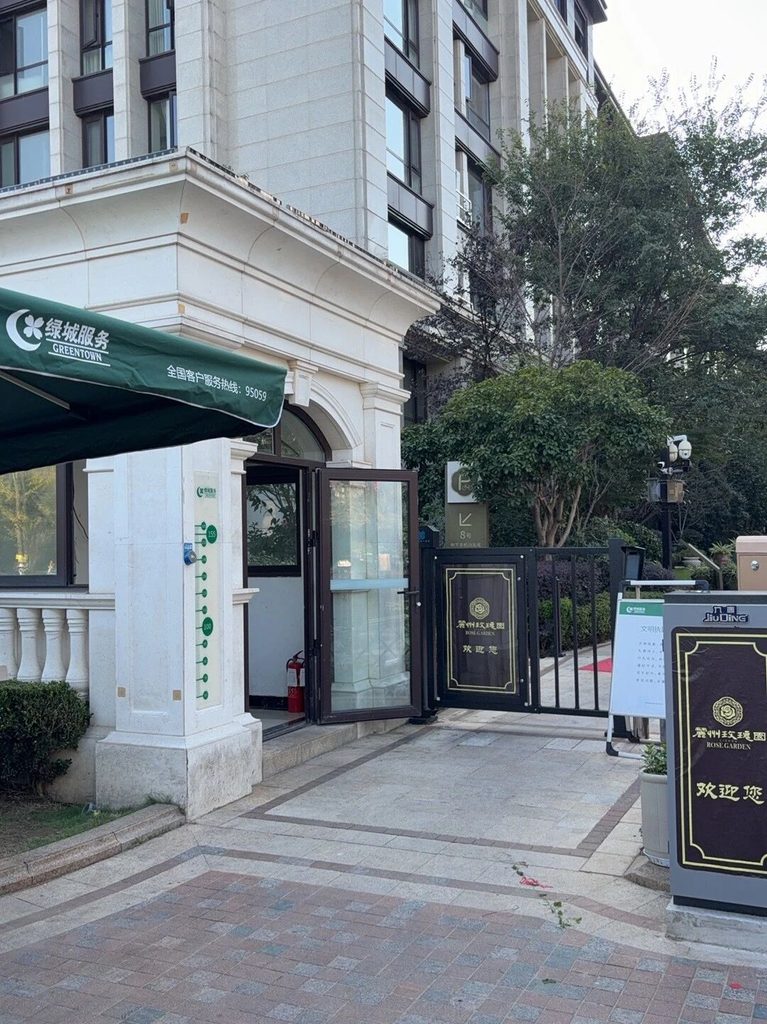
This is the side gate of the neighborhood that everyone in my city agrees is the most expensive one. I walked past it, took a photo, and then did the thing I always do — went home and looked up the actual numbers.
They were stranger than I expected.
Short answer: the villas in here are listed at ¥36.8 million to ¥40 million a house — about $5.45 million to $5.93 million, or roughly 13 times the median American home. That is in a county-level city of 620,000 registered residents in Zhejiang province. Per square metre it comes to about ¥63,000, which is 4.6 times the Yongkang city average. And there is no cheap way in: the smallest flat in the compound is ¥6.38 million.
First, Why “Lizhou Rose Garden”?
The gate says 丽州玫瑰园. The Rose Garden part is obvious. The Lizhou part is the interesting bit — it is my city’s name from 1,400 years ago.
Yongkang became 丽州 (Lizhou) in 621 AD, during the Tang dynasty, and the old name never really died. It is still on bus routes and restaurant signs and, apparently, the most expensive housing development in town. Locals read it as the old-money name.
The city itself explains a lot of the price. Yongkang sits in the middle of Zhejiang, about two hours south of Hangzhou, with 620,000 registered residents and another 640,000 migrant workers on the books. It is known across China as 五金之都 — the hardware capital — and it has the titles to prove it: door capital, mug capital, power tool capital, cookware capital.
The numbers behind those titles:
- 2025 GDP: ¥87.95 billion (about $13 billion) from a city most foreigners have never heard of
- Eight hardware industries make up more than 85% of its industrial output, sold to over 180 countries
- 19 consecutive years in China’s Top 100 Counties
- Average disposable income ¥66,967 a year in 2025 — 30th among China’s 40 highest-income county-level cities
That last line is the key one. This is not a struggling place. It is one of the wealthiest small cities in the country, and the housing market reflects it.
What ¥40 Million Actually Buys
Here is where the numbers stop meaning anything until you know what you get.
The villas at Rose Garden are 双拼 — semi-detached, two families sharing one wall. The typical unit on the market is:添加到对话
| Land | about 134 m² |
| Built floor area | 588 m² (6,330 sq ft) |
| Floors | 3 above ground, plus a basement |
| Bedrooms | 4 to 6 |
| Parking | 2 to 3 spaces, usually in the basement |
Four listings I found, all for the same basic product:
- ¥36.80 million — 588 m², shell condition, three parking spaces
- ¥38.00 million — 588 m², renovated, with basement
- ¥39.80 million — 588 m², with garden and three parking spaces
- ¥40.00 million — 582 m², semi-detached, two parking spaces
Now the part that takes a second to sink in. That is 588 square metres of building on 134 square metres of land. In American terms: a 6,300-square-foot house on a 1,440-square-foot lot. This is not a house with a yard. It is a four-storey tower standing on a patch of ground smaller than a tennis court.
Which is why the price per square foot is the number that matters. At ¥62,950 per square metre, that works out to about $866 per square foot. The median list price in the United States right now is $223 per square foot. Same planet, nearly four times the price.
“No High-Rises, All Villas” — Half Right
The first thing people say about Rose Garden is that there are no high-rises and it is all villas. Half of that is true.
No high-rises: correct. The villa zone has a floor-area ratio of 0.5, which is about as low as residential land gets in China, and 32% of the site is greenery. The landscaping is French formal, planted by flowering species, and in 2021 the compound was named a provincial garden-style residential district. The tallest buildings inside the gate are seven storeys.
All villas: not quite. Alongside the villas there are low-rise blocks of 大平层 — large-format flats, 183 to 245 square metres, in seven-storey buildings. They are not cheap either:添加到对话
| Flat | Price | Per m² |
|---|---|---|
| 183 m² | ¥6.38 million | ¥34,864 |
| 200 m² | ¥6.80 million | ¥34,000 |
| 235 m² | ¥8.68 million | ¥36,937 |
| 237 m² | ¥9.98 million | ¥42,110 |
So the entry ticket to the compound is ¥6.38 million — about $945,000 — and that buys you a flat, not a villa.
One more thing about the gate in my photo. It is staffed by Greentown Service, a Hangzhou property manager that Chinese buyers read as a quality signal the way Americans read a doorman building. The compound was finished in 2011, though the villa phase looks later — individual villas are dated 2016 to 2018 on listings.
Is It Actually the Most Expensive in Yongkang?
This is the claim I wanted to check, and it mostly survives — with one asterisk.
Secondhand price data for August 2026 ranks 丽州玫瑰园 (villas) first in the city at ¥62,950 per square metre. The next compound down is at ¥53,567. The Yongkang citywide average that month was ¥13,748, so the villas are asking 4.6 times the city average.
The asterisk is 江湾馨园, another villa compound out at Yuanzhou village, which some listing sites quote even higher. But those are reference prices with nothing actually for sale behind them. Its real transactions tell a different story: a 362 m² semi-detached sold at auction for ¥15.61 million after 61 bids, and a 720 m² detached house went for ¥26.79 million on a 146-bid auction. In January 2024 a similar 720 m² detached unit cleared at ¥30.82 million.
So on asking prices, Rose Garden is number one. On actual sales, nobody is number one, because hardly anything sells. Yongkang’s top end is thin — a handful of deals a year, with auction results landing 30–40% below asking. “The most expensive neighborhood in Yongkang” is really “the most expensive thing currently on the market in Yongkang.”
What It Looks Like From Outside
Two more comparisons, because they are what I keep thinking about.
Against local income. Average disposable income in Yongkang was ¥66,967 in 2025. A ¥36.8 million house is 549 years of that. Use the urban figure, ¥78,810, and it is still 467 years.
Against the rest of the town. The average secondhand home in Yongkang sells for the equivalent of about $189 per square foot. The villas at Rose Garden ask $866. Both numbers are real, in the same city, in the same month.
That gap is the actual story here. In a Chinese county town, ordinary housing is genuinely cheap by American standards — and the top of the market is priced like Manhattan.
FAQ: Buying a House in a Chinese County Town
What does 别墅 (biéshù) actually mean in China?
It does not mean what “villa” means in English. It covers semi-detached (双拼), townhouses (联排) and fully detached houses (独栋), and sometimes a large penthouse-style flat. The marker is low-rise construction with your own front door and your own parking — not how much land you own.
Can a foreigner buy one of these?
Not practically. China restricts foreign buyers hard: in most cities you need to have worked or studied locally for at least a year, the purchase has to be for your own use, and the money has to come in through approved channels. It is not a market you can buy into from overseas.
How much is ¥40 million in dollars?
About $5.93 million at ¥6.75 to the dollar. ¥36.8 million is about $5.45 million.
Is the Yongkang market going up or down?
Both at once. In September 2026 the citywide secondhand average fell 13.4% year-on-year to ¥13,419 per square metre, while the villa segment at Rose Garden was being quoted 20% higher than a year earlier. The bottom and the top are moving in opposite directions, which is happening in a lot of Chinese cities right now.
Why are county-town houses so expensive at the top?
Because the money is local and industrial. Yongkang has 74,400 registered companies and 199,000 business entities across a city of 620,000 people. When factory owners do well, they buy the most exclusive thing within driving distance of the factory.
Where I Got These Numbers
- Yongkang city averages for August 2026 and the city’s own ranking of its most expensive compounds — 58同城 Yongkang price index
- Villa and flat listings at 丽州玫瑰园 (villas ¥36.8M–¥40M; flats from ¥6.38M) — 58同城 and 安居客
- Auction results for 江湾馨园 — Wei Yongkang property coverage
- Yongkang GDP, population, income and industry titles — Yongkang Municipal Government and the 2025 statistical communiqué
- US median existing-home sale price $429,100 (August 2026) — National Association of Realtors; US median list price $419,250 and $223/sq ft (September 2026) — Realtor.com monthly trends
- Currency converted at ¥6.75 to the US dollar, October 2026
Over to You
Does anyone here actually live in Rose Garden? I would genuinely like to know how the inside compares to the gate.
And for readers anywhere else: what is the most expensive neighborhood in your town, and what does a house there cost?
— Ying