A few days ago we went out for a drive and I took the Li Auto i6 onto the highway. At the toll plaza I still had to stop and take a paper ticket, like it was 2010. When I asked why, the answer was simple: the car’s built-in ETC had never been activated, and activating it costs 50 yuan.
That got under my skin a little. We already bought the whole car. Why is there a separate bill for switching on something that’s already sitting inside it?
Short answer: the 50 yuan isn’t for hardware. It’s an issuance service fee charged by whoever issues the ETC account — in Li Auto’s case, the provincial expressway company — not by the carmaker, and it’s a one-time charge that never repeats. And here’s the thing I found after digging into 15 different brands: that 50 yuan is basically the industry’s floor cost. Almost everything above it isn’t an activation fee at all — it’s either hardware your car never had, or a bundle the carmaker decided to sell you.
First — What Even Is ETC?
ETC stands for Electronic Toll Collection, and in China it’s a single national standard. Instead of stopping at a window, your car carries a small radio unit — or, on newer cars, a module hidden behind the rearview mirror. A gantry reads it as you pass and the toll comes out of a linked payment account. No cash, no window, no queue.
Two things make it worth having:
- You get a discount. Since July 1, 2019, the Ministry of Transport has required ETC users to get at least 5% off tolls nationwide — that’s the “95 zhe” (95% of the price) every Chinese driver talks about. Provinces can stack more on top, especially for trucks and on quiet routes.
- It isn’t only for highways. Lots of shopping mall car parks bill through ETC too, so you drive straight out instead of queueing to scan a QR code at the exit.
And this is not a niche thing. In 2019 the State Council pushed to scrap provincial border toll booths and rolled out free ETC units through banks, with a target of 80% of cars fitted and 90% of highway traffic on ETC by the end of that year. Banks still hand them out free, because a free ETC card is a new banking customer.
The Money Has Three Layers — and Only One Is an “Activation Fee”
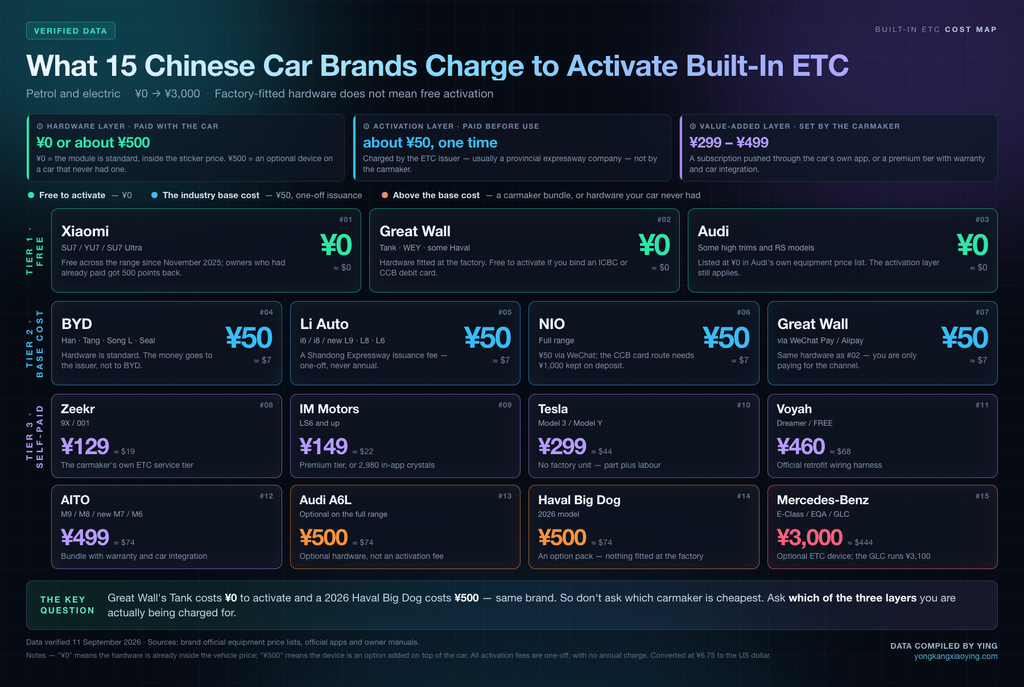
This is the part that clears up most of the confusion. When you buy a Chinese car with ETC, you may end up paying in up to three separate layers:
- The hardware layer — paid when you buy the car. Either ¥0 (the module is standard equipment, included in the sticker price) or around ¥500, if you’re buying the device as an optional extra on a car that doesn’t have it.
- The activation layer — paid before you can use it. About ¥50, one time. This is the ETC issuer’s fee, not the carmaker’s, and it’s where that 50 yuan invoice comes from. The industry’s baseline cost for issuing one ETC account sits right around 50 yuan.
- The value-added layer — set by the carmaker. Anywhere from ¥299 to ¥499: an ETC subscription pushed through the car’s own app, a premium tier with warranty and vehicle integration, or a package bundled with something else.
Once you separate those three, the pricing stops looking random. Anything at ¥0 or ¥50 is the hardware and issuance story. Anything above ¥50 is either a device you didn’t get for free, or a carmaker’s own bundle.
What Every Chinese Brand Actually Charges
Here’s the full ladder, checked against brand equipment price lists, official apps and owner manuals as of September 2026. Prices move, and some brands let you pay with loyalty credits — so check your exact model before ordering.
| Brand / model | You pay | What it really is |
| Xiaomi (SU7, SU7 Ultra, YU7) | ¥0 | Free activation since November 2025; earlier payers got 500 points |
| Great Wall — Tank 300/400/500/700, Wey, some Haval | ¥0 | Free if you bind an ICBC or CCB debit card |
| Audi — some high trims and RS models | ¥0 | Listed at zero in the official equipment price list |
| BYD (Han, Tang, Song L, Seal, Sea Lion, Bao 06, Yangwang) | ¥50 | Standard issuance fee |
| Li Auto (i6, i8, new L9, L8, L6) | ¥50 | Shandong Expressway issuance fee, one-off, never annual |
| NIO (all models) | ¥50 | WeChat channel fee; a CCB card route needs ¥1,000 kept on deposit |
| Great Wall via WeChat or Alipay | ¥50 | Same hardware — the fee is the payment channel |
| Zeekr (9X, 007) | ¥129 | Carmaker’s own ETC service subscription |
| IM Motors (L56 and up) | ¥149 | Premium tier, or 2,980 in-app crystals |
| Tesla (Model 3, Model Y) | ¥299 | Hardware — not fitted at the factory, plus labour |
| Voyah (Dreamer) | ¥460 | Hardware plus installation, from the official store |
| AITO / HarmonyOS Smart Mobility (M9, M5, new M7, M8) | ¥499 | Carmaker bundle with warranty and car integration |
| Audi A6L (option) | ¥500 | Optional hardware, not an activation fee |
| Haval Big Dog 2026 | ¥500 | Optional equipment — the device isn’t fitted at all |
| Mercedes-Benz (E-Class, EQA, GLC) | ¥3,000 | Optional ETC device; the GLC version runs about ¥3,100 |
At ¥6.75 to the dollar, that’s ¥50 ≈ $7.40 at the cheap end, ¥499 ≈ $74 in the middle, and ¥3,000 ≈ $444 for the Mercedes option. For a device that isn’t even a device — the module is already in the car on most of these — that’s a spread worth knowing about before you sign.
Free at activation: Xiaomi, Great Wall, some Audis
Xiaomi used to charge 50 yuan. When it launched the current SU7 it went free across the range and handed 500 points to every owner who had already paid. Great Wall’s Tank and Wey models are free too — if you bind an ICBC or CCB debit card. Audi quietly lists ETC at ¥0 in the equipment table on some high trims and RS cars. Lei Jun, Xiaomi’s founder, made a point of it on stage: he said he’d noticed some competitors charge around 500 yuan to activate a car’s own ETC.
The ¥50 club: BYD, Li Auto, NIO, Great Wall via WeChat
Four channels, same number, and none of them is the carmaker’s margin. It’s the ETC issuer charging for issuing the account — mostly provincial expressway companies such as Shandong Expressway. Pay a bit more attention to the asterisks: NIO’s route through WeChat is ¥50, but if you go the CCB card way you have to keep 1,000 yuan sitting on the card as a deposit, and Great Wall’s free version becomes a ¥50 version the moment you pay through WeChat or Alipay instead.
Above ¥50: you’re buying hardware or a bundle
This is where the stories diverge. Tesla’s ¥299 isn’t an activation fee at all — the car doesn’t come with a unit, so you’re paying for the part and the labour. Audi’s ¥500 on the A6L and Haval’s ¥500 on the 2026 Big Dog are the same: optional equipment, factory not fitted. Mercedes’ ¥3,000 is the most extreme example — an optional device on an E-Class, EQA or GLC. And then Zeekr’s ¥129, IM Motors’ ¥149 and AITO’s ¥499 are the third layer: the carmaker’s own service tier.
Same brand, different answers, by the way: Great Wall’s Tank costs nothing, while a 2026 Haval Big Dog costs ¥500 — because the Big Dog’s ETC is an optional extra. So “which brand is cheapest” is the wrong question. The right one is which layer you’re being charged for.
Two Cars in My Driveway, Two Very Different ETC Stories
Our own situation is a decent illustration.
The Li Auto i6 has built-in ETC. It has never been activated, because it costs 50 yuan and I never got around to it. That’s why we were taking a paper ticket on the highway.
My 2015 Passat doesn’t have built-in ETC at all. I bought a third-party unit on a social platform for 80 yuan, and it gets the same 5% highway discount. Originally I had a bank-issued ETC linked to a Postal Savings Bank card. When I stopped using that card I unbound the account and replaced it with one that auto-deducts through WeChat Pay. It has turned out to be genuinely handy for mall parking — I just drive out, instead of waiting behind three cars to scan a code.
So the honest read on all this:
- If you use the highway a lot, the fee pays for itself, whatever the number is.
- If you rarely drive the highway, the gap between free and 499 yuan matters more than the feature does.
- And if the car already has the hardware, a big activation number isn’t buying you anything you didn’t already own.
Does the Fee Actually Pay Itself Back?
Let’s do the arithmetic, because it’s less obvious than it sounds.
The discount is 5%. To earn back a 50 yuan activation fee you need 1,000 yuan of highway tolls. A class-1 passenger car (up to 7 seats) pays about ¥0.45 per kilometre on Chinese expressways — that’s the official rate in provinces such as Anhui — so 1,000 yuan works out to roughly 2,200 km of highway driving.
For us, that’s a couple of long holiday road trips. For someone who uses the expressway twice a year, it’s several years.
At 499 yuan the break-even point becomes about 22,000 km. And at Mercedes money — if you were somehow counting it against the discount — you’d need to drive around 130,000 km before it paid for itself. Nobody is doing that maths, which is exactly why that version is a hardware purchase and not an ETC decision.
FAQ: ETC Costs and Rules in China
Is ETC mandatory in China?
No, but it’s heavily favoured. Since January 1, 2020, toll discounts and holiday free-pass policies are generally tied to ETC, so cars without it pay the base fare.
How much is the ETC discount in China?
At least 5% off nationwide, in force since July 1, 2019. Provinces can add their own discounts on top, which is why you sometimes hear about 15% off.
Can visitors or rental cars use ETC in China?
Not worth arranging for a short trip. Rental cars often have a factory ETC already activated — ask at pickup. Otherwise you take the manual lane and pay by cash, WeChat Pay or Alipay.
Why did one carmaker charge me less than another?
Because you may be paying for different layers. Around ¥50 is the ETC issuer’s own cost and it barely moves between brands. Anything above that is either optional hardware your car didn’t come with, or a service tier the carmaker chose to sell.
Do Chinese brands really charge ¥3,000 for ETC?
One does — Mercedes-Benz lists its optional ETC device at around ¥3,000. That’s an optional factory device on the car, not an account-opening fee, and the ¥50 issuance layer still sits underneath it.
How much is ¥50 in US dollars?
About $7.40, at roughly ¥6.75 to the dollar (September 2026). ¥499 is about $74, and ¥3,000 is about $444.
Where I Got These Numbers
- Brand-by-brand activation fees — brand official equipment price lists, official apps and owner manuals, compiled 11 September 2026. This is the same dataset behind the four comparison charts I published on my Chinese account.
- The 5% minimum ETC discount and the 2019 nationwide rollout — Ministry of Transport, reported by People’s Daily, May 2019
- Class-1 passenger car expressway rate of ¥0.45/km — Anhui provincial government price list, 2026
Over to You
Did your car charge you to switch on the ETC that came with it? How much? And outside China — do your cars have this built in at all, or do you still stick a transponder on the windshield like we used to?
I’d like to know how other countries handle the same idea.
— Ying