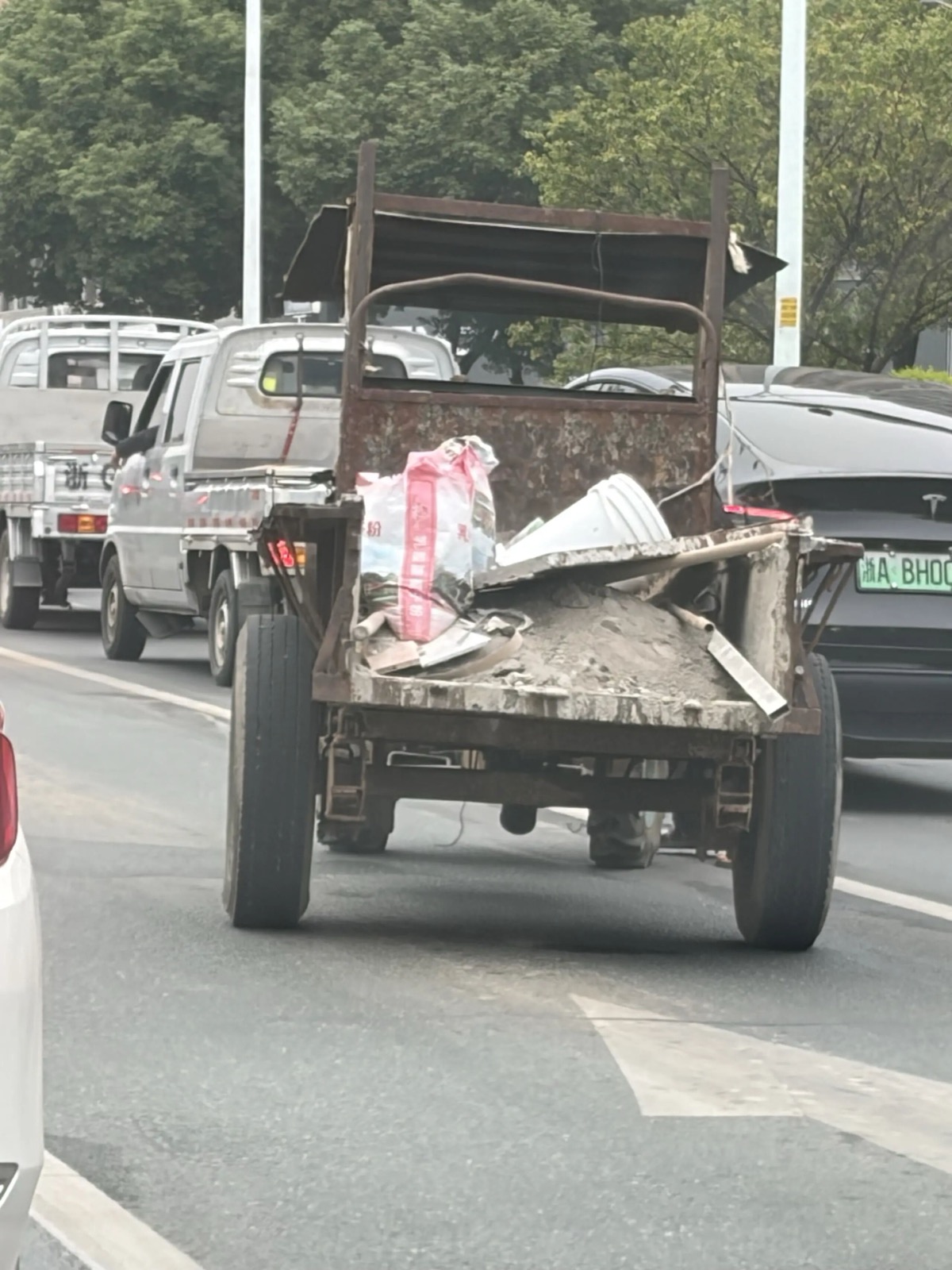
On the way out of town last Saturday I got stuck behind a walking tractor.
It was doing maybe fifteen kilometres an hour in the slow lane, wobbling slightly, the way these things always wobble. No number plate. The paint had gone entirely — just rust and the grey of weathered cast iron. The tyres were smooth enough that you could see the cords. The exhaust note was a steady, unhurried putt-putt, the sound of a single-cylinder diesel that has been running, on and off, since before I was born.
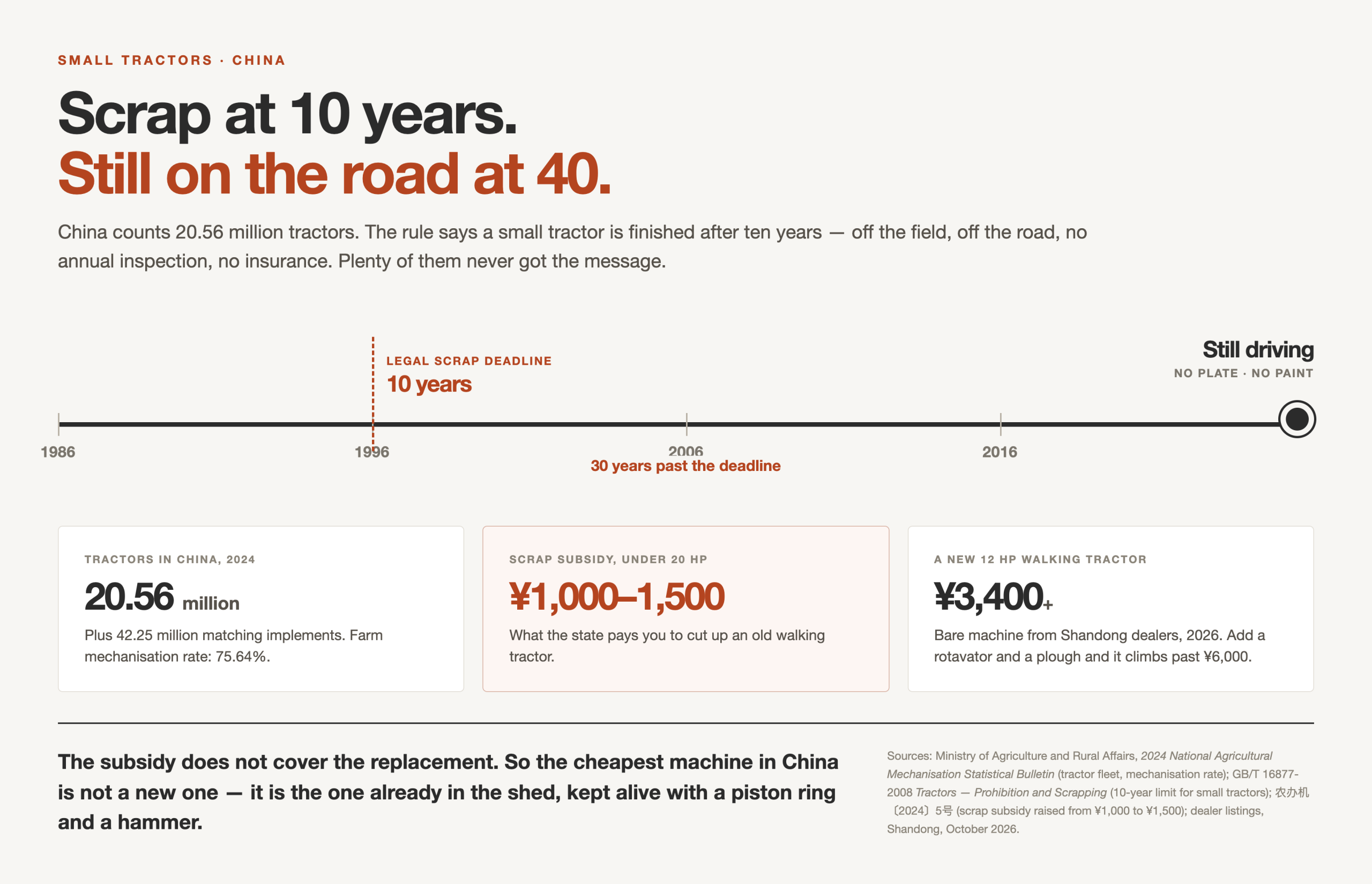
Nobody in the cars behind it honked. That is the part a visitor would notice first. A machine that would fail a safety inspection in any country on earth, moving through traffic, and the local response is to slow down and go around.
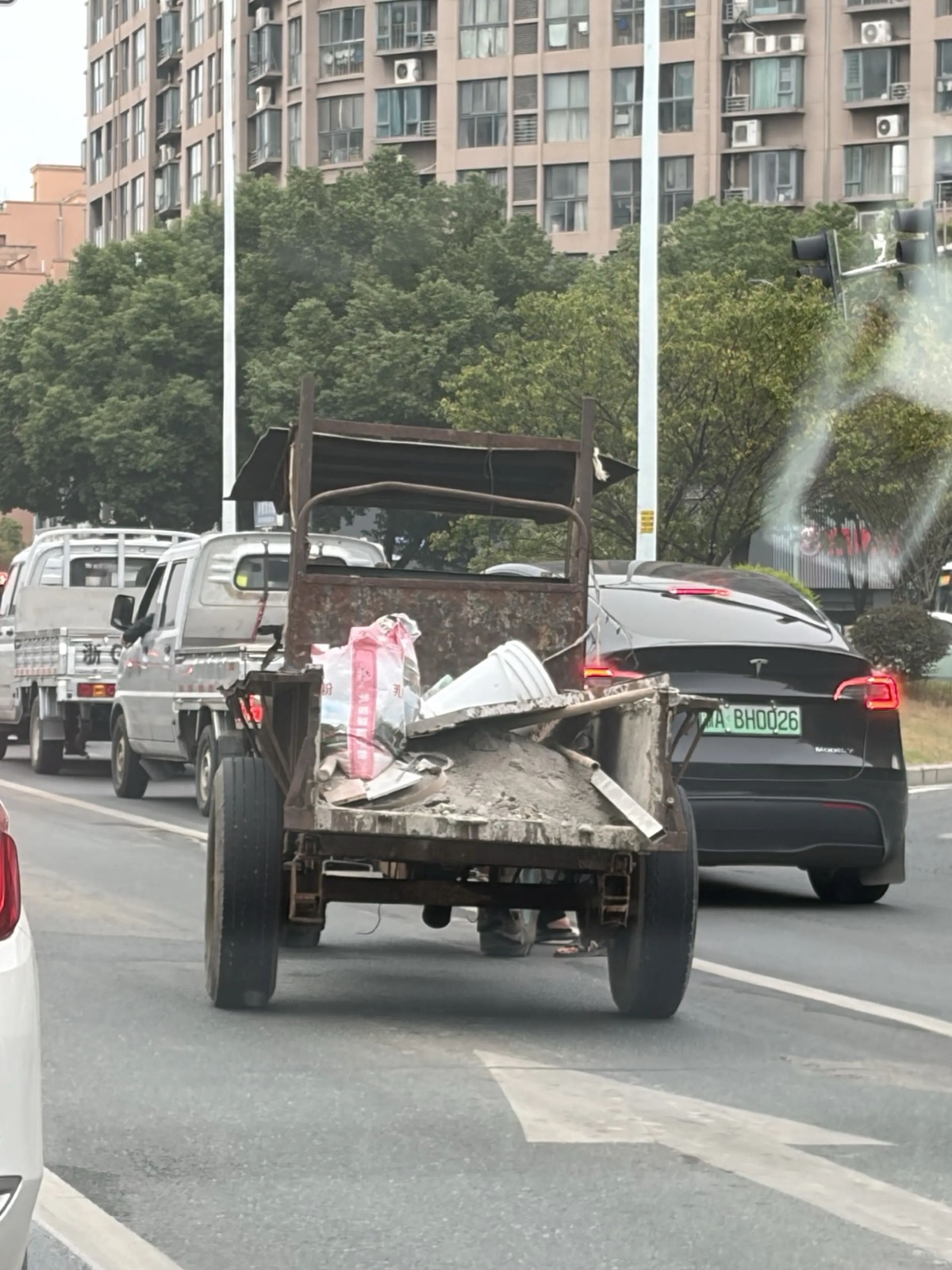
I have been thinking about that tractor since. Because China does have a rule that should have retired it decades ago, and the rule is not a suggestion. It is a national standard, it is enforced, and every year thousands of machines are formally scrapped under it. The tractor I followed is thirty to forty years old. The limit for its class is ten.
So how is it still moving?
This is the same puzzle I ran into with old village houses that burn to four walls, and with the six-floor apartment block: a written standard exists, it is not a secret, and the physical world quietly declines to match it.
The rule says ten years, plainly
The standard is GB/T 16877-2008, Tractors — Prohibition and Scrapping. It sets a service life for each class of machine, and the numbers are not generous (the full schedule as restated by Xixiangtang District in Nanning is worth reading, because it is written for tractor owners rather than for engineers):
| Machine class | Service life | Or accumulated work |
|---|---|---|
| Small tractor (engine ≤ 18 kW, incl. walking tractors) | 10 years | 12,000 hours |
| Medium and large wheeled tractor | 15 years | 18,000 hours |
| Crawler tractor | 12 years | 15,000 hours |
A walking tractor — the two-wheeled, hand-guided machine that does most of the small-plot work in southern China — falls into the first row. Ten years and it is finished. Not “should be reviewed”. Finished: it cannot pass the annual safety inspection, it cannot be registered, it cannot legally be driven on a road, and it is supposed to be deregistered and cut up.
The standard has a second trigger too. A tractor is also condemned if it fails the safety inspection three times in a row, or if it goes three consecutive inspection cycles without obtaining a certificate at all.
Local governments publish the consequences in unusually blunt language. One district government notice in Nanning spells it out: a scrapped tractor may not be inspected, may not be driven on a road, may not do production work, and should immediately stop being used. If you are caught driving one, the machine is confiscated. And because a scrapped tractor cannot hold the compulsory traffic insurance that every legal vehicle in China must carry, any crash is paid for entirely by the person holding the handles — plus, where someone is seriously injured, the possibility of a criminal charge.
That is the rule. It has been in force since 2008, and in earlier forms before that.
Why the ten-year line misses so many machines
Here is the mechanical reason the rule does not bite as often as you would expect: it binds machines that were registered in the first place.
To be deregistered, a tractor has to have been registered. To be inspected, it has to have a file. A farmer who bought a walking tractor in 1987 for cash, in a village, to work four mu of rice paddy and haul cabbage to the market, may never have had a plate at all. There was no transaction that generated one, and no authority that came looking.
A county-level clean-up I found while reading through these notices shows the shape of the problem. Jinggangshan city, in Jiangxi, published its 2026 deregistration list with an attachment named, in full, “Register of walking tractors due for scrapping (10 years), registered before 31 May 2016.” That is a government going through its own archives and matching registration dates against the standard, one machine at a time, because otherwise it has no idea which ones are past the line. The plate itself is an odd thing here — I wrote about what a Chinese plate is actually worth — but the tractor I followed had none at all, which is precisely the category that escapes the count.
And where the records do exist, the backlog is large. Shanxi province reported that as of the end of August 2025 it still had 13,763 machines past the national recommended scrapping age that had not been deregistered — mostly wheeled tractors. The province’s response was to send inspectors out to verify each one individually, distinguishing between “still in use”, “destroyed”, “lost” and “scrapped but not deregistered”. A category called scrapped but not deregistered tells you most of what you need to know about how this works on the ground.
The arithmetic that keeps it in the shed
Now the money, which is the real reason.
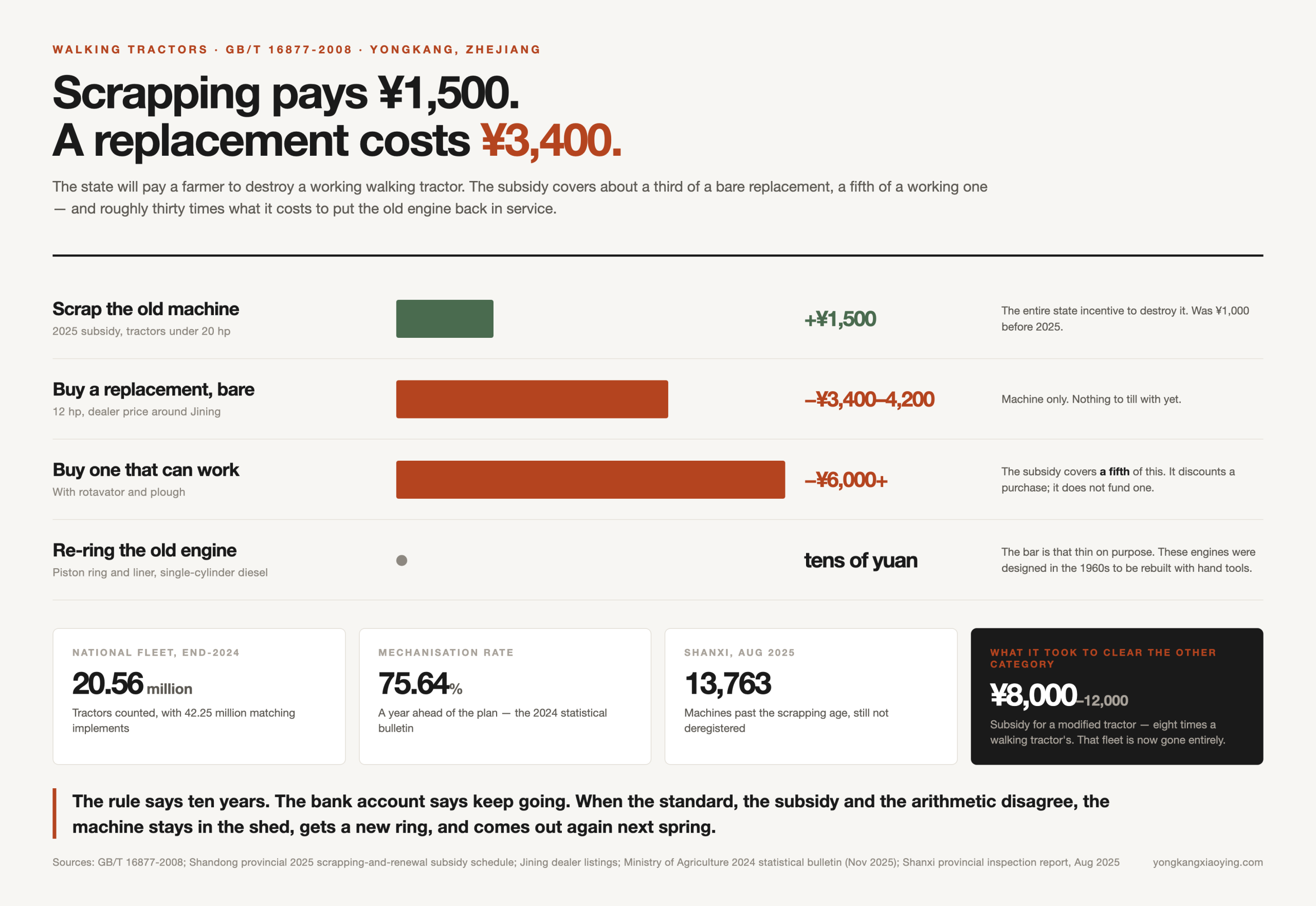
China does pay people to scrap old machines. The 2025 round of the farm machinery scrapping-and-renewal subsidy raised the ceiling for tractors under 20 horsepower — which is where walking tractors sit — from ¥1,000 to ¥1,500 per machine (provincial schedule, Shandong, 2025, which lists the row as “under 20 hp, including walking tractors”).
Fifteen hundred yuan. That is the entire state incentive to destroy a working tractor.
A new one costs more than twice that. Current dealer listings from the agricultural machinery cluster around Jining, Shandong — the country’s biggest source of these machines — put an 8 hp walking tractor at ¥3,400–3,800, a 12 hp at roughly ¥3,400–4,200, and a 15 hp at ¥4,200–5,000. Those are bare machines. Add the rotavator that does the actual tilling and a plough, and the bill climbs past ¥6,000.
| Cost | |
|---|---|
| Scrap the old machine, receive subsidy | +¥1,000 to +¥1,500 |
| Buy a replacement 12 hp machine, bare | −¥3,400 to −¥4,200 |
| Buy replacement with rotavator and plough | −¥6,000 or more |
| Re-ring the old engine instead | tens of yuan in parts |
The subsidy covers about a third of a bare replacement and a fifth of a working one. It does not fund the renewal; it discounts a purchase the farmer still has to find the money for.
Set against that, the cost of keeping a 40-year-old machine alive is almost nothing. A piston ring and a cylinder liner for a single-cylinder diesel are consumables. So is the injector. These engines were designed in the 1960s to be rebuilt in a workshop with hand tools, and the S195 pattern that powers most Chinese walking tractors is probably the most-repaired small diesel engine ever built. Any county in Zhejiang has a shop that stocks the parts, because the parts are also what the local factories make.
That is the whole mechanism. Replacing costs thousands. Repairing costs tens. The rule says ten years; the bank account says keep going.
Why this county in particular
Yongkang, where I live, is a hardware town. It makes door locks, saucepans, power tools, all-weather lamps — and, for a period, it made walking tractors.
During the Third Five-Year Plan, from 1966 to 1970, China went from importing hand tractors to producing them at scale. The Changzhou-built Dongfeng-12 was fixed as the national pattern in 1964; production of walking tractors nationally jumped from about 5,000 units in 1965 to 51,826 in 1970, and the national fleet reached roughly 120,000 machines. The state’s strategy was explicit — centralised design, decentralised production — so that provincial factories could build the same machine locally rather than ship it. The “Gongnong” series was the result, and Yongkang was one of the designated production bases, alongside Shanghai, Wuhan, Nanning, Shenyang and Kunming.
So the tractor I followed is not an import sitting in an alien economy. It is a machine designed in this country, built in towns like mine, from parts that this county still manufactures, for a farming system of small plots and short trips. Everything about it — the simplicity, the parts availability, the fact that a man with a spanner and an afternoon can bring it back to life — is a product of where it was made.
That is also why it survives. A machine built to be maintained by its owner in a place that makes every component will be maintained by its owner, indefinitely.
The category they did clear
There is one class of Chinese farm vehicle where the state’s patience ran out completely, and it is worth looking at because it shows what enforcement looks like when it is real.
Modified tractors — biànxíng tuōlājī, the transport-adapted machines that were essentially a tractor chassis fitted with a truck bed. They were everywhere in the 2000s: cheap, unregulated, used for freight and sometimes for carrying people. They also killed a lot of people.
The nationwide clearance campaign is now complete. As of 1 January 2026, driving a modified tractor on a road is simply illegal, with no registered machines left anywhere in the country. The subsidy for one was raised to ¥8,000 per machine, plus ¥1,000 for every year it was scrapped ahead of schedule, capped at ¥12,000 — roughly eight times what a walking tractor gets.
Why did that work and this does not? Because modified tractors competed with real trucks on real highways, carried paying cargo and passengers, and were therefore visible to traffic police every day. A walking tractor works a paddy field and hauls a trailer four kilometres to the drying yard. There is no enforcement presence in that four kilometres, and no economic competitor being undercut. It helps that Chinese traffic enforcement has a formal habit of warning before it fines, which is humane and also means the first ten years of a violation cost nothing.
What the machine actually costs, and who pays
The uncomfortable part of this is not aesthetic. A tractor with bald tyres and a forty-year-old braking system is a hazard, and the legal structure makes the hazard land entirely on the person least able to absorb it.
- A scrapped machine cannot hold compulsory traffic insurance. There is no insurer to claim against.
- Any injury or property damage is therefore paid by the operator personally, in full.
- If someone is seriously injured or killed, the operator can face criminal liability for a traffic offence, on top of civil damages.
- The brakes and steering on these machines degrade in ways the driver adapts to gradually and cannot perceive as a failure.
So the arrangement is: the state saves the cost of a real replacement programme, the farmer saves ¥3,000, and the risk is transferred to whoever is standing near the machine when something fails. In a village, that is usually a neighbour.
What would actually end it
Two changes, and neither is a slogan.
Register every machine at the point of sale. The ten-year rule cannot reach machines with no file. A register created at purchase — serial number, engine number, owner — makes the fleet visible, which is the precondition for everything else. Some provinces are already reconstructing that visibility backwards through dealer records and nameplates.
Pay replacement cost, not salvage value. The reason ¥1,500 does not work is that it treats the subsidy as a discount on a purchase the farmer was going to make anyway. A scheme that covers the replacement — or supplies a shared machine at village level instead of one per household — changes the arithmetic rather than decorating it.
There is also a technical fix in progress. A revised version of GB/T 16877 has been through public consultation and is heading for adoption; the draft adds accumulated worked area to the scrapping criteria, which will catch machines that are old in hours rather than in years. That is a better test. It is still a test that only applies to machines somebody has a record of.
FAQ
How old can a Chinese walking tractor legally be? Ten years from registration, or 12,000 accumulated working hours, under GB/T 16877-2008. After that it cannot pass inspection, cannot be registered and cannot legally be driven on a road.
How much does China pay to scrap one? ¥1,000, raised to ¥1,500 for tractors under 20 hp under the 2024–2025 scrapping-and-renewal scheme. The 2025 policy window closed on 31 December 2025.
Why not just buy a new one? A new 12 hp machine costs ¥3,400–4,200 bare, and over ¥6,000 with a rotavator and plough. The subsidy covers a fraction of that gap, while re-ringing the old engine costs tens of yuan.
Why are so many unregistered? Walking tractors were often bought for cash within a village for field work and short hauls, in an era when small farm machinery was not systematically registered. A machine with no file never triggers the ten-year rule.
Is it legal to drive one on a public road? A scrapped machine may not be driven on a road, may not be inspected, and cannot carry compulsory traffic insurance. If it is involved in a crash, the operator pays in full and may face criminal liability.
The number nobody budgets for
China counted 20.56 million tractors at the end of 2024, with 42.25 million matching implements and an overall mechanisation rate of 75.64% — a figure that arrived a year ahead of the plan, according to the 2024 statistical bulletin published in November 2025. By any measure that is a staggering fleet.
But a fleet figure is a stock, and a scrapping rule is a flow. The standard says what should leave; the subsidy says what leaving is worth; the arithmetic says what a farmer will actually do. When those three disagree, the machine stays in the shed, gets a new ring, and comes out again next spring — and continues to, because there is no year in which the numbers stop pointing the same way.
China is full of machines in exactly this position. I wrote about a pickup truck that vanished from the market and is now kept alive by owners rather than dealers; the difference here is only that the tractor is old enough to have been declared dead by law.
I followed that tractor for about two kilometres before it turned off toward a field. It was carrying nothing, going slowly, and did not appear to be in any difficulty. Forty years past its legal life, it was the cheapest thing on the road that day, and it was working.
Sources: 2024 National Agricultural Mechanisation Statistical Bulletin, Ministry of Agriculture and Rural Affairs (published 20 November 2025); GB/T 16877-2008 Tractors — Prohibition and Scrapping; 农办机〔2024〕5号 on raising the under-20 hp scrapping subsidy; 2025 provincial subsidy schedules (Shandong, Hubei, Hunan); Xixiangtang District road-safety notice on scrapped tractors; Jinggangshan 2026 deregistration announcement; Shanxi provincial tractor scrapping deployment, May 2026; dealer listings, Jining, Shandong, October 2026.