Walk through the older part of any Chinese town and count floors. Four. Five. Six. Almost never seven.
It does not matter which town. A county town in Zhejiang, a dusty district in Gansu, a suburb of Zhengzhou — the old residential buildings are the same height, made of the same beige tile, with the same stairwell and the same complete absence of a lift. For years I assumed this was a matter of taste, or money, or the shape of the land.
It is none of those. It is arithmetic, and the arithmetic comes from a single line in a national building code.
The 16-metre line
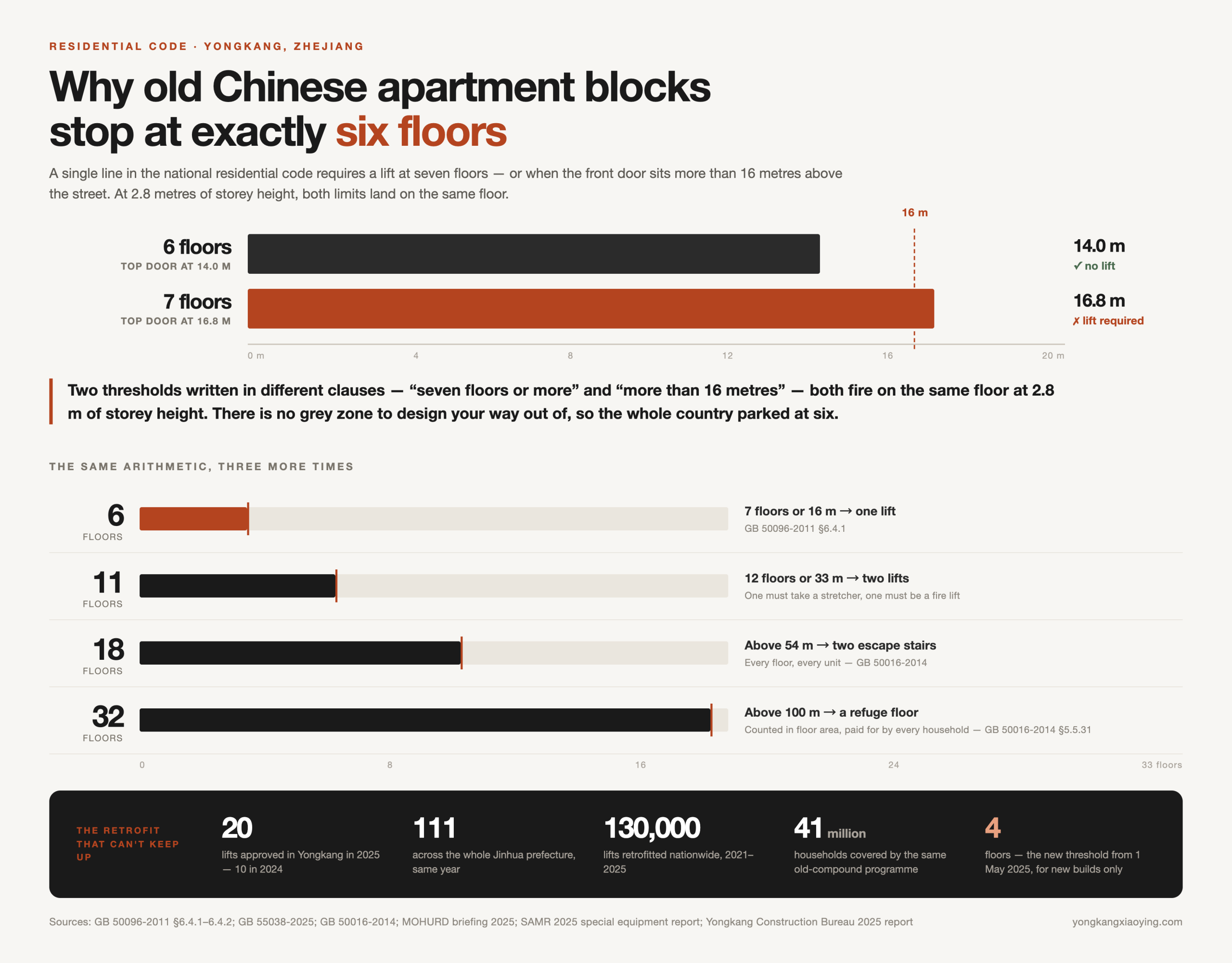
The rule lives in China’s residential design code, GB 50096-2011, section 6.4.1. Translated, it says a lift must be installed when either of two things is true: the building has seven floors or more, or the floor of the entrance to a home sits more than 16 metres above the outside ground.
Two triggers, and here is where it gets elegant. Chinese residential storey height in that era was about 2.8 metres. So:
- A six-floor building puts the sixth-floor front door at 14.0 metres above the street.
- A seven-floor building puts the seventh-floor front door at 16.8 metres.
Six floors clears both lines. Seven floors breaks both. The two thresholds were written independently, but at 2.8 metres of storey height they fire on exactly the same floor. There is no grey zone to argue in, no clever design that gets you an extra floor for free.
So developers stopped at six. Not because six is a nice number, but because six is the cheapest legal maximum.
What one extra floor would have cost
Retrofitting a lift into an existing six-floor block costs ¥250,000 to ¥400,000 today, and that is with the shaft bolted onto the outside and the building already standing. Put the lift inside at construction and you still pay for the shaft, the machine room, the car, the installation, the inspection, and then ¥4,000 to ¥5,000 a year forever to maintain it.
In Shanghai a lift is a rounding error. In a county town where the whole project margin is thin, the seventh floor is the difference between a viable building and one that never gets financing. Every developer in the country ran the same sum, and every developer in the country arrived at six.
What six floors feels like
The consequence is a specific kind of daily life, and anyone who has lived in one of these blocks knows the details.
Water pressure is weak at the top, because the roof tank is only so high above you. Anything heavy has to be carried — a bag of rice, a gas cylinder in the old days, a sofa, a fridge. When somebody dies, the stretcher goes down the stairs. When somebody moves in, the movers charge by the floor. Elderly residents who cannot manage the climb stop going out, which is exactly the problem the 2025 code change was written to fix.
The market prices it in. In these old blocks the sixth floor is generally the cheapest unit in the building: it is the hottest in summer, it is the most likely to leak, and it is the furthest from the ground. The first floor is the one families with an elderly parent want, even though it is dark and damp and everyone walks past the window. Nothing about this is mysterious once you know the lift was never there.
The same trick, three more times
Once you notice the six, you start noticing the other numbers, because the code does it again and again.
| Trigger | What the code demands | What gets built |
|---|---|---|
| 7 floors, or entrance above 16 m | At least one lift | 6 floors |
| 12 floors, or entrance above 33 m | Two lifts per building, one able to take a stretcher, one fire lift | 11 floors |
| Building above 54 m | Two separate escape stairs, every floor, every unit | 18 floors |
| Building above 100 m | A refuge floor | 32 floors |
The middle two rows come from the fire code, GB 50016-2014, which is a different document written by different people. It does not matter. The developer reads all of them at once and picks whichever floor count sits just below the cheapest threshold. That is why Chinese cities are full of 11-storey towers and 18-storey towers and almost no 12-storey or 19-storey ones. The skyline is not a design decision. It is a stack of cost cliffs, and the buildings are parked at the bottom of each one.
In May 2025, the first line moved
On 1 May 2025, a new mandatory standard took effect: the Residential Project Code, GB 55038-2025. It moved the lift threshold from seven floors to four. Any new home whose entrance is on the fourth floor or above — or more than nine metres above the ground — must now have at least one lift per building unit. The lift has to be big enough to take a stretcher. Storey height goes up to a minimum of three metres. Mobile signal has to reach inside the lift car.
The ministry’s own explanation is interesting, because it is not really about convenience. Japan and a number of European and American jurisdictions already require lifts at four to six floors, so the new figure brings China in line with practice elsewhere. The other reason is demographic: the country is ageing, and the people stuck on the fourth floor of a walk-up are the ones who cannot move.
From a construction point of view, the new rule is also an admission. It is far cheaper to build the lift in the first place than to bolt one onto a finished building later. The 2025 code exists partly because the country already knows how badly the retrofit route works.
You cannot retrofit a town
Here is what the retrofit route actually looks like, using my own city. Yongkang is a county-level city of roughly a million people in Zhejiang, known for hardware and kitchenware. According to the city construction bureau’s 2025 work report, Yongkang approved 20 retrofitted lifts across the entire year. In 2024 the figure was 10.
The whole of Jinhua, the prefecture that contains Yongkang and several other cities, added 111 in 2025.
Meanwhile Yongkang has 36 residential compounds built before 2000 that qualify for old-neighbourhood renovation, and since the programme began in 2012 it has completed 27 of them. The renovation work is real — pipes, roads, parking, waterproofing, wiring. What it does not usually include is a lift, because a lift is not infrastructure. A lift is a negotiation.
The negotiation
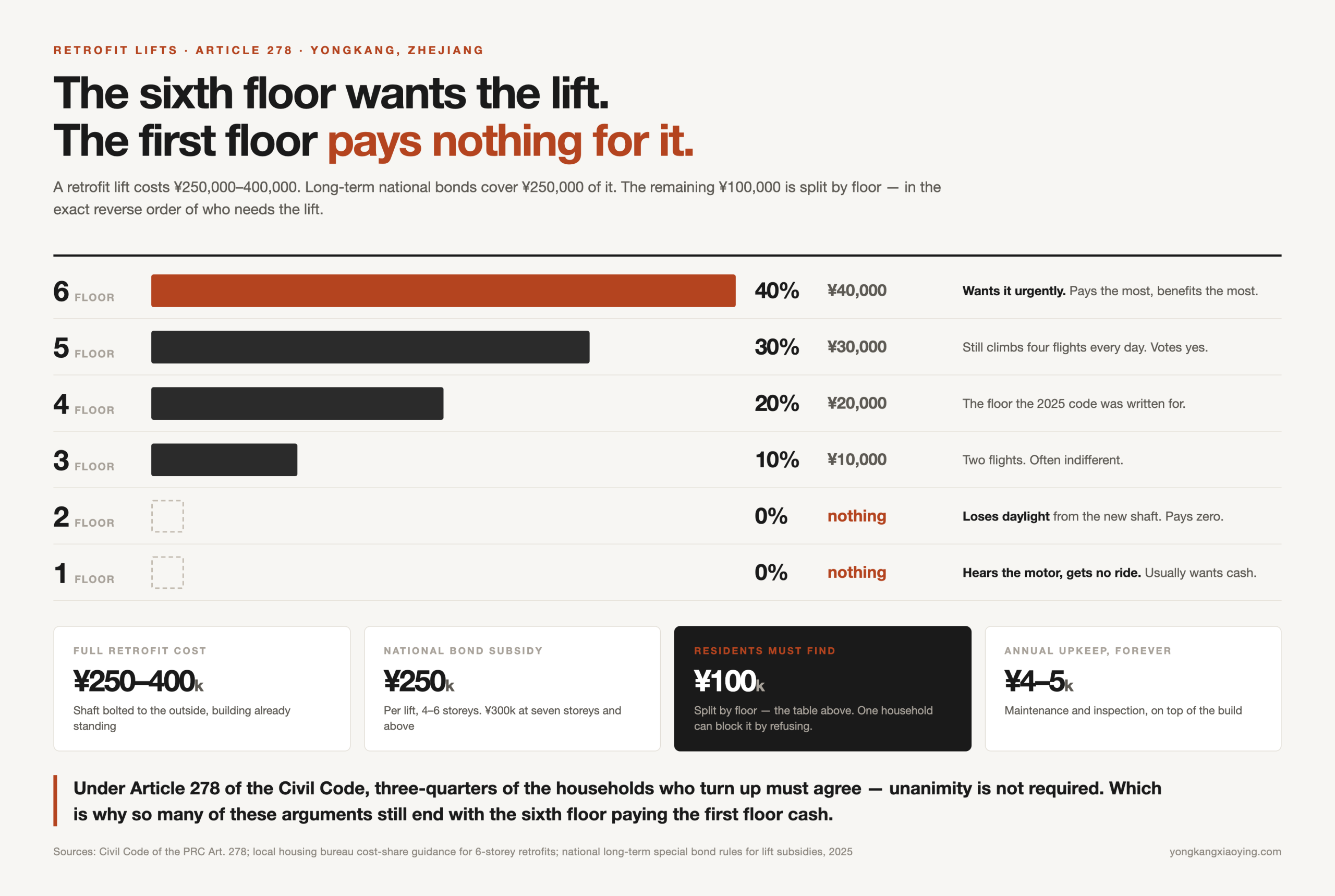
Retrofitting one lift means getting a whole stairwell of owner-occupiers to agree on money. The legal bar is set by Article 278 of the Civil Code: owners holding two-thirds of the floor area and two-thirds of the households have to turn up to vote, and three-quarters of those voting — by area and by headcount — have to say yes. Unanimity is not required, which was a deliberate change: the point was to stop one household blocking an entire building. In practice most disputes still end in compensation paid to the ground floor.
The money explains the argument. A typical retrofit runs ¥250,000 to ¥400,000. Long-term special national bonds now subsidise ¥250,000 per lift for four to six-storey buildings and ¥300,000 for seven storeys and above, leaving residents to find roughly ¥100,000 together. The recommended split for a six-floor building, from local housing bureau guidance:
| Floor | Share of the owners’ cost |
|---|---|
| 1st | 0% |
| 2nd | 0% |
| 3rd | 10% |
| 4th | 20% |
| 5th | 30% |
| 6th | 40% |
Read that table from the ground floor up and the politics becomes obvious. The household that pays 40% is the one that needs the lift most. The two households that pay nothing are the ones who lose light from the new shaft, hear the machinery, and get no benefit whatsoever. The sixth floor wants it urgently. The first floor would rather have the money.
Multiply that argument by every stairwell in every old compound in the country and you get the national picture.
The numbers that do not close
During the 14th Five-Year Plan, from 2021 to 2025, China renovated more than 240,000 old urban residential compounds, covering around 41 million households, and retrofitted 130,000 lifts.
One hundred and thirty thousand lifts, spread across 41 million households.
In the same period the country’s total lift stock reached 12.3 million units by the end of 2025 — more than half of all special equipment in China, and growing by roughly 900,000 a year, almost all of it in new buildings. New construction gets lifts at a rate the retrofit programme cannot approach. The old six-floor blocks are not being converted. They are being outlived.
What to look at when you visit
Two things, and both are visible from the street.
First, count the floors in the old neighbourhoods. You will find the six everywhere, and you will start to spot the 11s and the 18s in the newer parts of town with the same logic.
Second, look for the retrofit lifts. They are unmistakable: a slim glass or steel tower bolted to the north face of the stairwell, standing a metre or two off the wall, stopping at half-landings so that you still climb a short flight to reach your own door. There are twenty of them in my city this year. Against the number of six-floor blocks in town, that is close to nothing — and every one of them represents a stairwell where the argument was won.
A question for you
The six is a Chinese answer to a universal problem: how high do you build before the lift becomes mandatory? Britain has its own version — the walk-up flats that stop at four or five. American cities have the five-over-one, where the timber floors sit on a concrete podium because the code changes at that point. New York has its own cliff at six storeys.
So: what is the number where you live? Count the floors of the oldest apartment building in your town, and see whether it stops just short of something.
Sources: GB 50096-2011 Residential Design Code §6.4.1–6.4.2; GB 55038-2025 Residential Project Code, effective 1 May 2025; Ministry of Housing and Urban-Rural Development press briefing on the new code (2025); GB 50016-2014 Code for Fire Protection Design of Buildings; SAMR national special equipment safety report for 2025; Yongkang Construction Bureau 2025 work report; Jinhua Housing and Urban-Rural Development Bureau 2025 annual report; Civil Code of the PRC Article 278.
Related reading on this site: what it costs to put a private lift in a rural Chinese house, how long a Chinese lift is expected to last, and how air conditioners get installed on the outside of these buildings.
Pingback: Why a 40-Year-Old Tractor Still Runs on a Chinese County Road - Ying's County Town