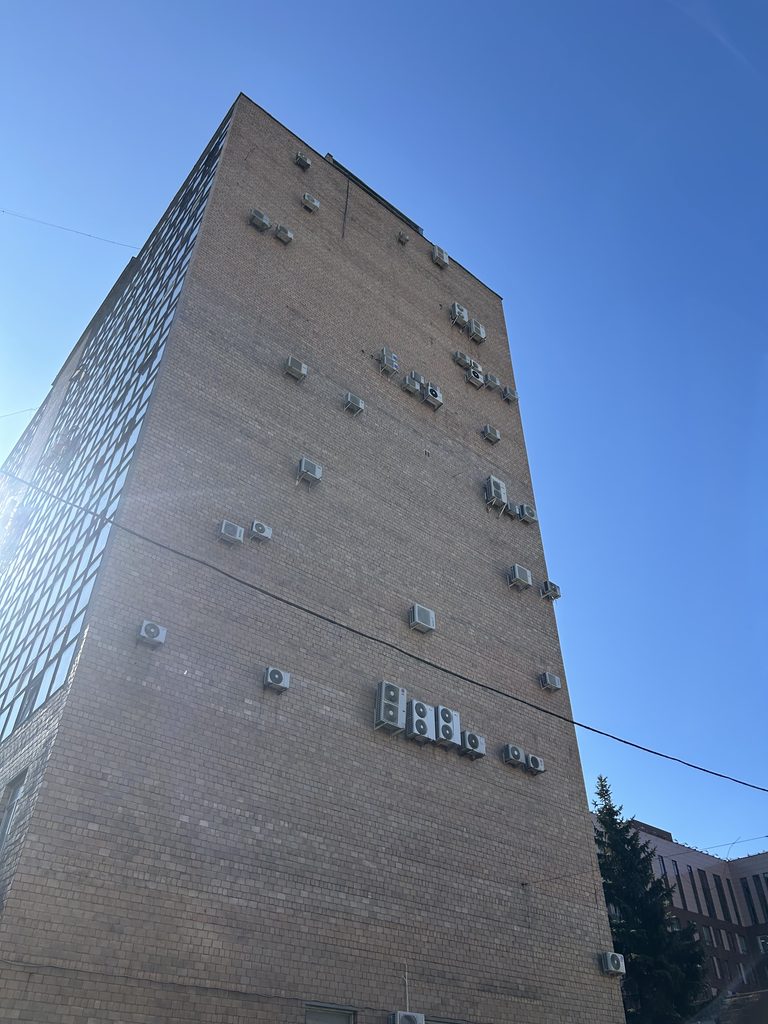
I took this photo on a business trip to Russia. The whole side of an apartment building, covered top to bottom in air conditioning units — a hundred of them, maybe more. No balconies on that side. No windows you could climb out of. And I remember standing there thinking: how did anyone get these things up there?
Short answer: there are four ways — rope access, lift trucks, cranes, and building-time installation. Which one was used here? Keep reading and you’ll know exactly what to look for.
Why Russian Apartment Blocks Are Covered in Air Conditioners
First, a bit of background, because this wall isn’t an accident.
A lot of older Russian apartment blocks were built in the Soviet era with central heating and zero air conditioning. There simply were no AC units to hang anywhere. Then came the 90s, summers got hotter, and everyone went out and bought a split-system AC — with exactly one place to put the outdoor unit: the outside wall.
So over twenty or thirty years, the wall fills up one unit at a time, apartment by apartment. Nobody planned it. It just grew, like a patchwork quilt made of compressors.
The 4 Ways AC Units Get Installed on Tall Buildings
1. Rope Access — the “Spider Man” Method
This is the most common way for occupied buildings. Workers rappel down from the roof on ropes, exactly like window cleaners, hanging side by side while they bolt each unit to the wall. It looks terrifying, but it’s fast, and it explains one thing you’ll notice in the photo: the units are lined up almost perfectly. That’s the signature of installers on ropes, lining each new unit up with the one below it.
2. Aerial Work Platforms (Bucket Trucks)
For the lower floors — say, the first three to five — a hydraulic lift truck is enough. A worker stands in the basket, installs the unit, moves the truck, repeats. Cheap and simple, but completely useless once the wall gets taller than the boom.
3. Cranes and Roof Hoists
When the units are too high for a truck and too heavy to carry on a rope, the crew uses a crane. For occupied buildings, that usually means a winch or hoist mounted on the roof: the unit is pulled straight up while a worker on a rope seat steadies it from outside. For brand-new buildings, a tower crane does the job before the scaffolding comes down.
4. Installation During Construction
The easiest time to install an outdoor unit is while the building is still being built. Workers stand on the scaffolding, mount the units in neat rows, done. That’s why modern commercial buildings in Russia often have their air conditioners pre-planned in tidy grid patterns — they were designed in, not hung on later.
So, How Was This Particular Wall Done?
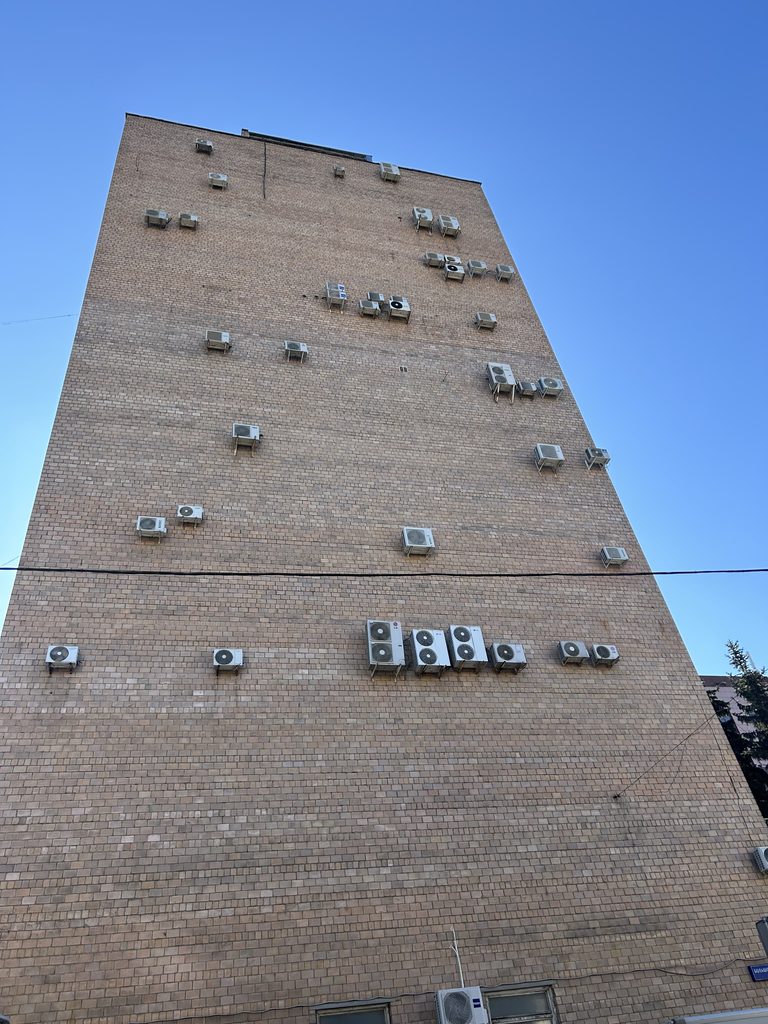
Looking at the photo again — an old residential block, fully occupied, with units on every floor — the answer is almost certainly rope access, with maybe a crane assist for the very top rows.
The proof is in the alignment. Perfect vertical lines, uniform spacing: that’s the fingerprint of installers hanging side by side on ropes, using the unit below as their guide.
FAQ: Air Conditioner Installation on High Buildings
How do they install AC units on high-rise buildings?
Four ways: rope access (most common for occupied buildings), aerial work platforms (lower floors), cranes or roof hoists (high and heavy units), and installation during construction (for new buildings).
Why are there so many air conditioners on Russian buildings?
Most older Russian apartment blocks were built with central heating and no AC. When summer heat arrived, residents installed split-system units themselves, and the only place for the outdoor unit was the outside wall — so the walls slowly filled up over decades.
Do Russian apartments have central air conditioning?
Almost never in older buildings. Soviet-era blocks have central heating but no central cooling; air conditioning is added per-apartment, which is exactly why you see so many outdoor units.
How much does it cost to install an outdoor AC unit on a high floor?
It varies a lot by country and building. Rope-access installation is the priciest option because of the labor and safety equipment involved; the higher and harder the access, the more you pay — sometimes several times the cost of a ground-floor install.
Over to You
If you’ve worked in HVAC or construction: have you done rope-access AC installation? Crane or bucket truck? And people from countries where AC spots are designed into the building from the start — does the idea of a wall covered in air conditioners look completely insane to you, or does every city have its own version of this?
I genuinely want to know how it’s done where you live.
— Ying