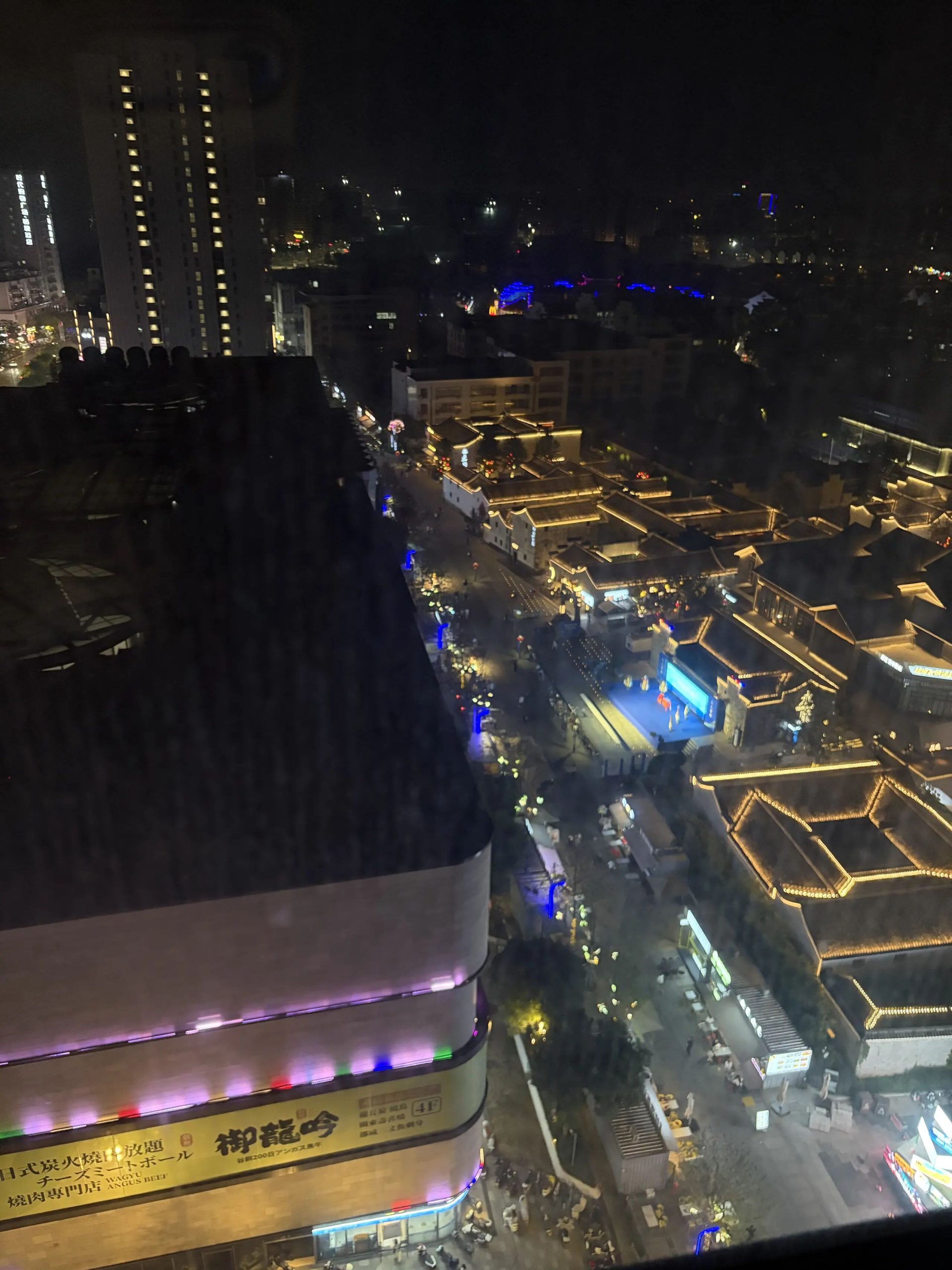
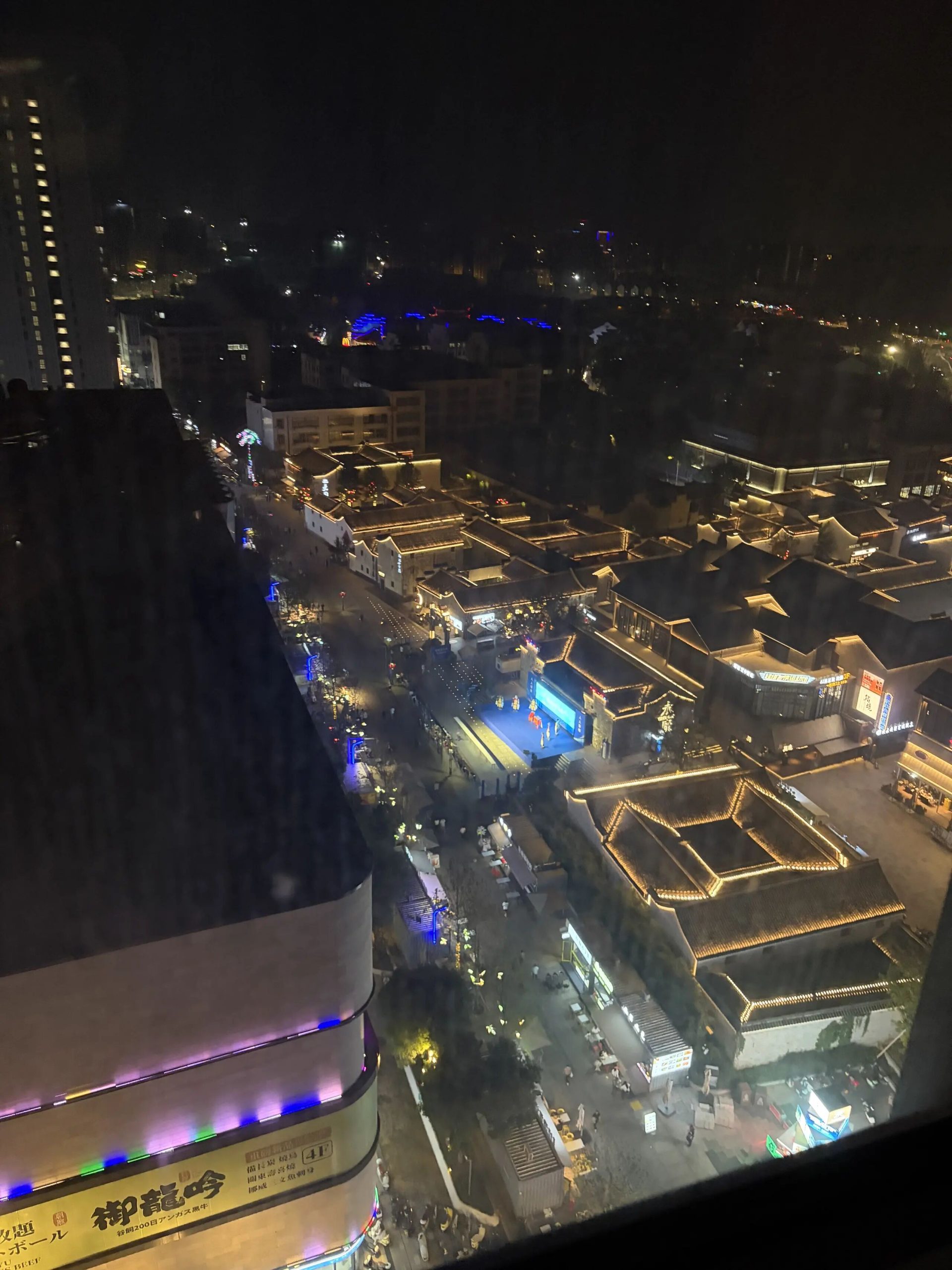
From a high floor of a residential tower beside Baolong Plaza, the old centre of Yongkang looks like two cities stacked on top of each other.
Directly below, there is a field of grey tiled roofs. Their eaves are traced with warm yellow LED strips, the kind that outline a building rather than light it. A narrow street runs between them, wide enough for a delivery cart. In the evening there are stalls, a lit stage, and a wash of blue light that seems to have no obvious purpose other than being blue.
Beyond that roofscape, maybe two hundred metres away, the city switches back to normal: thirty-storey apartment towers with lit windows, a shopping centre, an eight-lane road.
The first time I saw it, I assumed the rooftops were old. They are not all old. Some of them are seven years old. Some of them are eight hundred years old and were taken apart, numbered, and rebuilt exactly where they now stand.
I know this because I read the county’s own planning approval, and because the document turns out to be far more interesting than the street.
The question every Chinese county town now faces
Over the past decade, roughly every county in China has built something that looks like this. A pedestrian street with grey bricks, upturned eaves, a paifang gate at the entrance, red lanterns, a stall selling the same hand-made maltose candy that is sold in two thousand other counties.
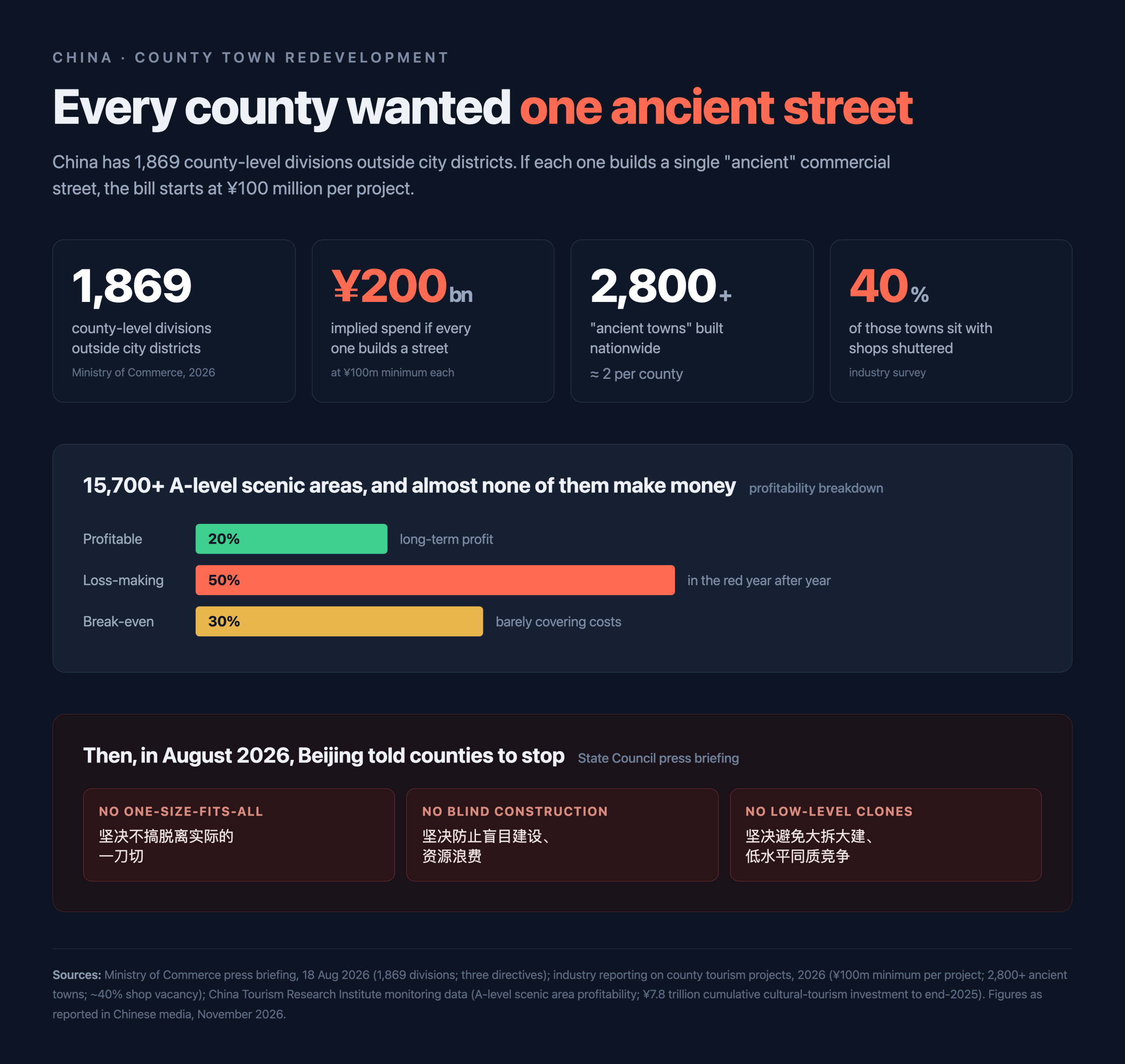
The numbers are not small. China has 1,869 county-level administrative divisions outside city districts, according to figures cited by the Ministry of Commerce. If every one of them builds a single “ancient” commercial street, and the floor for that kind of project is about ¥100 million, the implied national bill is close to ¥200 billion — some US$30 billion at current rates.
They did build. Industry reporting puts the number of newly built “ancient towns” at more than 2,800 nationwide. That is roughly two for every county in the country.
And they did not fill. Roughly 40% of those projects sit with their shopfronts shuttered.
This is not a niche problem. China has over 15,700 A-level scenic areas. Only about 20% make a long-term profit. About 50% lose money year after year. The rest break even and nothing more. Cumulative investment in cultural-tourism integration projects passed ¥7.8 trillion by the end of 2025.
The individual failures are spectacular. Dafu Ancient Town in Zhangjiajie cost ¥2 billion to build. Over four years it lost ¥1.08 billion. In the first half of 2024, its two flagship attractions sold 2,300 tickets in total — a daily average of under fifteen visitors. The only business in the whole complex that reliably made money was the car park.
Then, in August 2026, Beijing told them to stop
On 18 August 2026, at a State Council Information Office briefing, the Ministry of Commerce used the word “resolutely” three times in a row.
Resolutely no one-size-fits-all approach divorced from local reality. Resolutely no blind construction and wasted resources. Resolutely no mass demolition and low-level homogeneous competition.
Read in English, that is bureaucratic caution. Read in the original, it is closer to a stop-work order. 千县一面 — “a thousand counties, one face” — is the phrase officials now use to describe what the last decade produced, and they are not saying it as a compliment.
The ministry also set out what counties should be doing instead: renovate rather than demolish, classify by population and economic base rather than copy a template, and if you are a small county with a shrinking population, sort out your logistics and your market before you sort out your tourism brand.
That was the national mood when I went looking for the file behind the street below my window.
So I pulled the planning approval
Chinese county governments publish a surprising amount of this material. Yongkang’s Development and Reform Bureau issued approval 永发改审批〔2022〕321号 for the “Jiefang Street distinctive cultural block — new construction and partial historic building restoration” project. It is a technical document about floor areas and structural categories, and it answers the question that no tourism brochure will.
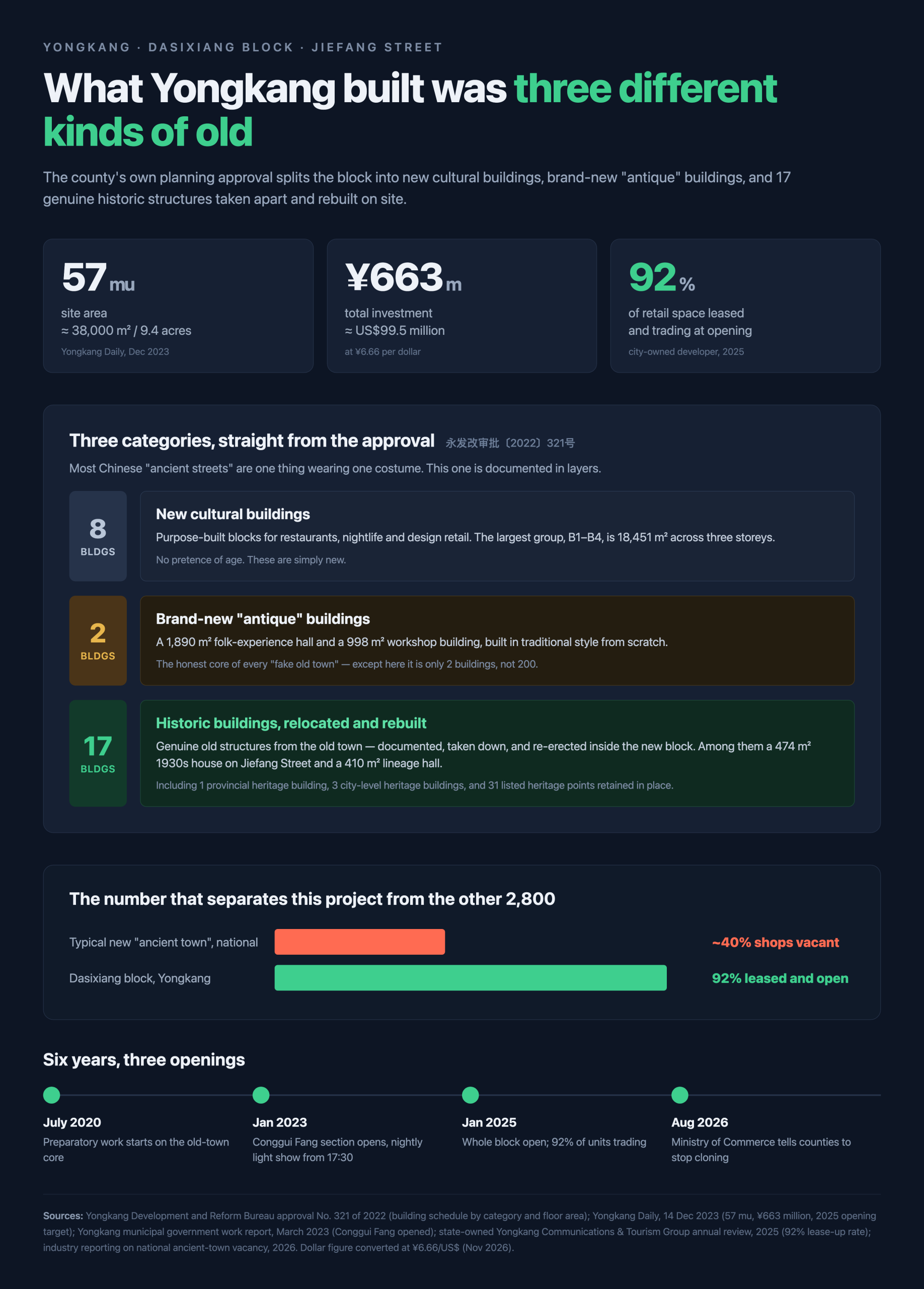
The site is in the old city centre, west of Jiefang Street, bounded on the east by the service road behind Baolong Plaza. Total land area is about 57 mu, roughly 38,000 square metres or 9.4 acres. Total investment: approximately ¥663 million, or about US$99.5 million.
But the interesting part is that the approval splits the buildings into three categories, and those three categories are not the same thing wearing the same costume.
Eight new cultural buildings. Purpose-built blocks for restaurants, nightlife, and design retail. The largest group, B1 through B4, is 18,451 square metres across three storeys. There is no pretence of age here. They are simply new buildings, and the document says so.
Two brand-new “antique” buildings. A 1,890-square-metre folk-experience hall and a 998-square-metre workshop and study centre, built in traditional style from scratch. This is the honest core of the “fake ancient town” genre — except that here it is two buildings out of twenty-seven, not the entire street.
Seventeen historic buildings, relocated and rebuilt. Genuine old structures from the surrounding old town, documented, taken down, and re-erected inside the new block. Among them: a 474-square-metre Western-style house on Jiefang Street, a 410-square-metre lineage hall from Jiankang Lane, and a 94-square-metre shopfront.
Seventeen buildings that were taken apart and put back
I want to be careful about what “relocated” means here, because it is the kind of word that can cover a lot.
In a Chinese old-town redevelopment, a 迁建 (qiānjiàn) building is surveyed, drawn, and dismantled. Its timber frame is marked piece by piece, the tiles and carved brackets are catalogued, and the whole assembly is rebuilt on a new site, typically a few hundred metres away, using as much original material as survives. It is not a replica. It is also not untouched.
Whether you find that acceptable depends on what you think an old building’s value actually is — the timber, or the ground it stands on. A preservationist will tell you that a house moved is a house damaged. A county that has already watched three of these houses collapse from rot will tell you that a house moved is a house that still exists.
Yongkang’s own numbers lean towards the second position. The block retains one provincial-level heritage building, three city-level heritage buildings, and 31 listed heritage points — some in place, some relocated. The old structures that were not moved were given new programmes rather than left as exhibits: Xu Gonglu’s former residence became the Yongkang municipal archive; Xu Pinhong’s house is now the Dasixiang contemporary art museum; Wang Jinyao’s house holds a scale model of the old walled city and functions as a memory hall.
That last detail is the one I keep coming back to. A fake ancient street sells you a fantasy of the past. A city memory hall, staffed and open, tells you what actually happened to the place.
Why this one did not empty out
The county-owned developer that runs the block published its annual review for 2025. The Dasixiang cultural block had opened fully, and the lease-up and trading rate had passed 92%.
Set that against the national figure of roughly 40% vacancy and the gap is the whole story.
Some of that gap is easy to explain and does not transfer. Yongkang is not a poor county. It is the hardware capital of China — door locks, power tools, kitchenware, all-terrain vehicles — with a population of about 620,000 and a manufacturing base that produces genuine disposable income. A 6.63-hundred-million-yuan retail project in Yongkang is not the same risk as the same project in a county losing a third of its young people to Hangzhou.
But part of the gap is a design choice, and this part does transfer.
The block is not a walled attraction with a ticket gate. It sits on the street grid of the old city, open on all sides, and people walk through it on the way to somewhere else. It has a bookshop — Zhongshuge, the chain known for its mirrored interiors — which is a real reason to go indoors rather than a photo opportunity. It has restaurants that local people actually eat at. The 92% is not a measure of how many souvenir stalls were installed; it is a measure of how many businesses found a commercial reason to be there.
Compare that with the standard model: build the street, move the old residents out, set the rents at five times the old level, watch the long-standing shops — the bun stall, the shoe repair, the hardware store, the seed merchant — fail to afford it and leave, then fill the units with chains that last eight months.
The grid they were trying to restore
There is a detail that makes the Yongkang project harder to dismiss as pure invention.
The old walled town of Yongkang had a documented layout: 二街九巷十六坊 — two streets, nine lanes, sixteen wards. The two streets were Shangjie and Xiajie, today’s Jiefang Street and Shengli Street. The lanes had names like Wuyi Lane, Taohua Lane, Dasixiang. The wards were named for exam success and imperial favour: Zhuangyuan Ward, Beizhen Ward, Ying’en Ward.
The new block is laid out as 三街九巷十二屏 — three streets, nine lanes, twelve screens. The street names and the lane pattern follow the historic survey. The “screens” are new, and they are decorative. But the underlying circulation — where you can walk, which corner turns into which — is not invented.
Dasixiang itself is named for a man. Wang Chong, a Yongkang native who passed the imperial examination in 1528 and went on to command three provinces’ worth of troops against the Mongols, was granted a ceremonial archway in his home town. The lane beside it took his title, Grand Marshal, and over four centuries the official name wore down into the colloquial one. That etymology is now a street sign.
The light show runs every night, and that is the point
On 3 January 2023, the first section of the block — Conggui Fang — opened with a light show called “Butterfly Dream”. It has run every night since, from 17:30 to 21:00, free.
A nightly free light show is, on its face, the most clichéd thing a Chinese commercial district can do. It is also the cheapest possible way to make an open-air street usable after dark in winter, when the temperature drops to five degrees and nobody lingers in an unlit alley. The lights are not there to attract tourists from other provinces. They are there so that the people who already live in the surrounding blocks have a reason to walk through at eight in the evening.
That distinction — a district built for residents that happens to be photogenic, versus a district built for photographs that nobody lives near — is roughly the difference between a 92% lease-up and a car park that is the only profitable part of a ¥2 billion development.
Not everything here worked
I do not want to write a success story, because that is not what I saw.
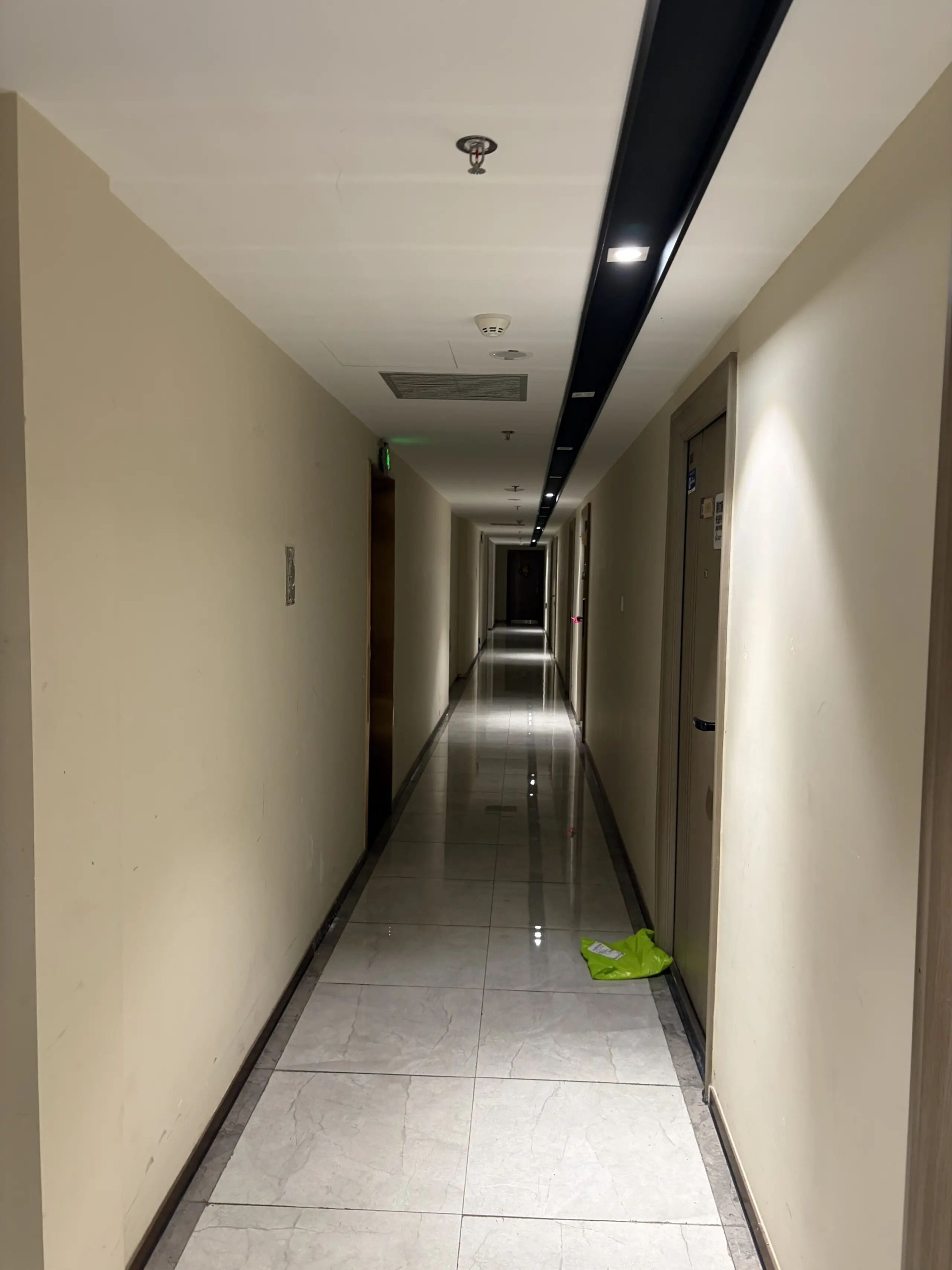
The corridors inside the residential tower above the block, the part that was converted to small offices and studios, are mostly empty. On a weekday afternoon the hallway I walked down had one green plastic bag in it and nothing else. The commercial logic of “apartments above a heritage district” has not arrived yet. It may not.
And the shops in the block itself are not all the ones the planning documents imagined. There is a Japanese-style charcoal grill on the fourth floor of the tower, with 食べ放題 in white lettering on the window, which is not exactly the local heritage experience. Some units are still in fit-out two years after the main opening.
Vacancy, in other words, exists here too. It is just not the majority condition. The difference between 40% empty and 8% empty is not a moral difference. It is the difference between a project that had a reason to exist and one that had a budget.
What a county should actually copy
The Ministry of Commerce’s three directives are easy to quote and hard to operationalise, so here is the version I would hand to a county mayor, written from the top floor of a tower on Baolong Plaza.
Do not demolish the street to build a street. The economic damage of a redevelopment is not the construction cost. It is the loss of the low-rent commercial floor — the bun shop, the shoe repair, the seed merchant — that made the old street work in the first place. Once the rents triple, that floor does not come back, and the county has traded a functioning market for a photograph.
Move the buildings if you have to, but document what you moved. The difference between a relocated historic house and a pastiche is the file. Yongkang’s file lists seventeen structures with their floor areas. Any county can produce that document. Most do not, because most are not moving anything real.
Build for the people who live within a kilometre, not for the people who will arrive by coach. A free nightly light show for local residents is worth more than a ticketed attraction for a tour group that eats dinner elsewhere.
And accept the possibility that the answer is nothing. The ministry’s own framing allows for this: if you are a small county with a shrinking population, fixing your logistics and your market is the higher-value move. Not every county needs a heritage district. Some need a bus route that runs after seven in the evening.
China is going to keep building these streets. The 2,800 already exist, the ¥7.8 trillion is already spent, and the demolition crews have not gone home. But the era of the template is closing, and the counties that survive it will be the ones that can answer a simple question: what is actually here?
In Yongkang, the answer turned out to be seventeen buildings and a lane named after a Ming dynasty general. That is a thinner story than a two-billion-yuan fantasy. It is also the only one that will still be true in fifty years.
All building categories, floor areas, and heritage counts in this article come from Yongkang Development and Reform Bureau approval No. 321 of 2022 and from the Yongkang municipal government’s published work reports. The 57-mu site area and ¥663 million investment figure were reported by Yongkang Daily on 14 December 2023. The 92% lease-up rate comes from the 2025 annual review of the city-owned Yongkang Communications and Tourism Group. National figures — 1,869 county-level divisions, 2,800+ ancient towns, ~40% vacancy, 20% scenic-area profitability, ¥7.8 trillion cumulative investment — come from Ministry of Commerce statements of 18 August 2026 and Chinese industry reporting published in 2026. Dollar conversions at ¥6.66/US$, November 2026.
Pingback: China Regulates Wok Smoke. America Only Regulates the Fire It Causes. - Ying's County Town