At a banquet in one of the new hotels in my town, I went looking for air.
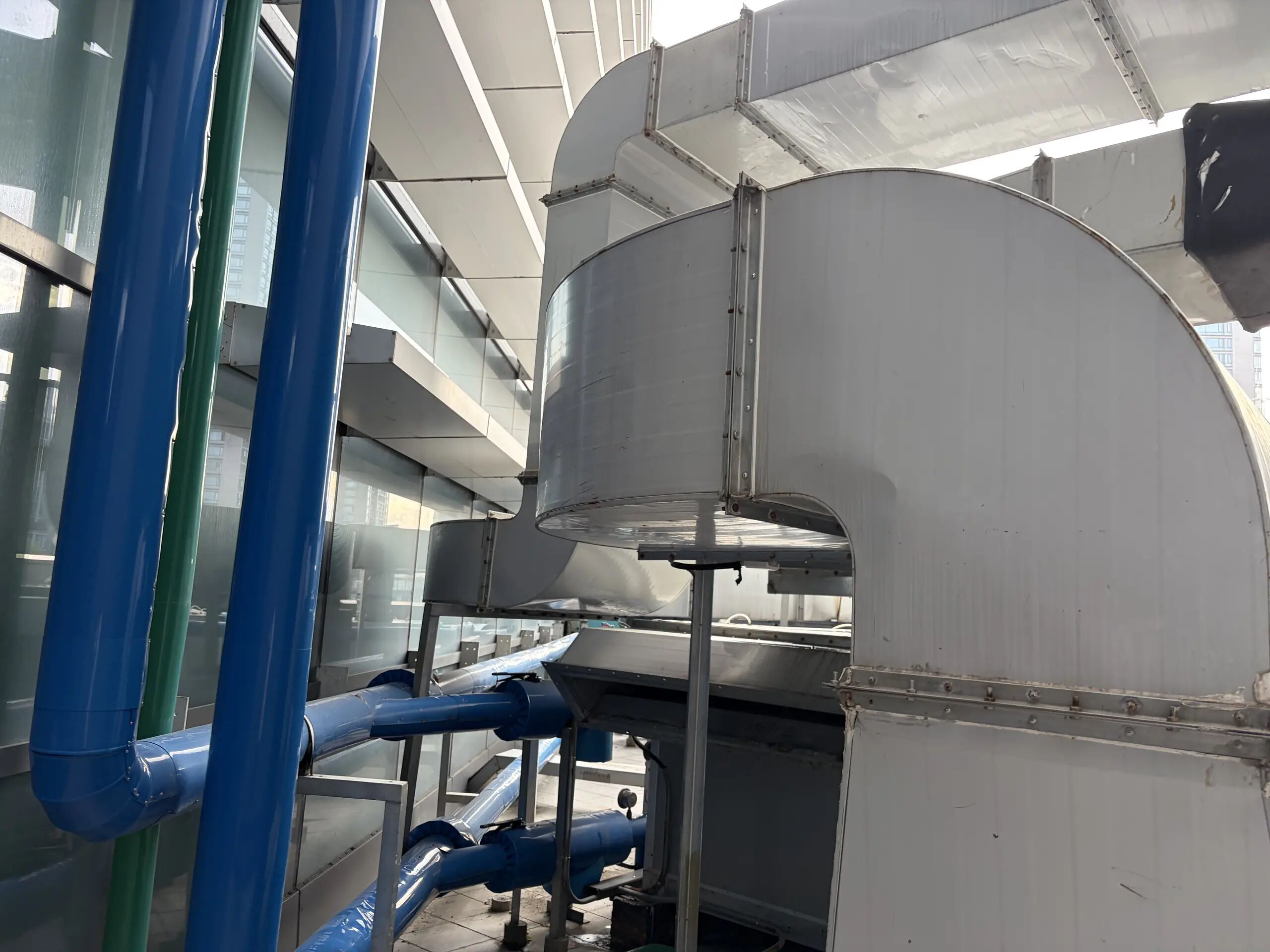
The banquet hall was on a lower floor and the corridor outside it smelled of hot oil, so I followed a fire door out onto a service terrace. What I found there was a machine I could not name.
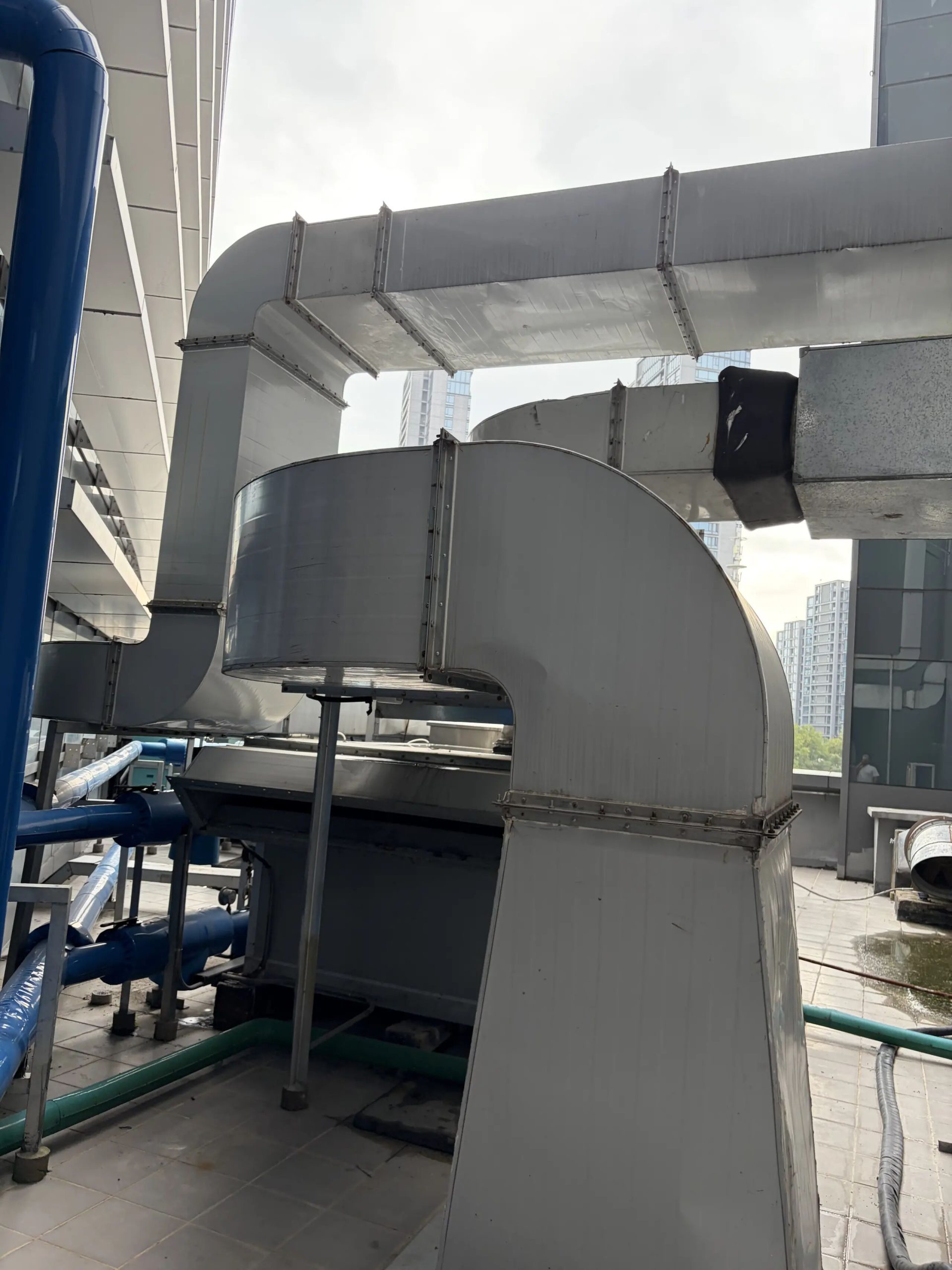
Two fat pipes, wrapped in glossy blue, running vertically up the face of the glass curtain wall, then bending ninety degrees at hip height and continuing horizontally into the dark. A thin green pipe shadowing them the whole way. And beside it, in pale galvanised steel, a system of rectangular ducts as thick as a man’s chest, bolted at every joint, sitting on steel legs, with an elbow the size of a small car sweeping up and away.
It was industrial. It was ugly. It was, I found out later, the most legible piece of environmental enforcement in my city, and it is doing a job that most American cities have decided not to do at all.
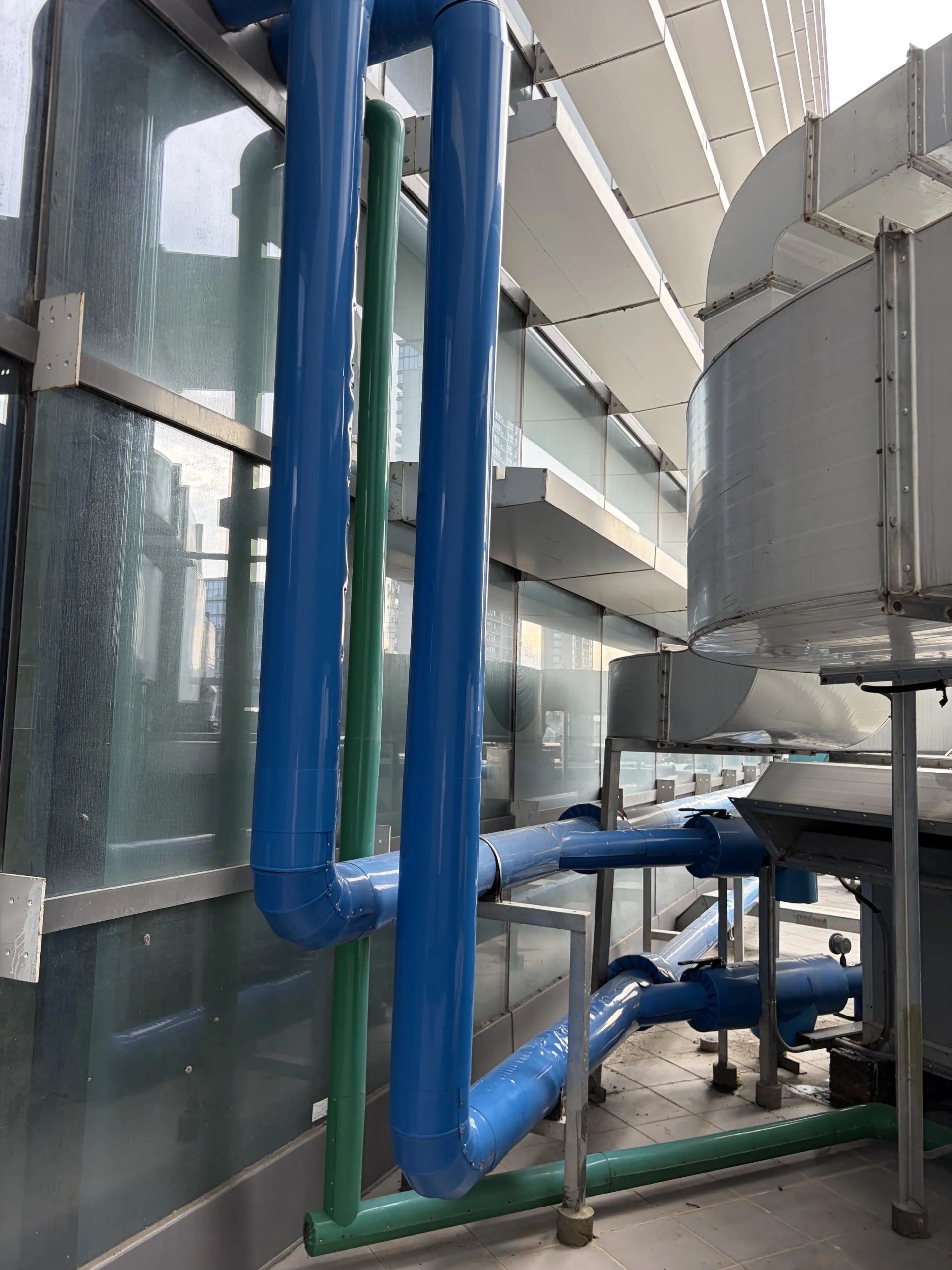
I took three photographs and posted them to my Chinese WeChat account with a caption that was 96 characters long and one hashtag: #hotelfacilities. What is this stuff for? Ordinary households don’t have any of this. Nobody answered.
So I went and found out.
The short answer, before the long one
The pale steel boxes are not chimneys. They are kitchen exhaust ducts — the pipework that carries cooking smoke off a commercial range, through a filter, and out above the roof. The blue pipes are insulated chilled-water lines for the building’s air conditioning; the blue is just a PVC jacket over the insulation, a contractor’s habit rather than a rule. The green pipe is water, and that one is a rule: China’s national pipeline colour code, GB 7231-2003, assigns water the colour 艳绿, bright green.
Three systems, three colours, one terrace. But the interesting part is what is missing from the picture.
There is no visible smoke. There is no smell of cooking out on that terrace, even standing directly beside the discharge. That is not an accident of the wind. It is the result of a legal instrument that has no equivalent in the United States: a numeric limit on how much cooking smoke a restaurant is allowed to emit.
China caps it at 2.0 milligrams per cubic metre. American law caps nothing.
What the regulation actually says
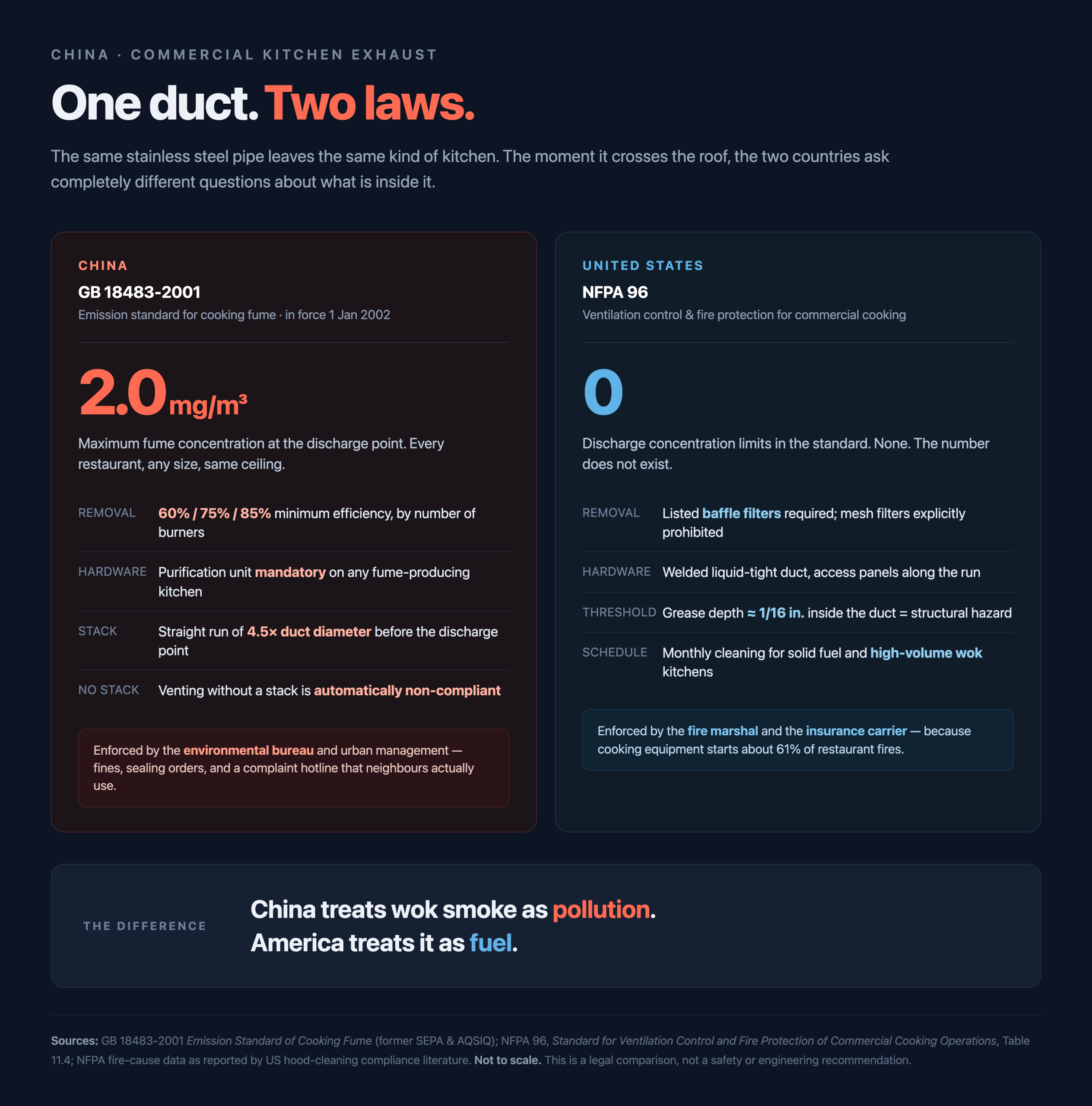
The standard is GB 18483-2001, the Emission Standard of Cooking Fume, issued by the former State Environmental Protection Administration and the General Administration of Quality Supervision, and in force since 1 January 2002. It is short, technical, and unusually specific.
| Requirement | Value |
|---|---|
| Maximum fume concentration at the discharge point | 2.0 mg/m³ (all sizes) |
| Minimum removal efficiency, small establishment (1–3 burners) | 60% |
| Minimum removal efficiency, medium (3–6 burners) | 75% |
| Minimum removal efficiency, large (6+ burners) | 85% |
| Straight run required before the discharge point | 4.5 × duct diameter |
| Unorganised discharge (venting without a stack) | Treated as non-compliant |
Three of those lines deserve a second look.
The 2.0 mg/m³ figure applies to every restaurant in the country regardless of size. A six-burner hotel kitchen and a two-burner noodle shop on my street answer to the same ceiling. The scale only changes the equipment — the smaller the operation, the more the standard lets raw cooking do the work, because a small shop has to strip 60% of the oil out of its exhaust and a large kitchen has to strip 85%.
The 4.5× diameter rule is the detail that tells you a combustion engineer wrote this. A fume sampling probe cannot sit near an elbow, because the air is still tumbling there and the reading will be nonsense. The standard forces a straight, settled length of pipe before the sample point so that the number on the test report means something. That is a document written by people who intended to measure, not to gesture.
And the last line is the one that has teeth in practice: venting without a proper stack is automatically non-compliant. You cannot argue that your unmeasured discharge is fine. The absence of a duct is itself the violation.
Why China bothered
Because Chinese cooking is, in air-quality terms, an industrial process performed at domestic scale.
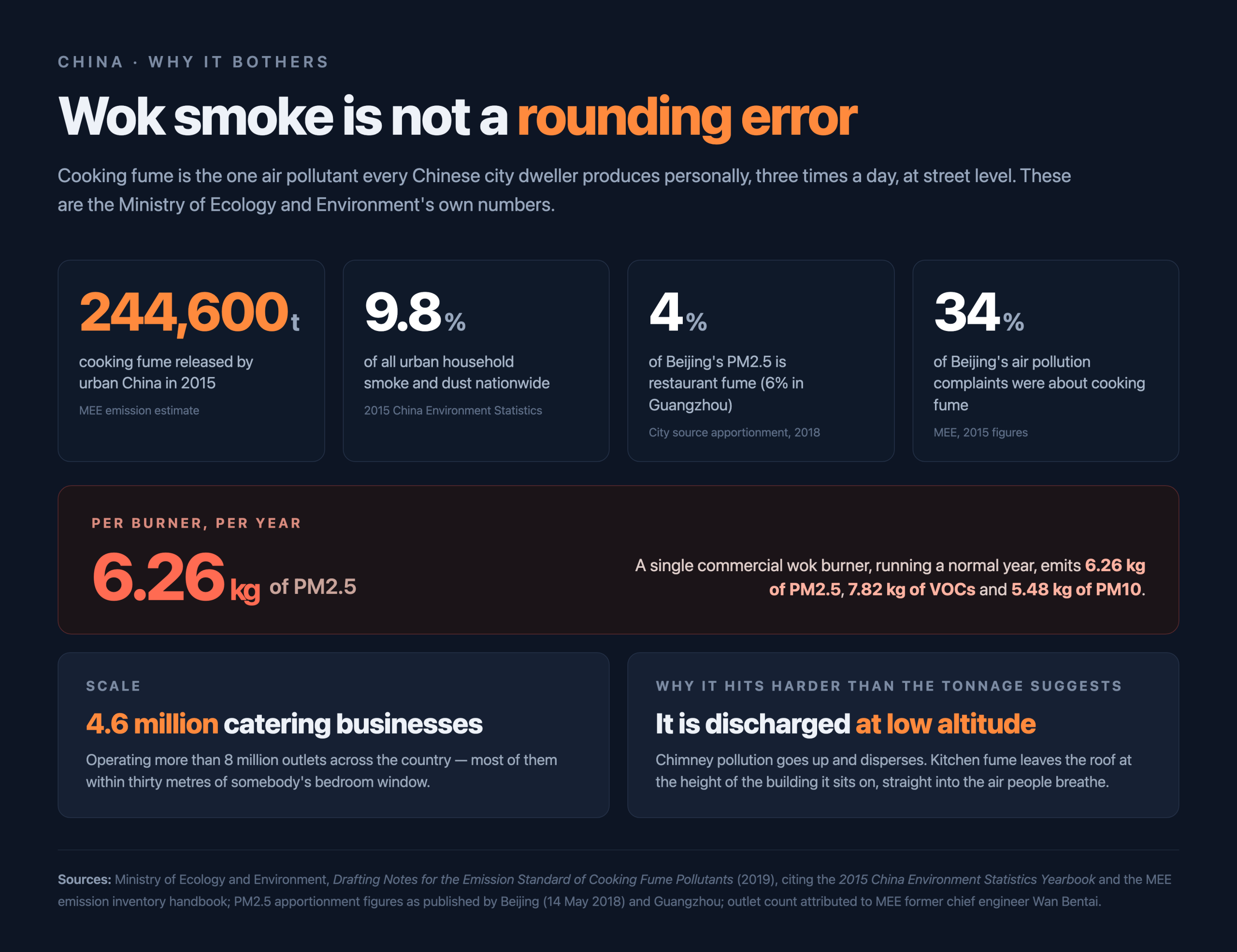
A commercial wok burner runs somewhere between 65,000 and 130,000 BTU — several times the heat output of a standard Western range, hot enough that cooking oil aerosolises almost the instant it hits the pan. The aerosol is not steam. It is liquid oil droplets, solid particulate, and volatile organic compounds, and it is almost entirely fine particulate: according to China’s Ministry of Ecology and Environment, more than 80% of the mass of cooking fume particulate is PM2.5, and 50–85% of that is PM1.
The ministry’s own numbers, from its 2019 drafting notes for a revised standard, are the ones I keep coming back to:
– A single commercial burner emits roughly 6.26 kg of PM2.5 and 7.82 kg of VOCs per year, based on the ministry’s emission inventory handbook. – In 2015, urban China released about 244,600 tonnes of cooking fume, equal to about 9.8% of all smoke and dust from urban household sources nationwide. – Cooking fume accounted for roughly 4% of PM2.5 in Beijing and about 6% in Guangzhou, per the cities’ own source apportionment studies. – In 2015, 34% of all air pollution complaints in Beijing were about restaurant cooking fume. In July 2019 it was still 28.1% of air-related reports. Ningbo logged 1,867 such complaints in 2017 and 1,916 in 2018.
There are more than 4.6 million catering businesses in China operating over 8 million outlets. And as the ministry’s former chief engineer Wan Bentai put it, cooking fume has two properties that make it worse than its tonnage suggests: it is widely distributed, and it is discharged at low altitude — straight into the air that people on the ground are breathing.
That is the whole justification. Not climate. Not the ozone layer. The smell outside your window, and the fine particles that come with it.
Now the American paragraph
The United States regulates commercial kitchen exhaust heavily. It just regulates something else.
NFPA 96, Standard for Ventilation Control and Fire Protection of Commercial Cooking Operations, is the governing document, adopted into state and local fire codes across the country. It is a serious standard. It specifies hood construction, requires listed baffle filters (mesh filters are explicitly prohibited), mandates access panels at intervals along the duct, requires welded liquid-tight joints, and sets cleaning frequencies by cooking load: monthly for solid-fuel cooking and high-volume operations that include wok cooking, quarterly or semi-annually for moderate loads.
It also sets a grease-depth threshold inside the duct — around 1/16 inch, about 1.6 millimetres — above which the system is a structural hazard regardless of when it was last cleaned. NFPA data attributes about 61% of restaurant fires to cooking equipment, and grease-clogged ducts are what turn a pan fire into a building fire.
All of that is about one thing: whether the oil inside the pipe will catch fire.
NFPA 96 does not contain a discharge concentration limit. It does not require an electrostatic precipitator. It does not require an operator to prove that the air leaving the roof meets a particulate number, because in the American framework, the cooking fume that successfully exits the building is not a regulated air pollutant at all. It is a nuisance at most — a matter for a local odour ordinance if a neighbour complains loudly enough.
The two systems are answering different questions.
| China (GB 18483-2001) | United States (NFPA 96) | |
|---|---|---|
| Legal basis | Air pollution control | Fire prevention |
| Question asked | How much fume leaves the roof? | Will the grease in the duct burn? |
| Numeric limit | 2.0 mg/m³ at discharge | Grease depth ~1/16 in. inside duct |
| Required hardware | Fume purification unit (60–85% removal) | Listed baffle filters, welded duct |
| Enforcement | Environmental bureau / urban management | Fire marshal, insurer |
| Who pays attention | Neighbours, inspectors, complaint hotline | Insurance carrier |
This is not a story about one country being smarter. It is a story about two legal lineages. America’s commercial kitchen code grew out of fire insurance and the model fire codes of the early twentieth century, and it still behaves like an insurance document. China’s grew out of the 1987 Air Pollution Prevention and Control Law and the “blue sky” campaigns of the 2010s, and it behaves like an emissions permit.
But the practical consequence is visible on any rooftop. In an American city, a restaurant’s cooking smoke exits through a fan on the roof and disperses. In a Chinese city, it goes through a box first, and somebody can be fined if the box is switched off.
The part that is genuinely, specifically Chinese
Buying the box is the easy half. The hard half is that a purification unit only works while it is switched on and clean, and a small restaurant owner has every incentive to switch it off — the unit draws power, and cleaning it costs money and closes the kitchen for a few hours.
This is where my city gets interesting.
In 2019, Yongkang’s comprehensive administrative enforcement bureau inspected 3,123 restaurants. Of those, 2,335 were required to install fume purification equipment, and the installation rate reached essentially 100%. Over the first five months of that year the bureau opened 103 cases and collected 533,000 yuan in fines; it cleared 240 coal-burning street stoves; and it used its power to seal cooking ranges — physically shutting down the equipment — in six cases where owners refused to comply. Yongkang later became the first city in Jinhua prefecture to issue a five-figure fine for burning honeycomb coal in a restaurant kitchen.
By 2024 the same bureau’s development-zone squad had moved to a “one shop, one file” model: 395 food businesses inspected, 285 formal compliance notices issued, 8 restaurants given deadlines to install equipment they had skipped.
By 2025 the language had changed from installation to operation. The city now runs what it calls day patrols plus night checks, specifically targeting two behaviours with a lovely, bureaucratic bluntness: installed but not used, and used but not washed.
And in neighbouring Jinhua’s development zone, the whole thing was closed into a loop. Two dense commercial streets with nearly 200 restaurants were generating 24 cooking-fume complaints in a single year. The district then:
– required new restaurants to have their purification equipment pre-approved by four agencies jointly before opening, – moved all 68 remaining non-compliant shops onto compliant equipment, reaching a 100% installation rate, – put the cleaning log on a WeChat mini-program, where operators upload their own maintenance records — the reporting rate has run at 100% for four consecutive months, – installed third-party online monitoring on the equipment, so the backend knows in real time whether the unit is running, – and ran joint street-level patrols five times a week.
The complaint count for the first nine months of the year fell to three.
Read that again. Twenty-four complaints to three, in one year, on a street with 200 restaurants. A resident told the local paper she could finally open her windows and hang washing out again. That is the entire return on this apparatus: one woman’s window.
What it costs, and who pays for it
I want to be honest about the bill, because this kind of system is not free and the people paying it are not large corporations.
A commercial electrostatic fume purifier for a mid-sized restaurant runs into the tens of thousands of yuan installed. It consumes electricity continuously while the kitchen is working. It has to be physically cleaned — the collection plates come out and get washed — on a schedule that a busy wok kitchen will need to keep to monthly, sometimes more often. A restaurant that skips it faces a fine, a sealing order, or a complaint from the flats above, which in a Chinese county town are usually about thirty metres away.
Small operators complain about this constantly. Some of them cheat, which is why the night patrols exist. There is a whole genre of local enforcement reporting about shops that run the purifier only during inspections, or that cut a bypass into the duct.
But set that against the alternative. The alternative is what my hotel terrace looks like without the box: a wall of steel ducting whose entire purpose is to throw the problem into the sky above someone else’s building.
What the ugly pipes are actually for
Standing on that terrace, I had assumed I was looking at leftovers — the back-of-house plumbing that nobody designs, just accumulates. A fire door, a wet tiled floor, some pipes, the weather.
It is the opposite. Every joint in that ducting is bolted because a standard says it must be sealed. The straight run before the discharge exists because a sampling probe has to be able to sit there. The purification box is inside that steelwork, and the reason the terrace smells of nothing is that it is switched on, and that somebody in an office has a record of the last time it was washed.
The blue pipes and the green pipe are just air conditioning and water. Ordinary building services, dressed in a colour code from 2003. But they are standing next to the part of the building that the state actually watches.
In my town, a restaurant’s smoke has an owner. It has a number attached to it, a limit, a machine, a maintenance log on a phone, and a fine schedule. In most American cities, it has a fan.
If you want to know what happens when the fire the American system is worried about actually takes hold in an old Chinese house, I wrote about that here: [Why Do Old Chinese Farmhouses Burn Down to Four Walls?](https://yongkangxiaoying.com/why-old-chinese-farmhouses-burn-to-four-walls/). And for what a county town does with a spare ¥663 million, see [China Built 2,800 Fake Ancient Towns. Mine Rebuilt 17 Real Ones.](https://yongkangxiaoying.com/fake-ancient-towns-china-yongkang/)
FAQ
Are those stainless steel pipes on Chinese rooftops chimneys? No. A chimney carries combustion exhaust from a boiler or furnace. These are kitchen exhaust ducts, carrying cooking fume from a commercial range through a purification unit and out above the roof. They look industrial because they are sized for industrial volumes of vapour — a commercial wok burner produces several times the fume of a domestic stove.
Why do Chinese restaurants have so much pipework on the roof? Because Chinese regulation requires three separate things a Western kitchen usually does not: a capture hood over every cooking station, a purification unit that removes 60–85% of the oil from the exhaust, and a discharge stack that places the outlet above the building and away from neighbours. Each of those adds steelwork.
What are the blue and green pipes? The blue pipes are chilled or hot water lines for the building’s air conditioning, wrapped in insulation and a blue PVC jacket — the blue is a contractor convention, not a national standard. The green pipe is a water line. Under China’s pipeline colour code GB 7231-2003, water is 艳绿, bright green, and that one is the standard.
Are Chinese restaurants legally required to install fume purifiers? Yes. GB 18483-2001 requires any food business that produces cooking fume to install purification equipment and keep it running during operation, with minimum removal efficiencies of 60%, 75% or 85% depending on the number of burners. Venting without a proper stack is treated as automatically exceeding the limit.
Does the United States have an equivalent limit? Not on emissions. NFPA 96 governs commercial kitchen exhaust as a fire standard — hood design, grease filters, duct access, cleaning frequency and grease depth inside the duct. It sets no limit on the concentration of particulate leaving the building, and cooking fume is generally not a regulated air pollutant at the federal level.
How often does the purification equipment have to be cleaned? There is no single national interval; it depends on cooking load and the equipment type, and local enforcement in Zhejiang now pushes operators to log each cleaning. In practice a busy wok kitchen needs it monthly. Jinhua’s development zone tracks this through a WeChat mini-program where operators upload their own maintenance records.
How much does this cost a small restaurant? Equipment plus installation for a mid-sized shop runs into the tens of thousands of yuan, with ongoing electricity and cleaning costs on top. It is a real burden on thin-margin businesses, and enforcement agencies in Zhejiang openly target operators who install the equipment and then switch it off to save money.