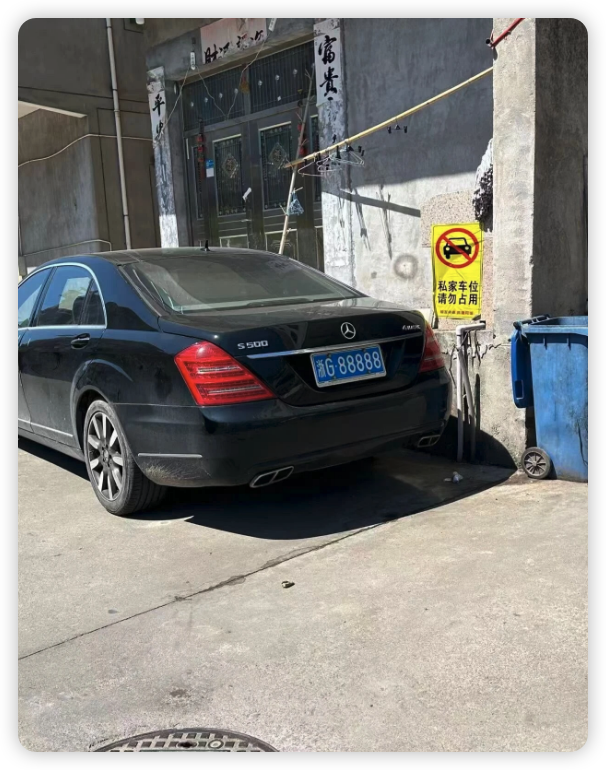
Saw this in our village the other day — a black Mercedes-Benz S500 4MATIC, parked in a tiny alley between two old houses. The car itself is not surprising anymore; you see nice ones in our county town sometimes. But the license plate stopped me: 浙G·88888.
Five eights in a row. I had to take a photo.
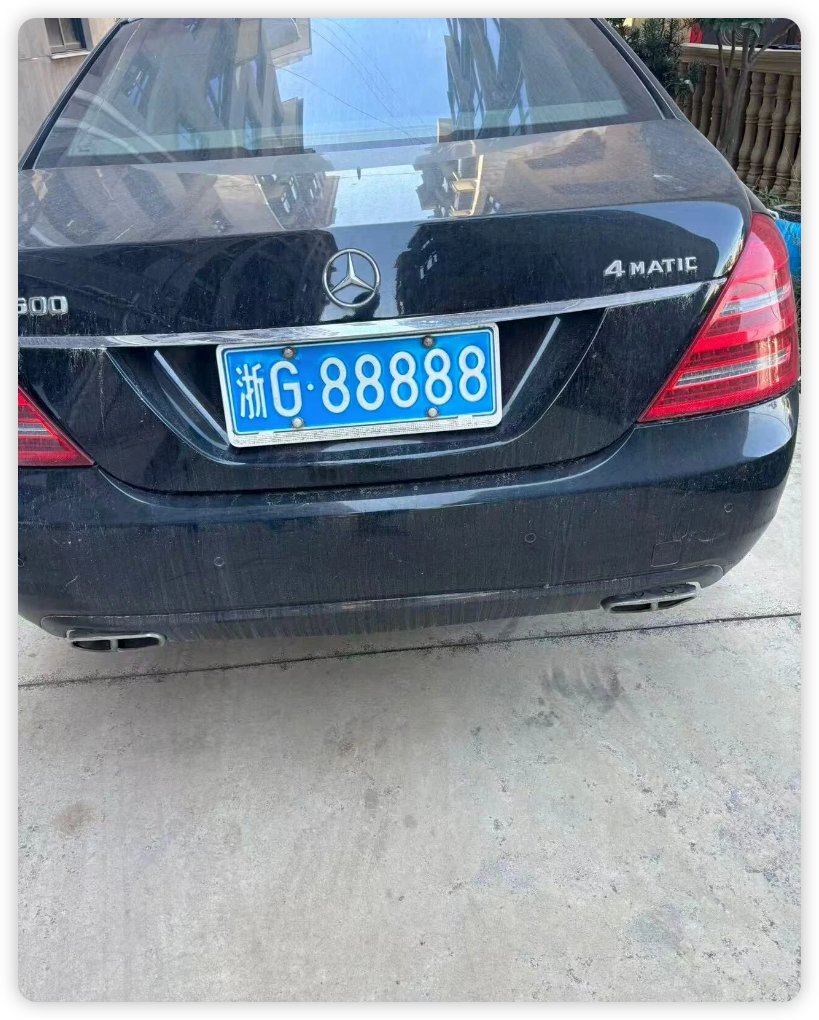
So, how much is a plate like that actually worth? I had to look it up.
What “88888” means in China
The number 8 is a big deal in Chinese culture. It sounds like the word 发 (“fā”), which means “to get rich.” So anything with lots of 8s is considered lucky. A plate with five of the same digit in a row — what people call a “豹子号” (bàozi hào, literally “leopard number”) — is the kind of thing that makes a car stand out the moment it pulls up.
In some Chinese cities, license plates are sold at public auction, and that’s where the prices get wild. Reportedly, plates with five repeating digits have sold for several hundred thousand RMB, and in a few famous cases, north of a million. A regular plate in a big city like Shanghai or Shenzhen might cost you around 80,000–100,000 RMB even without the lucky numbers. So yeah, an 88888 is its own thing.
For context: 浙G means the car is registered in Jinhua, Zhejiang — that’s the city our county (Yongkang) belongs to. Seeing a Jinhua 88888 in a small village alley is a bit like seeing a unicorn at the corner shop.
The car itself
The Mercedes S500 4MATIC is the brand’s full-size flagship. The 4MATIC part means all-wheel drive. In China, a new S500 runs around RMB 1.1–1.3 million (about USD 150,000–180,000), and you can option it up from there. So the car and the plate together are probably pushing two million RMB, give or take.
Which is wild, because the alley it’s parked in is the same one where the neighbour parks his electric scooter, and the wall behind has a hand-painted “Private Parking — Please Don’t Park Here” sign that looks about fifteen years old. That’s the thing about China — the flashy and the very ordinary are usually right next to each other.
Do other countries do this?
I keep wondering if this is a purely Chinese thing, or if people in other countries also pay a fortune for “good” license plates.
I know the UK has its personalized registrations (the DVLA sells cherished numbers like “1 A” for hundreds of thousands of pounds), and the US and some European countries have vanity plates — but you mostly pay a small fee, not the price of a car. In most places I can think of, a license plate is just a license plate.
Here, the plate is almost part of the car’s value. People talk about it like a second asset. Is that weird? Or just a different kind of attachment?
If any of you are from somewhere that takes license plates seriously, I’d love to hear how it works. How much would you actually pay for a plate that made you smile every time you looked at the back of your car?
— Ying