
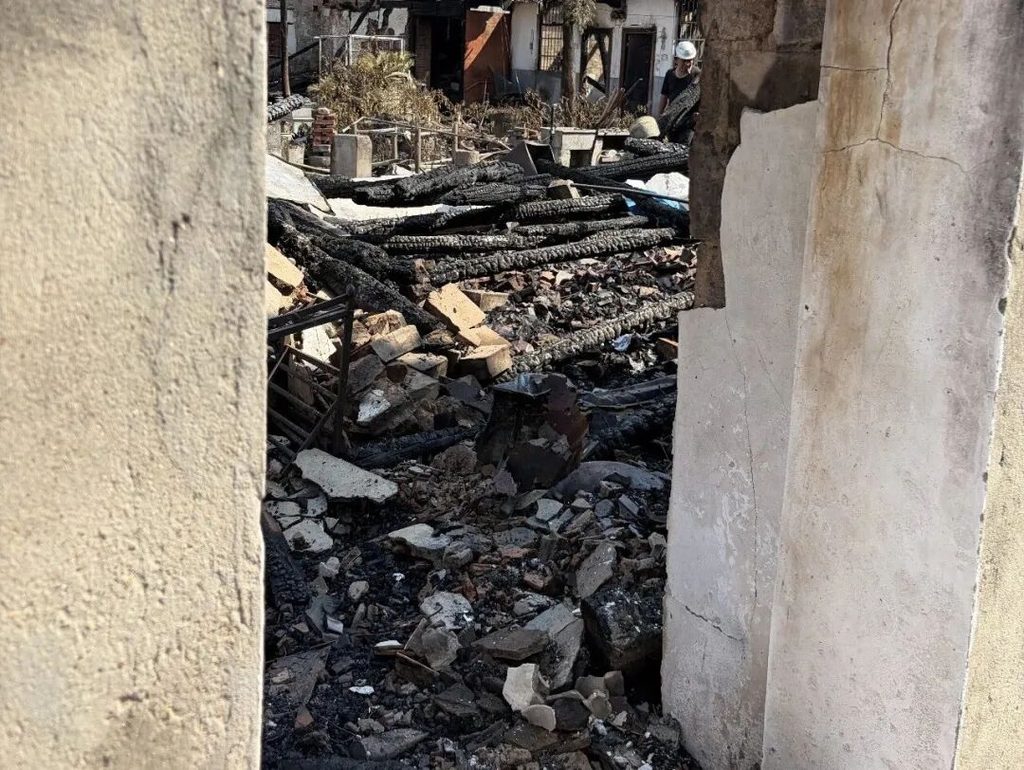
This is what was left of a house after a fire. Everything that could burn, burned. What you can still see standing is the outer wall — brick, maybe 30 centimetres thick — and nothing else. No roof, no beams, no floor, no furniture. Just four walls holding up the shape of a building that isn’t there any more.
I’ve seen that shape a lot. And I’ve walked past houses like the one in the second photo: a Qing-dynasty courtyard compound, timber frame, brick shell, the kind that is everywhere in the villages of Zhejiang.
My own family’s house is in a village. So I wanted to know why this kind of fire is so hard to stop — and what you can actually do about it.
Short answer: three things stack up. The building is essentially kiln-dried fuel inside a brick shell, with a courtyard in the middle that works as a chimney. It reaches the point of no return in about 15 minutes. And in most villages the nearest fire station is 20 to 30 minutes away, down lanes a fire truck may not fit through. By the time anyone with a hose arrives, there is nothing left to save.
Let me take those in order, because each one is fixable — just not all at once.
One: The House Is Kiln-Dried Fuel With a Chimney In the Middle
A Qing-era village house is a timber frame with brick infill. The brick is only a shell. The thing holding the roof up is wood, and it has been drying for 150 years.
That matters more than it sounds. Fresh timber sits at about 60% moisture content. “Air-dried” timber is 12–18%. Wood in a 200-year-old house is drier than air-dried — it is fully dried — and the cracks that open up over a century become paths for fire to travel inside the beams.
Then the numbers get bleak:
- Wood’s volatile content, the part that turns into flame, is about 86%. For coal it is up to 50%, charcoal 11%, coke 4%.
- Wood ignites at 200–350°C, lower than any of those fuels.
- Pine framing burns at about 2 centimetres per minute.
- A timber historic building carries roughly 33 times the fire load of a modern one — about 1 m³ of wood per square metre of floor, against a modern limit of 20 kg/m².
So if a timber house does not get effective water within 15 to 20 minutes, it goes as one piece, at 800–1,000°C.
And the layout helps the fire rather than you. A courtyard compound is courtyards inside courtyards, with covered corridors linking building to building — and a corridor is a motorway for fire. Even the Forbidden City got this wrong: of the four fires that hit its three great halls during the Ming dynasty, three of them took all three halls at once, because there was no fire compartment between them and the side halls were joined by roofed walkways.
The courtyard itself is the chimney. Hot gas rises, the opening at the top pulls fresh air in at the bottom, and the fire gets exactly the draft it wants.
Two: Nothing Arrives In Time
China’s standard for a fire station is to reach the edge of its district within 5 minutes. That sounds good until you look at the district sizes: no more than 7 km² in the city, no more than 15 km² in the suburbs. It is a standard written for built-up areas.
Villages are not built-up areas, and they were not planned. The code requirement for a fire lane is a clear width and clear height of at least 4 metres. Plenty of village lanes are two metres wide with a power cable overhead at three. And villages have their own barrier designs: 限高杆 (height-restriction bars) and 限宽墩 (width-restriction blocks), put up to keep heavy trucks off village roads. In Lüliang, Shanxi, officials surveyed their districts and found 389 of these barriers blocking fire access.
Distance is the part I keep coming back to. When Taishun county in southern Zhejiang set up its village-level system, a resident described the old situation plainly: a house fire used to mean waiting at least half an hour for a truck from the township.
And when it arrives, it often cannot reach the building. Last year a wooden, tile-roofed farmhouse in Qingtian, Zhejiang, burned in a strong wind and took neighbouring buildings with it.
Is this only a Chinese problem? No. In the United States, NFPA 1710 asks career departments to get a first engine to a fire within 4 minutes of travel time, 90% of the time. But most US departments are volunteer, and they fall under NFPA 1720 instead — which for rural areas (under 500 people per square mile) allows 14 minutes for six firefighters to be on scene, and only 80% of the time. Reported rural worst cases run past 20 minutes. The difference is density: the US has career stations roughly every 1.5 miles in its cities and volunteers driving in from home in the countryside. China has far more villages than it could ever ring with fire stations.
Three: The Fires Start Where Maintenance Doesn’t Reach
In March 2026 the national fire service published its figures for 2025:
- 841,000 fires reported nationwide
- 1,827 deaths and 2,161 injuries
- ¥8.53 billion in direct property damage
- Fires down 7.6% and deaths down 9.5% on 2024
- But rural areas were 61.4% of all fires and 51.9% of all deaths — and both shares went up
On causes, electrical faults started 30.8% of every fire in the country. Then careless use of open flame (20.8%), leftover embers (16.6%), smoking (16.5%) and children playing with fire (3.9%).
Rural fire in China is an electrical story more than anything else. The clearest case I found was in Jinhua, in my province: an abandoned brick-and-timber old house caught fire at night. Investigators found an outdoor lamp at the doorway that had been powered continuously for 15 years. The wiring had long since perished. A thunderstorm that night short-circuited it, and it set light to everything stored inside. Nobody had lived there for years. Nobody had switched the lamp off in fifteen.
And the local one. In my own city of Yongkang, in September 2025, a four-storey self-built house burned. The fire started in a candle workshop on the ground floor — a lot of wax and finished stock — and that floor was gone almost immediately. Nobody died. The official account gives one reason: the landlord had followed fire department advice and built a solid brick wall between the living area and the workshop. That wall stopped the fire and the smoke from going upstairs.
One wall. That was the whole difference.
What Villages Are Actually Doing About It
Zhejiang has been running retrofits for years, and the numbers are real:
- Keqiao district, Shaoxing: 2,000 old village houses fitted with earth-leakage protection and rewired; 30 fire water intake points added along village roads; village volunteer brigades across the whole district. Separately, 300 “one-button” fire pumps placed along rivers in villages dense with rented and self-built homes — pump, hydrant, hoses and nozzle in one kit, so a villager can start water without waiting for anyone.
- Qujiang district, Quzhou: 1,380 retrofits creating a solid separation between shop or workshop space and living space; 2,284 window bars and security grilles removed because they trapped people inside; 58 micro fire stations for traditional villages; 8,873 networked smoke alarms and pull-cord alarms installed for residents living alone.
- Xianju county: ¥3 million of county money to rewire 5,017 old timber and concrete houses, plus compulsory separation for the ash pits under wood-fired stoves.
- Baoyang township, Taishun: a “water point plus village micro-station” model which the township says cut initial response to under 5 minutes.
That last one is the template that makes sense to me, because it accepts the obvious: the professional fire truck is not coming in time, so the first five minutes have to belong to the village.
But here is the honest problem with village fire brigades. The equipment arrives before the habit does. A village gets a micro-station, a pump, hoses, maybe a small truck. Then everyone goes back to work and nobody drills. The brigade exists on paper; nobody has ever run the pump under pressure. Four people who have practised once are worth more than a shed of equipment nobody has touched.
So What Actually Helps
If you live in a house like this, or your parents do, the list is short and unglamorous:
- Never leave the house with something still burning. The most common cause in the national data is careless use of fire, and it is almost always a pot on a stove or a gas ring left on.
- Get the wiring inspected, especially if it is original. Electrical faults are the number one cause. In a timber house the wiring should run inside conduit, with a fire-retardant plate behind every switch and socket.
- Put a solid wall between living space and anything that burns well — a workshop, a store of wax, cardboard or straw. The Yongkang case is the argument: one wall saved lives.
- Clear the buildings nobody uses. Empty village houses fill up with paper, straw and cardboard, and they catch from outside — a spark, a firework, a cigarette. Removing barred windows and grilles is the same idea from the other direction: people need a way out.
- Walk your own lane. Does a fire truck fit? Is the 4-metre gap actually clear? Is there a height bar across it? If not, the fire brigade is theoretical.
FAQ: Rural House Fires in China
How long does it take a fire truck to reach a Chinese village?
Longer than any standard assumes. The national standard is to reach the edge of a station’s district in five minutes, but those districts are defined for built-up areas, around 7 km². Villages sit outside them. In the mountainous parts of Zhejiang, residents have described waiting at least half an hour for a truck from the township.
What starts most rural fires in China?
Electrical faults, by a wide margin — 30.8% of all fires nationally in 2025. After that come careless use of open flame (20.8%), leftover embers (16.6%) and smoking (16.5%). In old wooden houses the mechanism is usually perished wiring, often in a building nobody has maintained for decades.
Why can’t they just put it out from outside?
Because the outer wall is brick and the inside is wood. Water has to reach the burning timber, and in a courtyard compound the fire sits behind walls on several sides with heat and smoke going straight up the middle. Studies of timber buildings put the water needed at roughly twice the volume of wood that is burning.
Is this different in other countries?
The physics are the same anywhere you build in wood — London in 1666, Chicago in 1871, every old European town. What differs is distance. The US standard for career departments is a first engine within four minutes; for volunteer departments in rural areas it allows 14 minutes for six firefighters to arrive, and only 80% of the time. Rural fire is hard everywhere. It is just more concentrated in China, where so much housing is still old timber in villages.
What is the single most useful thing a village can do?
Build a water point plus a micro fire station, and then rehearse with it. Taishun county reports initial response under five minutes with that model. Equipment without practice does not work at three in the morning.
Where I Got These Numbers
- National fire statistics for 2025, including the rural split and cause breakdown — People’s Daily report on the National Fire and Rescue Administration briefing, March 2026
- Fire lane clear width and clear height of 4 m, and rural height/width barriers — Lüliang fire authority
- Fire station coverage standard: 5 minutes to the district edge, no more than 7 km² urban — Fuling district fire plan, citing GB 51080-2015
- Wood burning at 2 cm per minute, 15–20 minutes to large-area burning, and the 33× fire-load figure — Tianjin Yun, quoting Wang Shiren of the Beijing Institute of Ancient Architecture
- Volatile content, ignition temperature and moisture content — Sohu explainer on old-building fires
- Flashover at roughly 160 seconds in a full-scale timber-building fire test — CNKI, historic-district full-scale fire experiment, 2026
- The Yongkang candle-workshop fire and the solid-wall retrofit — Xiuzhou News, December 2025
- The Jinhua fire caused by a lamp left on for 15 years — The Paper
- Keqiao, Qujiang, Xianju and Taishun retrofit programmes — Zhejiang Emergency Management Department, Keqiao reply to a CPPCC proposal and Tencent News on Baoyang township
- US response-time standards, NFPA 1710 and NFPA 1720 — Metrans study on emergency vehicle operations
Over to You
Can a fire truck actually get down your village lane? Not in theory — have you ever watched one try?
And if your village has a brigade or a micro-station: has anyone in your household ever practised with it?
I would like to know how many of us are waiting on a truck that cannot arrive.
— Ying
Pingback: Why a 40-Year-Old Tractor Still Runs on a Chinese County Road - Ying's County Town