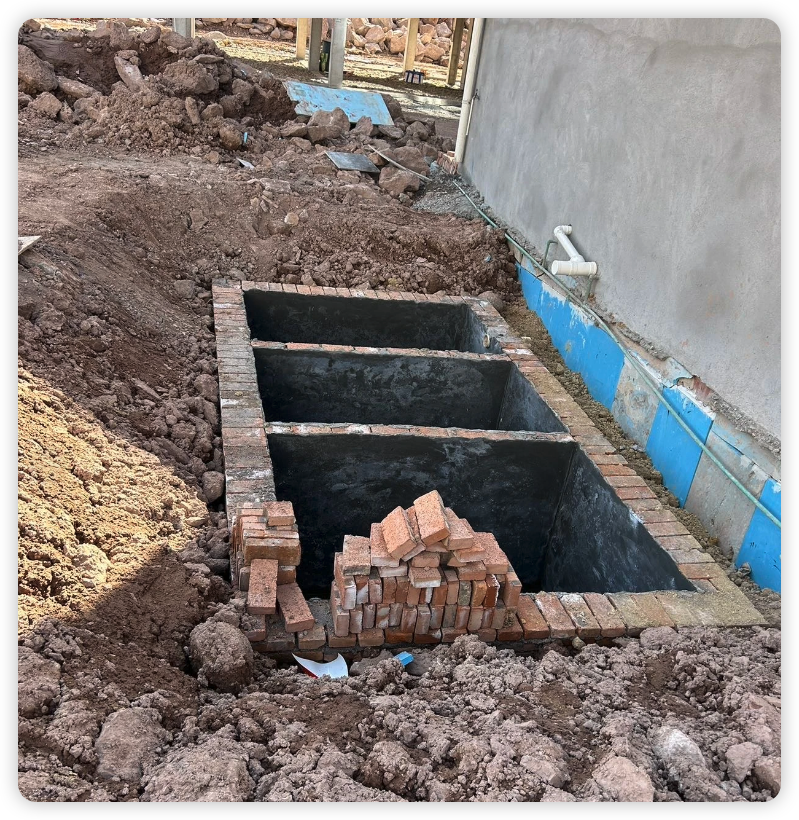
I’ve never really understood how septic tanks work. Ours is just three pits in the ground — three chambers, no moving parts, no pumps. And with a family of five using it every day, I keep coming back to the same question:
Won’t it eventually fill up? And if it fills up, then what?
Short answer: yes, part of it does fill up — and that’s exactly why every rural household in China knows the phone number of a 抽粪车 (honey wagon / septic pump truck). Let me explain the whole system, because it’s actually cleverer than “three pits” suggests.
How a Three-Chamber Septic Tank Works
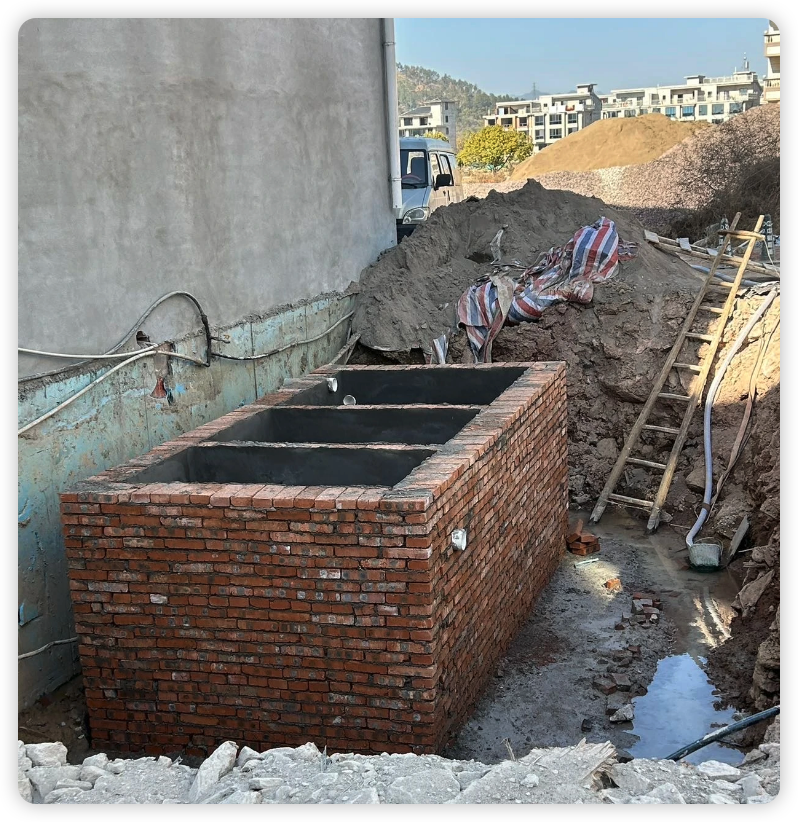
Rural Chinese houses typically use the “three-compartment septic tank” (三格化粪池), a design the government standardized years ago. Here’s what each chamber does:
Chamber 1 — settling and digestion. Everything from the house enters here first. Solids sink to the bottom; grease and scum float. Anaerobic bacteria get to work breaking down the organic material, which is why nothing smells as bad as you’d expect once the tank is established.
Chamber 2 — continued fermentation. Liquid overflows from chamber 1 into chamber 2 through a pipe set at the top. The same bacterial process continues, further breaking down whatever’s left in suspension.
Chamber 3 — storage and discharge. The most clarified liquid ends up here — the “effluent” — which drains out to a soakaway field, a drainage channel, or (in newer villages) a municipal sewer connection. The discharge is almost all water at this point, not waste.
So the system isn’t storing everything. It’s separating, digesting, and draining. Roughly speaking: liquid leaves, solids stay and shrink.
So Does It Fill Up? Yes — Slowly
Here’s the honest answer: anaerobic digestion can’t break down everything. Some solid material is simply resistant — hair, sanitary items, grit, and a fraction of the organic matter just doesn’t decompose. That residue accumulates at the bottom of chamber 1 and chamber 2, year after year.
That’s the sludge. It’s why every septic tank eventually needs to be pumped out — typically every 1 to 3 years, depending on how many people live in the house.
One person produces a surprising amount of waste per year. Multiply that by a family of five for three years, and yes, the sludge layer gets real.
What Happens When It’s Full: The Pump Truck
This is the part that answers my original question. When the tank reaches capacity, you call a septic pumping service — a 抽粪车, literally a “manure-pumping truck.” A truck arrives with a vacuum hose, opens the manhole cover, and pumps the sludge out into a tank on the truck. It’s then taken away for proper treatment.
The cost: usually 100–300 RMB (~$15–45) per pump-out in rural areas, depending on distance and volume. If you split it between two households sharing a tank, less per family.
After pumping, some owners add water to re-establish the bacterial culture, and the tank goes back to work. The whole process takes about half an hour, and nobody in the family has to think about it for another couple of years.
The Alternatives (and the Government’s Push)
Modern rural China has been upgrading this system under the “toilet revolution” (厕所革命) campaign, which started around 2018. In villages close to cities, houses increasingly connect directly to municipal sewer networks, eliminating the septic tank entirely. Others use biogas digesters, where the methane produced can be piped back into the kitchen for cooking — waste-to-energy at household scale.
Where there’s no sewer connection and no pump service nearby, some households rely on soakaway pits, which is when you start hearing complaints about overflow. That’s the real-world answer to “what if it fills up”: in a properly serviced village, it doesn’t reach that point. It gets pumped.
FAQ: Septic Tanks in Rural China
How often does a septic tank need to be emptied?
Typically every 1–3 years, depending on household size. A family of five might need pumping every 1–2 years; a small household can go longer.
What happens if a septic tank is never emptied?
It fills with sludge. First the drainage slows down, then waste backs up into the house, and eventually the tank can overflow. It also stops treating waste properly, which is an environmental problem.
How much does it cost to pump a septic tank in China?
In rural areas, roughly 100–300 RMB (~$15–45) per service call, depending on the volume of sludge and how far the truck has to travel.
What is a three-compartment septic tank?
The standardized Chinese rural septic tank: three connected chambers that separate solids from liquid, digest the solids anaerobically, and discharge clarified water. It’s the standard design in rural household sanitation.
Do rural Chinese houses have modern plumbing?
Increasingly, yes. Since the 2018 “toilet revolution,” rural sanitation has been upgraded, with many villages now connected to municipal sewage networks and indoor flush toilets standard in new builds.
Over to You
For readers outside China: how does your household handle waste — septic tank, sewer, or something else? And does anyone else out there share my worry about what happens in year ten?
I’d like to think I’m not the only person who thinks about this stuff.
— Ying