This piece was first published in Chinese on my WeChat account on 15 October 2026. What follows is a translation of what I wrote that day, with background notes added for readers outside China.
These past few days I needed a place to take photographs, which in a county town is harder than it sounds. You can’t just walk out into the street — the street is not a studio. So like everyone else here, I opened Meituan (美团) and searched for a studio near my home. One came up with a reasonable price. It was inside the Baolong Plaza apartments.
That is when I noticed something. Inside that apartment building there are shops. Quite a lot of them.
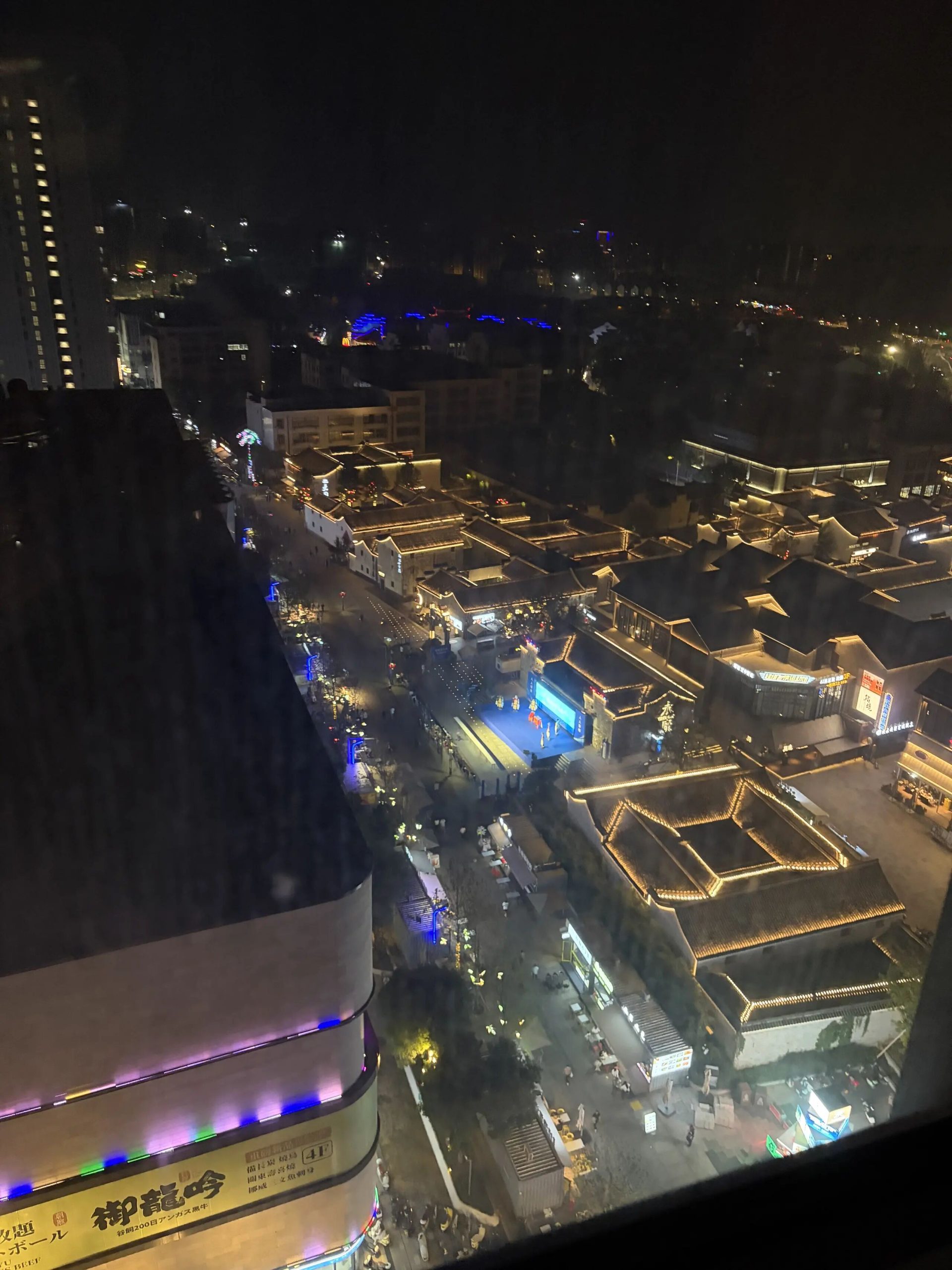
My impression of apartments had always been that they are hard to sell and small. It turns out they are also not bad for running a small business — especially the kind that does not need a street-level frontage at all.
Looking down from upstairs, it is actually quite a pretty view.
What I was actually looking at
The sign I could read most clearly from the photos is 御龍吟 — Yulongyin — with 日式燒肉放題 underneath it: Japanese-style all-you-can-eat yakiniku, and beneath that, 燒肉專門店, barbecue specialty shop. The English line on the board reads WAGYU, ANGUS BEEF.
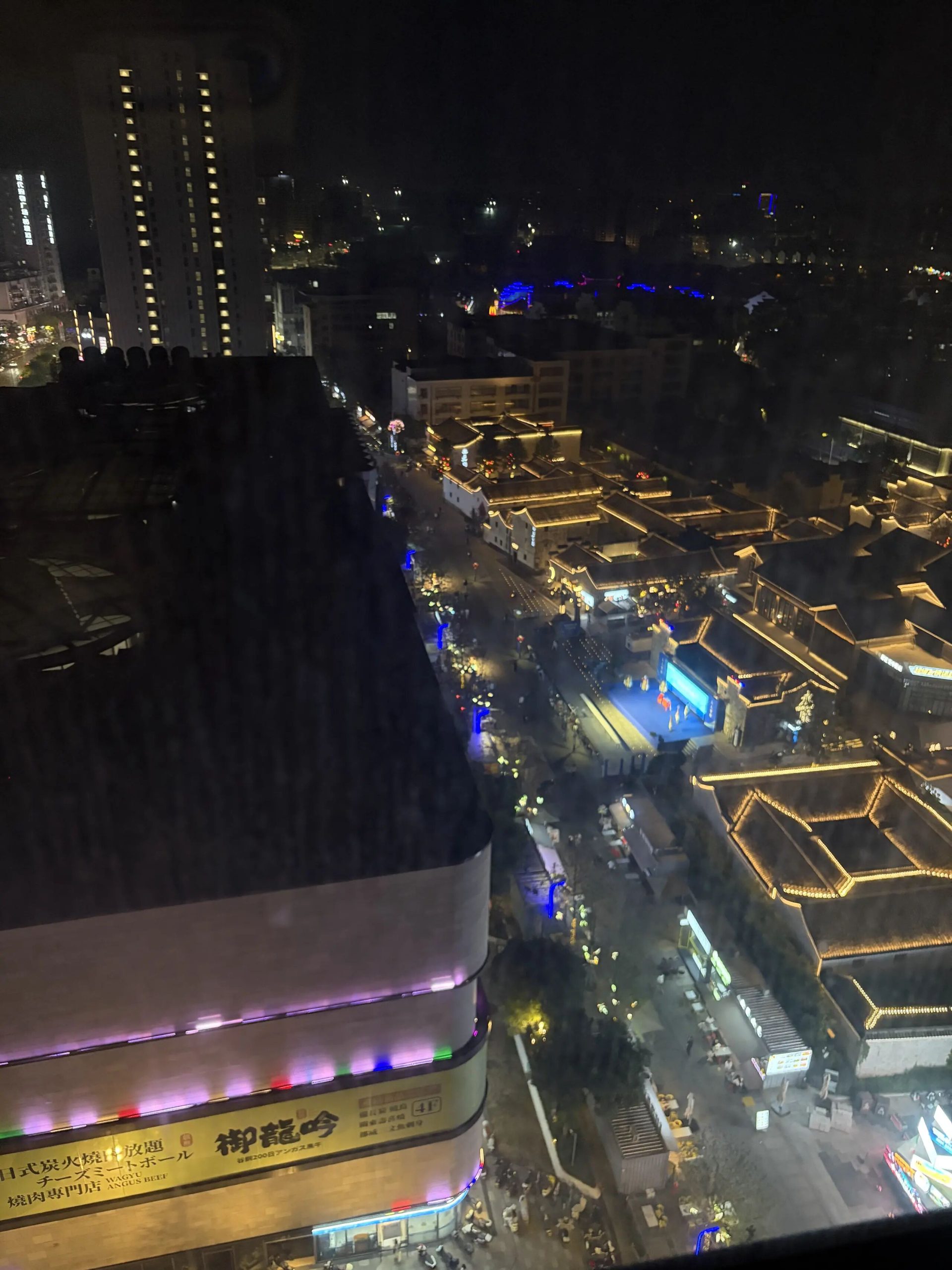
So this is not a convenience store selling cigarettes. This is a restaurant with a grill on every table, several floors up an apartment tower, in a county town of 620,000 people.
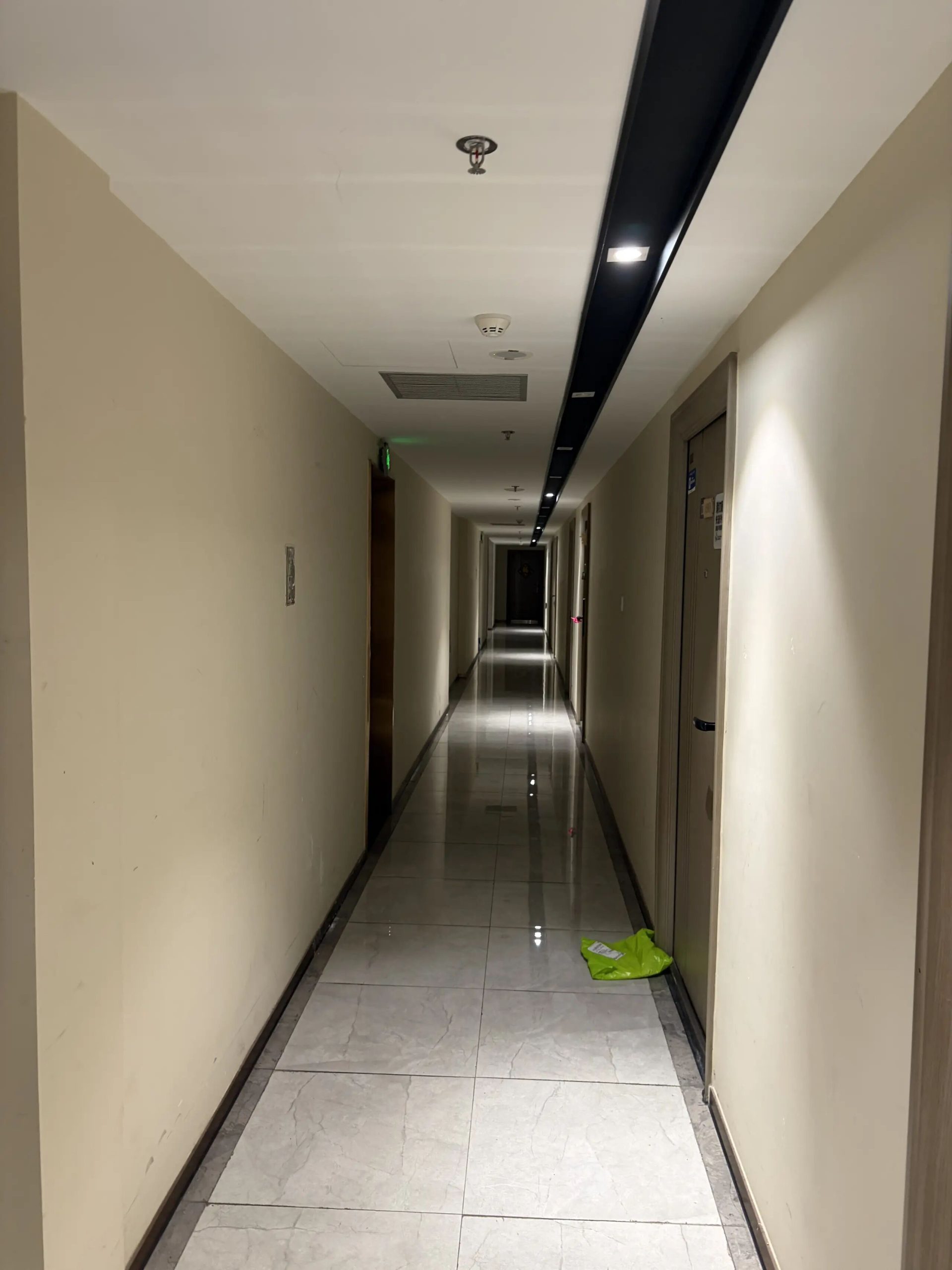
The part that would be illegal in America
This is where the story stops being a curiosity and becomes something structural.
Baolong Plaza (宝龙广场) opened on 20 November 2020 — the first shopping centre in Yongkang. Total floor area 350,000 square metres, of which 63,000 is the mall. The rest is LOFT city apartments, housing and a themed retail street. It was the 61st operating project for Powerlong Commercial, which is listed in Hong Kong. More than 200 brands moved in, 60 of them new to the city.
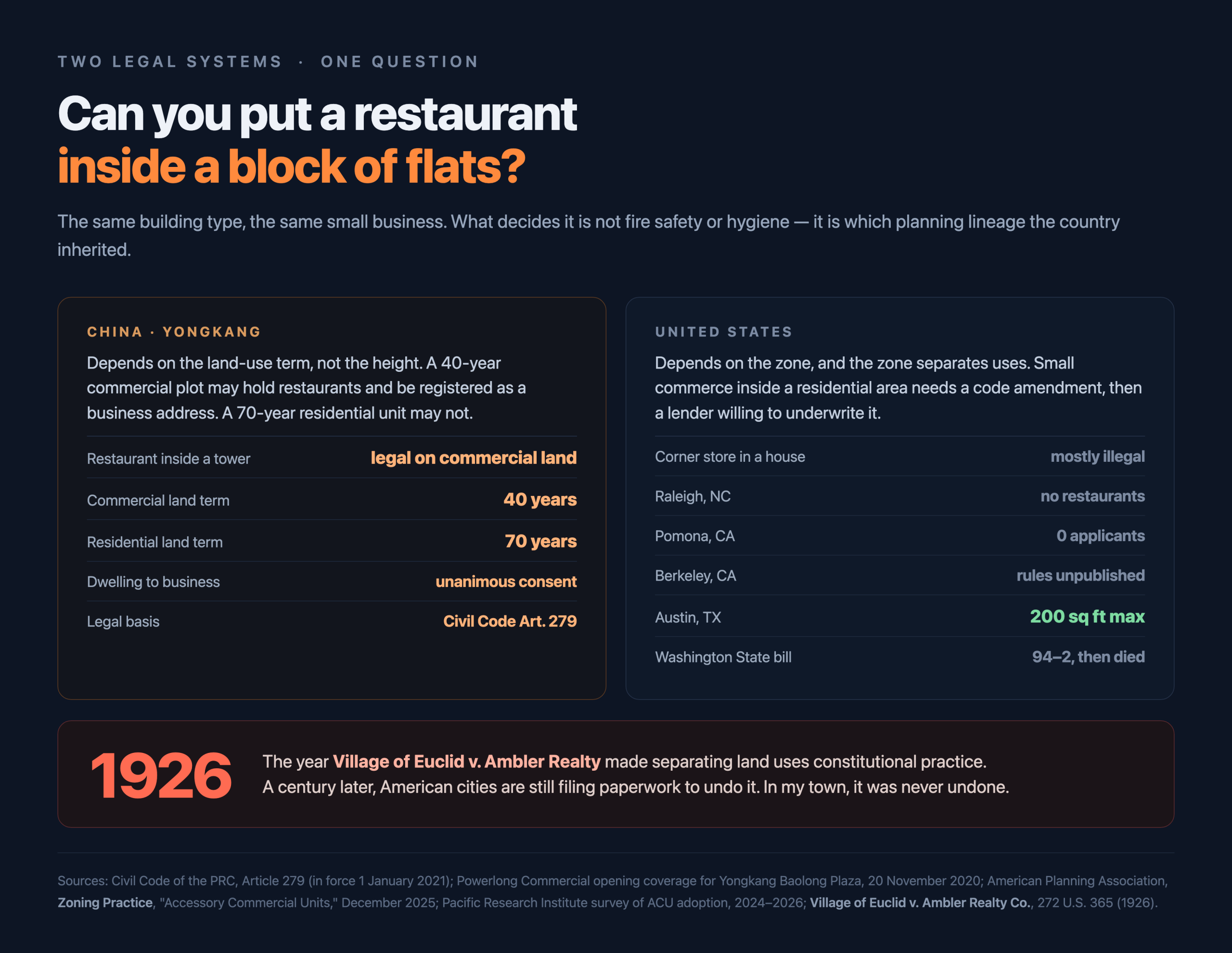
The critical detail is what those apartments sit on. Chinese property has a distinction that doesn’t exist in most English-speaking countries: the land-use term attached to the plot. Ordinary housing sits on residential land with a 70-year term and cannot be registered as a business address. Commercial land gets 40 years, or 50 for mixed use, and the units on it can be registered as a company address, which is precisely why LOFT apartments are marketed to young buyers and small operators on exactly that promise. They are also charged commercial rates for water and electricity, cannot be used for household registration (户口), and carry no school district.
So the restaurant upstairs is not a resident quietly breaking a rule. The building was zoned and sold for this. 御龍吟 is there legally, because the floor it sits on was never residential in the planning sense.
The thing that would require permission is the opposite case: converting genuine residential property into business use. That is governed by Article 279 of the Civil Code (民法典), in force since January 2021: an owner may not convert a dwelling into premises for business operations without the unanimous consent of all owners whose interests are affected. Chinese courts enforce that literally. In a 2024 Sichuan case, a homeowner who had converted a flat into a homestay — with a valid business licence — was still ordered to stop operating and restore the residential use, because the neighbours had never agreed. A business licence, the court said, does not make an unlawful conversion lawful.
Why the American version is different
In the United States, the corner store is not merely uncommon. In most of the country it is illegal by zoning code, and was made so deliberately in the twentieth century.
Euclidean zoning — named after the 1926 Supreme Court case, Village of Euclid v. Ambler Realty — separated land uses by category, on the logic that residents should not live next to a noisy or polluting factory. The side effect was that shops were pushed out of residential zones entirely. Corner groceries, sandwich counters and front-room tailors that had existed since the streetcar era became legally non-conforming, then disappeared.
What is happening now is a slow, contested effort to legalise them again. The American Planning Association’s Zoning Practice for December 2025 devoted an issue to what it calls accessory commercial units — small businesses embedded in residential lots, like a coffee kiosk in a converted garage or a backyard salon — and described the concept as “still a fringe zoning concept,” with few examples of cities that have fully integrated it.
The scoreboard so far:
| City | What it did | Result |
|---|---|---|
| Spokane, WA | Allowed pre-2012 commercial buildings to revert to commercial use | Under 100 properties eligible |
| Raleigh, NC | Legalised ACUs inside or attached to homes | Still bans restaurants and outdoor seating |
| Pomona, CA | Allowed a garage to be used for a home-run business | By-right, but no homeowner has yet applied |
| Austin, TX | New category for businesses up to 200 sq ft | Adopted March 2026 |
| Berkeley, CA | Directed staff to permit neighbourhood retail | Rules still unpublished after 2.5 years |
| Washington State | Bill passing the House 94–2 | Died in a Senate committee, third year running |
Read the Raleigh row again. Raleigh legalised home businesses, dry cleaners, music studios — and explicitly prohibited restaurants. In my town, a restaurant with a grill in every booth sits several floors up an apartment tower, and nobody considers it remarkable.
Why this difference exists, and what it costs
Two planning lineages. America separated uses to protect residents from industry, and kept separating them long after industry left. China built high-density mixed developments because the alternative — low-rise, single-use, car-dependent suburb — was never affordable for a country urbanising at that speed. Planner Peter Calthorpe, in conversation with Chinese planners, put it plainly: mixed use is easier to achieve in a Chinese city than an American one, because a residential plot in China may include ground-floor commercial, whereas in the United States the zoning code does not permit it and the risk assessment on the financing will not clear it.
The Chinese approach is not cost-free. Article 279 exists for a reason, and the litigation behind it is real: noise, cooking fumes, strangers in the stairwell. There is a reason the regulations on commercial space attached to housing require independent entrances and evacuation stairs, with entrances not facing the residential courtyard, and a dedicated flue designed for noise and fume standards. The county-town version of mixed use is convenient and it is also occasionally someone’s upstairs neighbour running a mahjong parlour.
But walk through the Baolong apartments in the evening and you see what the trade buys. The photography studio I booked sits in one of these units, cheap and with good light. The yakiniku restaurant sits in another because the building is legally allowed to hold it. Somewhere above, someone’s laundry is drying. None of it is zoned apart from the rest of life, because county towns cannot afford to zone anything apart from anything.
America is now spending enormous political effort trying to reintroduce something it spent the twentieth century removing. In my town it never left. All I did was look for a place to take pictures, and it was upstairs.
FAQ
Can you legally run a restaurant inside an apartment building in China? Not in residential units. Article 279 of the Civil Code requires the unanimous consent of affected owners, and courts have shut down businesses that had licences but no consent. It is legal in buildings whose land-use term is commercial — commonly 40-year LOFT apartments — because those units are not residential in the planning sense and can be registered as business addresses.
What is a 40-year property in China? The land-use term, not the building. Residential land gets 70 years; commercial land 40, mixed use 50. Shorter terms come with commercial water and electricity rates, no household registration, and no school district — which is exactly why these units are cheap and why small businesses use them.
Why can’t you put a shop in a US residential zone? Because Euclidean zoning separates uses by category, a framework dating from the 1926 Village of Euclid decision. Bringing small commerce back requires amending the code city by city, and lenders and insurers will not underwrite a use the code does not name. That is why accessory commercial unit reform has spread slowly despite broad rhetorical support.
Sources
– Civil Code of the People’s Republic of China, Article 279 (in force 1 January 2021); enforcement examples reported by China Court Network, 2024 and 2025. – Powerlong Commercial / Yongkang Baolong Plaza opening coverage, 20 November 2020: 350,000 sq m total, 63,000 sq m mall, LOFT apartments, 200+ brands. – American Planning Association, Zoning Practice, “Accessory Commercial Units,” December 2025. – Pacific Research Institute, on ACU adoption in Spokane, Raleigh, Pomona, Austin, Berkeley and Washington State, 2024–2026. – Peter Calthorpe, interviewed on mixed-use planning in Chinese versus American cities.