This piece was first published in Chinese on my WeChat account on 14 October 2026. What follows is a translation of what I wrote that day, with background notes added for readers outside China.
I don’t watch sports. I downloaded the app anyway.
Apple shipped a new one — Apple Sports, 苹果体育 — so I installed it to have a look. What I actually wanted to know was whether it carried the Zhejiang BA (浙BA), the provincial city basketball league that has swallowed this province whole for the past year. I opened it, scrolled through the leagues, and no. It does not.
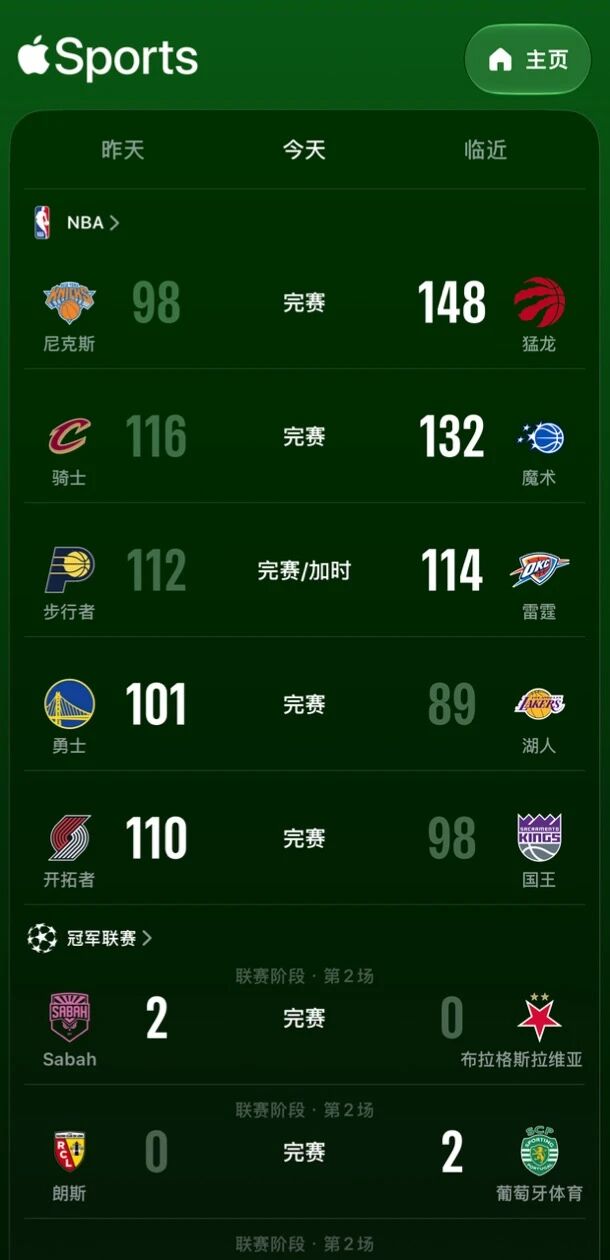
That is my whole reason for installing it, and it failed on the spot. But I kept the app, because of how it looks.
What I actually saw
The thing is clean. Genuinely clean, in a way almost nothing on a phone is any more. You pick the competitions you care about, and then you get scores and schedules. That is the entire product.
No video. No photographs. No highlight clips, no news feed, no ads, no pop-ups asking you to subscribe to anything.
For NBA games there is a text play-by-play. And on the scoreboard itself, when two teams are facing each other, there is a slow drifting animation between them — the two badges sway toward each other and back, like they are weighing each other up before the game.
Setting aside the question of whether it is useful, I think it is quite elegantly made.
What the app is, for anyone who hasn’t seen it
Apple Sports launched on 21 February 2024 in the United States, the United Kingdom and Canada only. It is free, it runs only on iPhone, and it asks for iOS 18 or later. Apple’s own framing at launch, from services chief Eddy Cue, was that the whole point was to be “very clean, really easy to use, and most importantly, fast — meaning real-time” at the one thing a fan wants in the middle of a game: the score.
It is deliberately not a sports app in the ESPN sense. There are no clips, no analysis, no personalities, no fantasy leagues. It does one job and refuses the rest, which is either admirable or useless depending on what you came for.
It reached the China App Store on 14 October 2026 — the day I wrote the original post. Two and a half years late, and quietly, without a launch event.
The Chinese interface is complete. The data inside it isn’t.
This is the detail I only noticed because I was taking screenshots.
The shell is properly localised. The tabs read 昨天 / 今天 / 临近 — yesterday, today, upcoming. A finished game is 完赛. A game that went to overtime is 完赛/加时. The team names are the Chinese ones a Chinese reader actually uses: 尼克斯 for the Knicks, 猛龙 for the Raptors, 勇士 for the Warriors, 湖人 for the Lakers, 骑士 for the Cavaliers, 魔术 for the Magic. The stats page is entirely in Chinese, with 投篮命中率 (field goal percentage), 三分命中率 (three-point percentage), 篮板 (rebounds), 盖帽 (blocks), laid out as paired bars in the two teams’ colours.
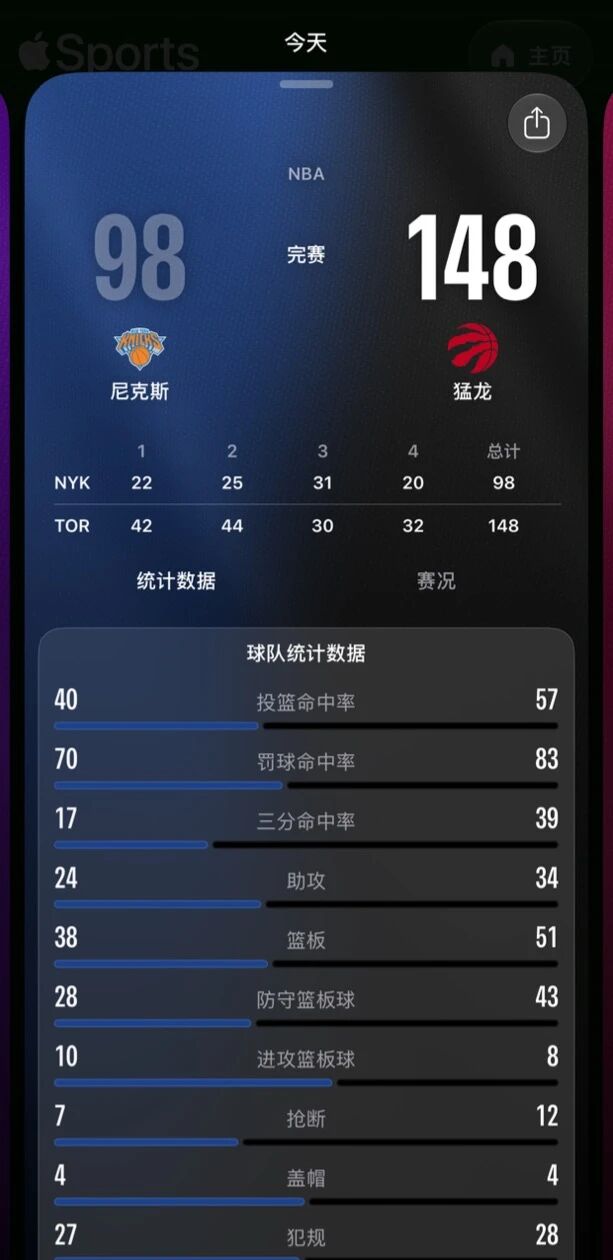
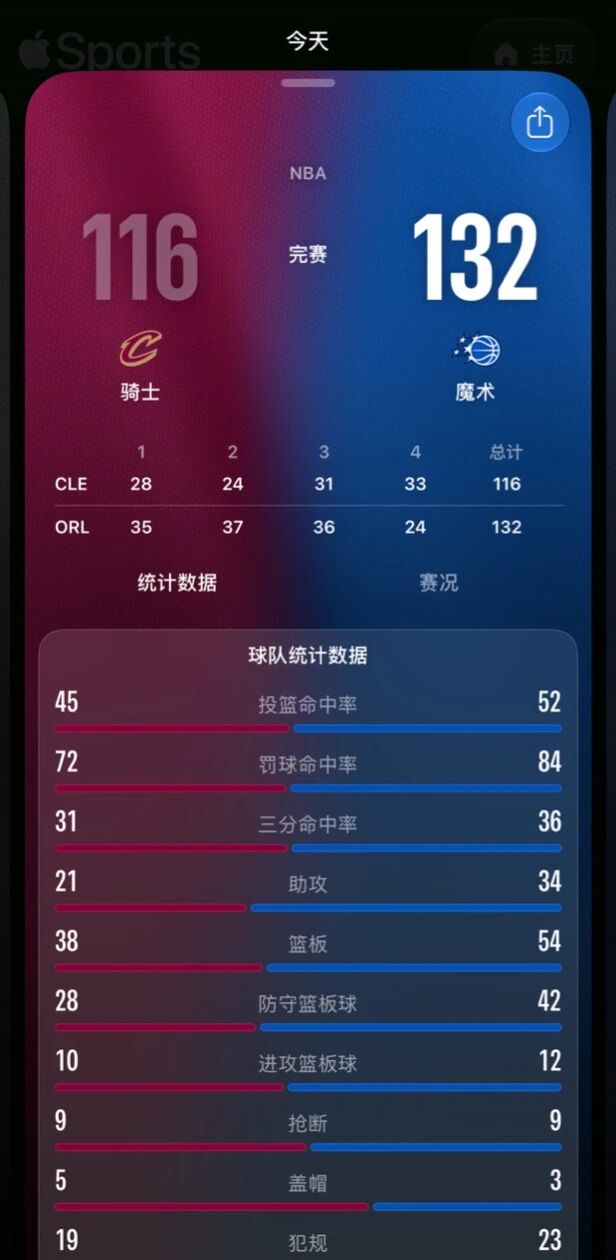
Then you tap 赛况 — the play-by-play tab — and the Chinese stops dead:
Daeqwon Plowden personal foul (Micah Potter draws the foul).
Leaky Black makes regular free throw 1 of 2.
Hansen Yang shooting foul (Leaky Black draws the foul).
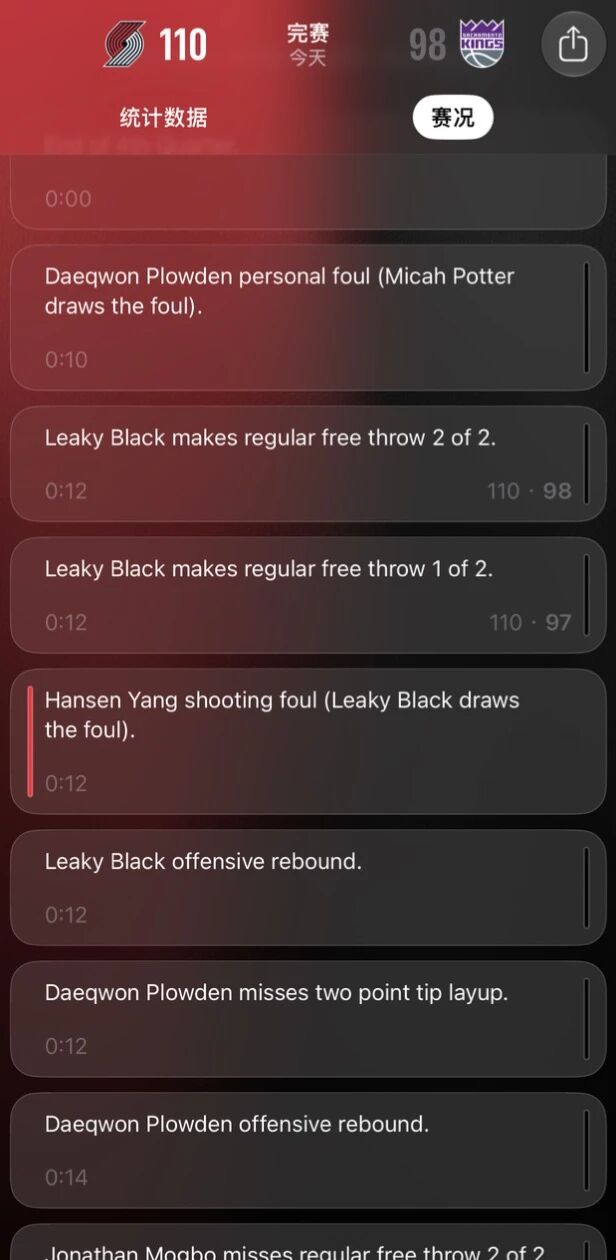
Timestamps down the left in game clock, the running score creeping up on the right, and every line in English, in the raw phrasing of whatever data provider Apple buys from. Chinese tech coverage of the launch put it flatly: content is English only. From the screenshots, the truth is a bit more lopsided than that. The app is Chinese enough to tell you 尼克斯 lost by fifty. It is not Chinese enough to tell you why.
I don’t think this is a scandal. It is just what “localisation” means when you license a live feed instead of producing one. The interface is a translation problem and Apple solved it. The play-by-play is a data problem, and nobody at the feed has been paid to write “利基·布莱克两罚一中” for a county reader in Zhejiang.
What the app can follow, and what it can’t
Scroll the “more to follow” list and you get the shape of Apple’s world: 女子冠军联赛 (Women’s Champions League), 英超联赛 (Premier League), 所有足球 (all football), 男子网球 and 女子网球 (men’s and women’s tennis), 美巡赛 (PGA Tour), 美国女子高尔夫巡回赛 (LPGA), NHL, WNBA, NFL, MLB, 大学橄榄球 (college football), and college basketball, currently marked 休赛期 — off-season.
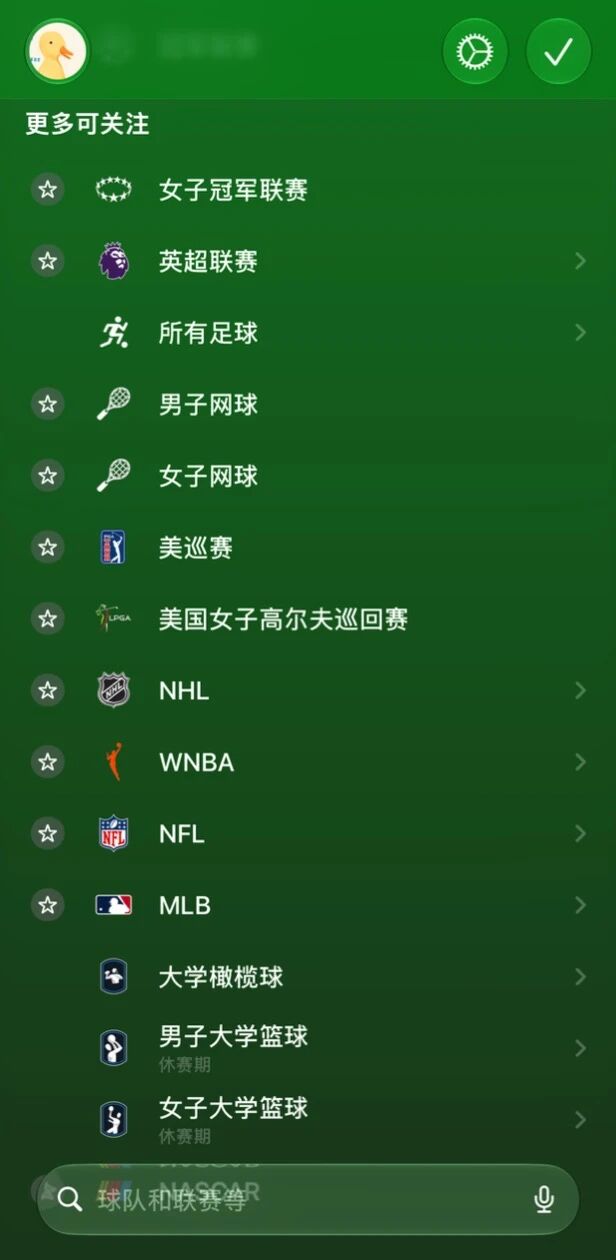
Notice what is not on that screen. No CBA. No Chinese Super League — as of the launch it wasn’t there either, which Chinese tech press picked up on, and Apple’s own China listing never claimed it. The Chinese Super League only arrived in version 4.6 on 12 November 2026, in the same update that added UFC and the Russian and Swedish top flights. That was the 26th football competition Apple had added in five updates since July. The CBA, as of this week, is still missing.
So the app that landed in a Chinese county in October can show you the NBA, the NHL and college basketball in Alabama, but not the professional basketball league of the country it was released in.
And the league my county actually watches
None of which explains the thing I actually wanted, because the 浙BA isn’t the CBA either.
The Zhejiang BA — Zhejiang Provincial City Basketball League — is an amateur competition between teams representing counties and city districts. The first season ran from 6 July 2025 to the final on 6 February 2026, when Hangzhou beat Lishui 93–71. Ninety-three teams from 90 county-level divisions across the province’s 11 cities. Professional players are explicitly barred from entering. The line people use about it here is: 白天当老板,晚上抢篮板 — boss by day, fighting for rebounds at night.
The numbers are not small. Nearly 1.79 million admissions across the season. More than one billion views on the online streams. Over 30 billion impressions across the whole internet, which is a figure I’d normally distrust except that in this province it did not feel exaggerated. Tickets were priced at 8, 18 and 28 yuan — about one to four US dollars — and sold out in one to two minutes, with real-name entry and face checks at the gate. When the 2026 season’s Shaoxing final went on sale, one host city logged 48,000 people queuing in the booking system for a gymnasium.
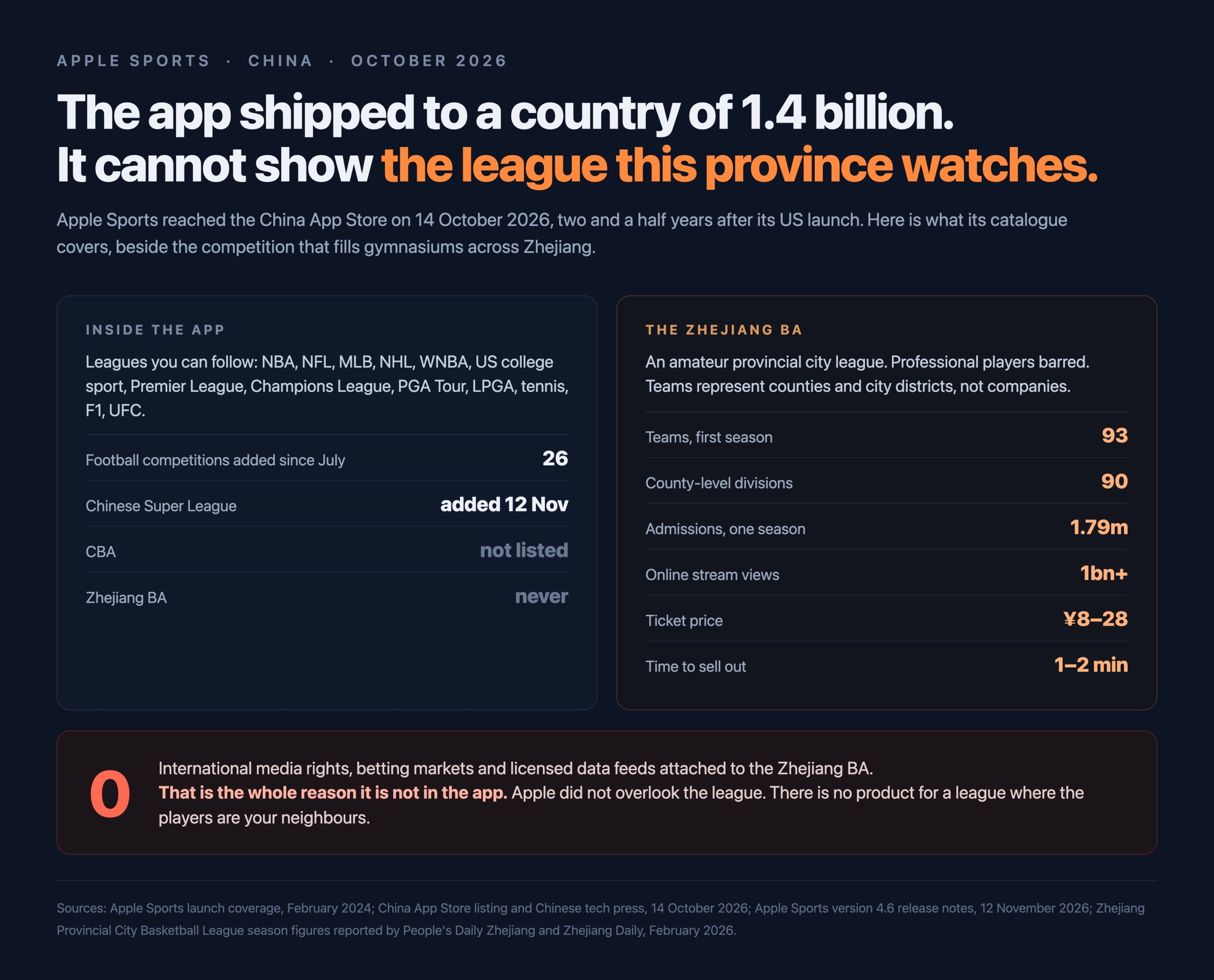
The catalogue on the left is a licensing list. The column on the right is a province.
The most valuable player of the final was a university freshman. Lishui’s best scorer was an ordinary office worker who put up 33 points in game three. One player came back from doing business in Europe to play; another drives an excavator by day.
That league has no international media rights, no betting markets and no data feed that a company in Cupertino can license. That is the entire reason it is not in the app. Apple did not overlook it. The app’s design makes it structurally impossible to include: there is no product for “a league where the players are your neighbours.”
What’s left
I still have the app on my phone. I open it maybe once a week, look at scores for teams I have no stake in, and close it. It is the cleanest thing on my home screen.
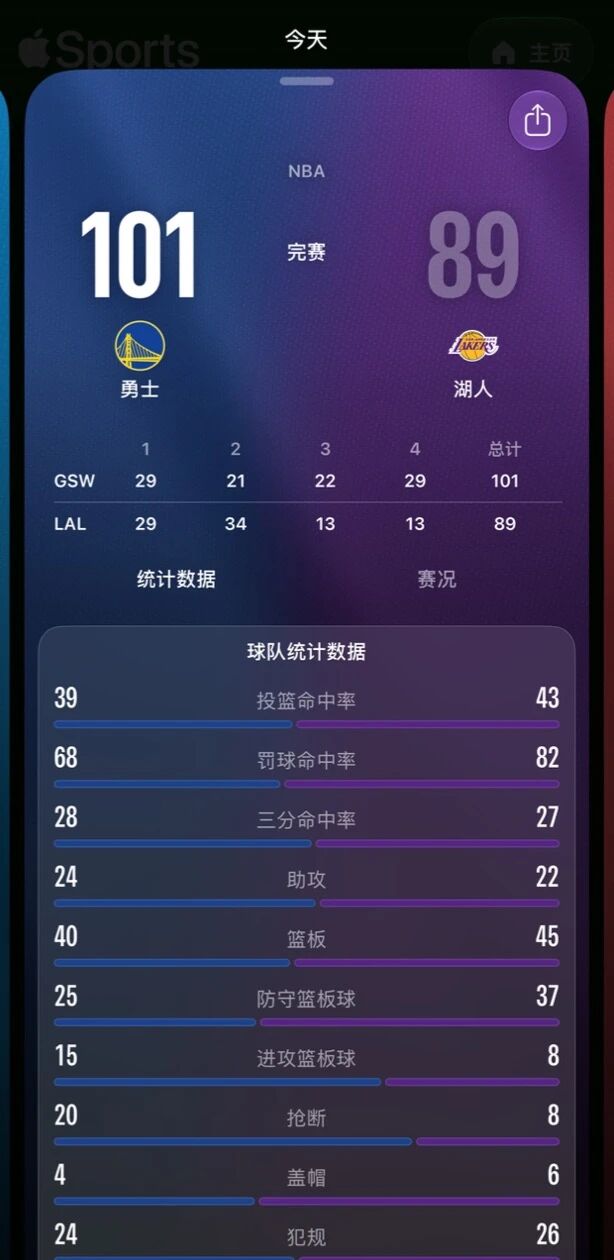
But there is something odd about the shape of it. A company built the fastest scoreboard in the world, shipped it to a country of 1.4 billion people, and the one competition that fills gymnasiums across my province — 93 teams, nearly 1.8 million admissions, tickets gone in ninety seconds — has no way of appearing on it at all. What appears instead is a basketball game in Toronto played while I was asleep, rendered beautifully, in Chinese, for a reader who will never attend one.
I don’t watch sports. But if the app had carried the 浙BA, I would have watched.