I picked up my Li Auto i6 on 27 June 2026. Rear-wheel drive, 720 km of claimed range, ¥249,800.
On 11 September I opened the Li Auto website to check whether they had added a new colour. The configurator was gone. In its place: “Current model unavailable, please contact a product expert.”
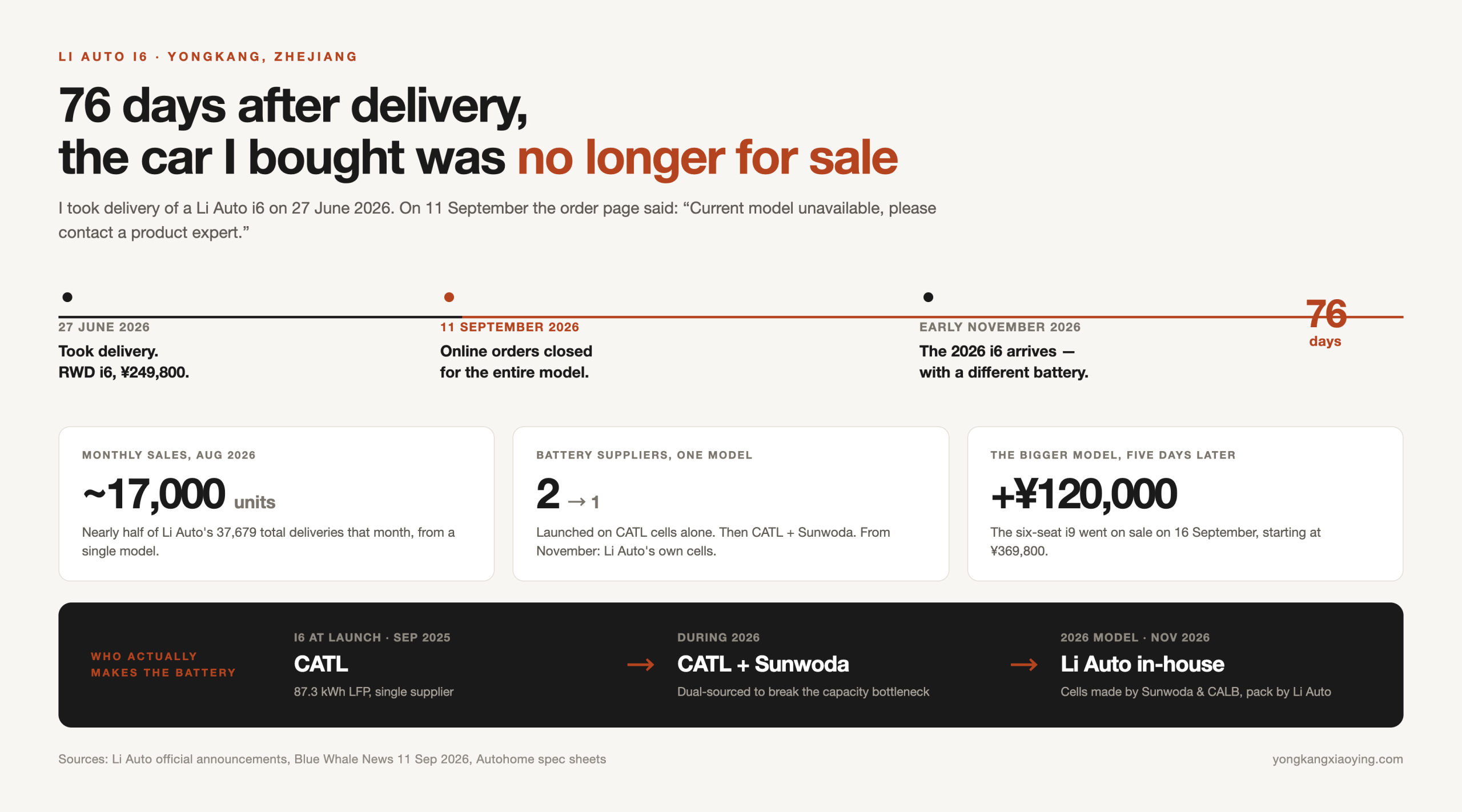
Seventy-six days. The car was not recalled, not faulty, not a flop — it was selling around 17,000 units a month, close to half of everything Li Auto delivered that August. It was simply over. The 2026 version arrives in early November, and the factory had stopped taking orders so it could retool.
I have written before about how fast Chinese cars change. Living through it as an owner is a different thing.
What actually changed
Not the body. Not the interior. The 2026 i6 gets two things: Li Auto’s own 5C fast-charging battery, and Li Auto’s own Mach chip for driver assistance.
Both of those used to be bought from someone else. That is the part worth paying attention to.
My car does not have one battery. It has one of two
The i6 launched in September 2025 with CATL cells only. CATL — 宁德时代 — is the largest battery maker on earth, the company that supplies Tesla, BMW, Volkswagen and half of China.
Then the orders piled up and CATL could not keep pace, so from November 2025 Li Auto ran a dual-supplier setup: CATL and Sunwoda, both building the same 87.3 kWh LFP pack to the same specification. Li Auto’s president Ma Donghui said on the Q3 2025 earnings call that the two suppliers’ cells were guaranteed to meet identical performance and quality standards.
Mine came with the CATL pack. I know because I asked, and because the window sticker says so.
By September, when I walked into a dealership out of curiosity, the salesperson told me the CATL versions were essentially gone — what was left on the lot was nearly all Sunwoda, in whatever colours and interiors nobody else had wanted. His pitch: “Big discount on the current stock, and the Sunwoda battery has a longer warranty.”
That is a sentence I have never heard in a Western dealership. Nobody in Europe or America asks which company made the cells in their car, because there is only one answer per model. Here, the answer changes by the batch.
And it is about to change again
The 2026 i6 does not use CATL or Sunwoda cells. It uses Li Auto’s own cell design, manufactured under contract by Sunwoda and CALB, with the pack assembled by Li Auto itself.
Li Auto’s product line chief Li Xinyang explained the logic on 8 September: with hundreds of billions of yuan of battery volume per year, having two contract manufacturers build your own cell design is how you keep supply stable at scale. You own the recipe; someone else owns the factory.
The same thing is happening to the i9 right now, and this is where it gets genuinely strange for a foreign buyer.
The i9 went on sale on 16 September with CATL’s 5C NMC cells. From late October, Li Auto switches to its own 5C NMC pack — and the order page will state which battery brand you are getting.
Think about that for a second. In China, a car manufacturer publishes the battery supplier on the configurator, the way a laptop maker tells you which CPU you are buying. Buyers here have learned to care.
It is not just Li Auto
On 4 September 2026, Xiaomi announced strategic battery partnerships with CALB and Sunwoda for its SkyNomad line. Xpeng and Leapmotor have been widening their supplier lists too. Chinese media have a word for the trend: quninghua — “de-CATL-isation.”
Li Xiang, Li Auto’s founder, pushed back on the obvious reading. Self-developing batteries, he said, does not mean CATL’s products are not good enough — CATL remains one of the best battery brands in the industry. The point is to hold the core technology the way Apple and Huawei hold theirs. “In the embodied-intelligence era, batteries and chips are the most core barriers.”
Whether that is vision or vertical-integration theatre depends on how the 2026 cars actually perform. What is not in doubt is the direction.
The bigger car arrived five days after mine was delisted
On 16 September — five days after the i6 order page went dark — Li Auto launched the i9. One trim, ¥369,800.
| i6 RWD (mine) | i9 | |
|---|---|---|
| Price | ¥249,800 | ¥369,800 |
| Length | 4,950 mm | 5,225 mm |
| Wheelbase | 3,000 mm | 3,168 mm |
| Kerb weight | 2,380 kg | 2,745 kg |
| Battery | 87.3 kWh LFP | 101 kWh NMC |
| CLTC range | 720 km | 705 km |
| CLTC consumption | 13.6 kWh/100 km | 15.1 kWh/100 km |
| 0–100 km/h | 6.5 s | 4.9 s |
| Turning radius | 5.85 m | 5.30 m |
| Seats | 5 | 6 |
| Driver-assist compute | Nvidia Thor-U, 700 TOPS | Li Auto Mach M100, 1,280 TOPS |
| Drag coefficient | — | 0.215 |
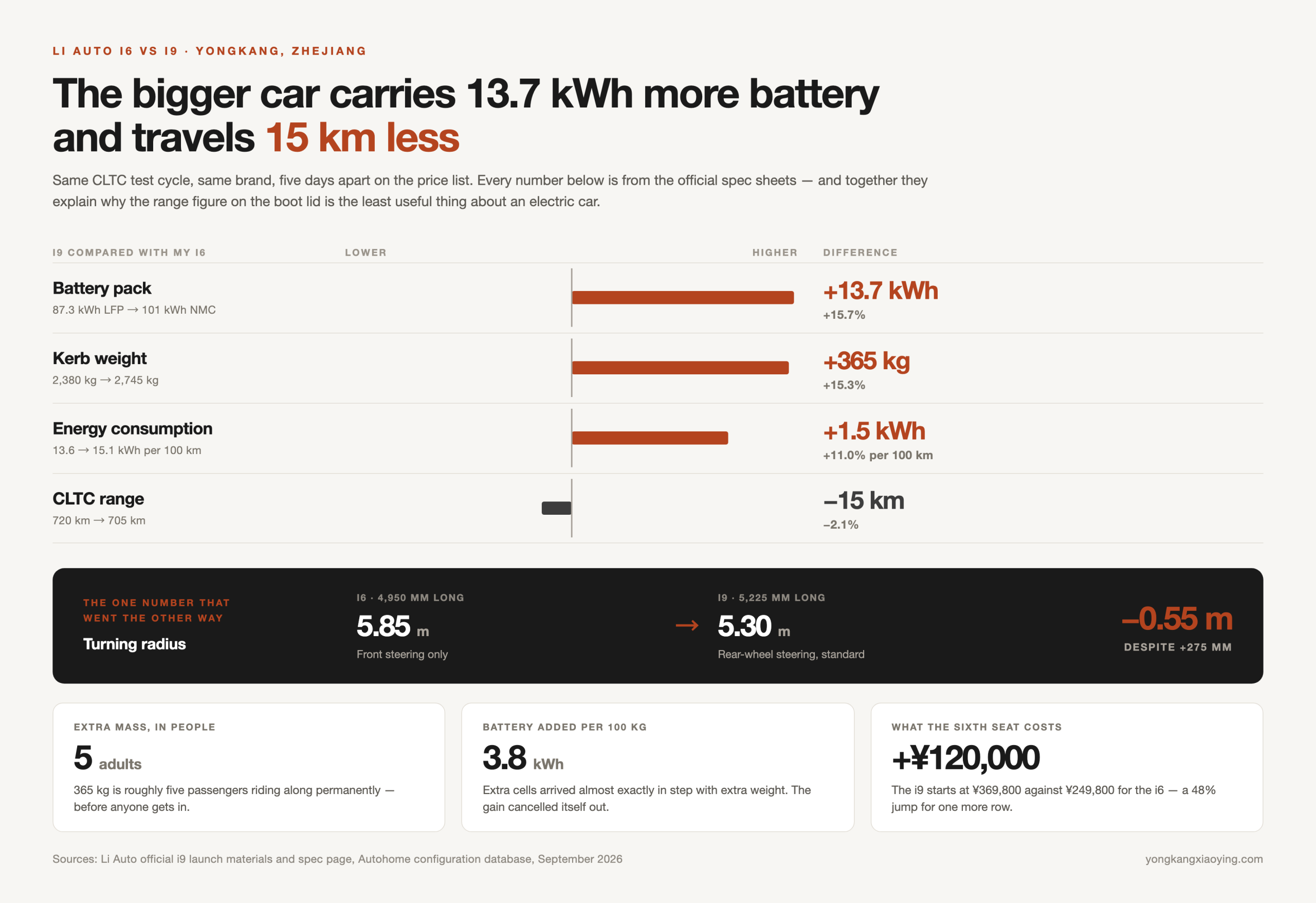
Look at rows six and seven. The i9 carries 13.7 kWh more battery than my car and travels 15 km less on the same test cycle, while using 11% more energy per kilometre.
That is not a failure. That is physics being honest. The i9 is 365 kg heavier and 275 mm longer, and a bigger frontal area at 120 km/h costs more than a bigger battery buys. Every Chinese car forum has a thread about this and every one of them concludes the same thing: the number on the boot lid is a test-cycle artefact, and the number that matters is consumption.
The one number that genuinely surprised me
Not the 4.9-second sprint. The turning radius.
The i9 is 275 mm longer than my car and turns in a 5.30 m radius. Mine needs 5.85 m. Half a metre, on a car that is bigger in every dimension.
That comes from rear-wheel steering, standard on the i9. In a town like mine — old streets laid out for handcarts, underground car parks with columns in the wrong places, a 3.5 m gap at the village entrance — half a metre is the difference between one clean turn of the wheel and a three-point shuffle with someone waiting behind you.
Anyone who has driven a five-metre car into a Chinese basement garage understands why this is the feature I keep thinking about, and the 1,280 TOPS of compute is the one I keep forgetting.
Why I am not trading up
Three reasons, and none of them are about money.
One: five seats is what I actually use. Most days it is me and my wife. Add my parents and it is four. The sixth seat would matter perhaps five times a year, and it costs ¥120,000 to have it available.
Two: my car became an orphan in the best possible way. The i6 with a CATL pack is now a configuration nobody can order. In a market where buyers have started asking which cells are in the floor, that is not obviously a bad thing to own.
Three: nothing about the i6 is obsolete. 720 km CLTC, 800V architecture, 10 minutes to add 500 km, and AD Max driver assistance with a lifetime zero-subscription fee. The 2026 version adds faster charging and in-house silicon. It does not make mine slow or dumb.
What this pace does to owners
Here is the thing nobody tells you about buying a car in China: you are not buying a product, you are buying a snapshot of a moving factory.
A German model runs seven years and gets one facelift. A Chinese model can be redesigned in twelve months, re-sourced in eighteen, and discontinued while it is still the best-selling car in its segment. My car went from “just delivered” to “no longer orderable” in less time than it takes most people to get a passport renewed.
For buyers, that means two new habits that would sound absurd elsewhere: ask which battery supplier you are getting, and assume the version you test-drive will not exist by the time you finish paying for it.
For the manufacturers, it means a car is never finished. The i6 I bought was the best value five-seat electric SUV in China on the day I signed. It still is. It just is not for sale any more.
If you have bought a car in a market where the model changes this fast — or one where it does not — I would like to know how the dealership handled the battery question. Comments are open.
Sources: Li Auto official launch materials and i9 spec page; Blue Whale News, 11 September 2026; Autohome configuration database; Li Auto Q3 2025 earnings call; Xiaomi battery partnership announcement, 4 September 2026.