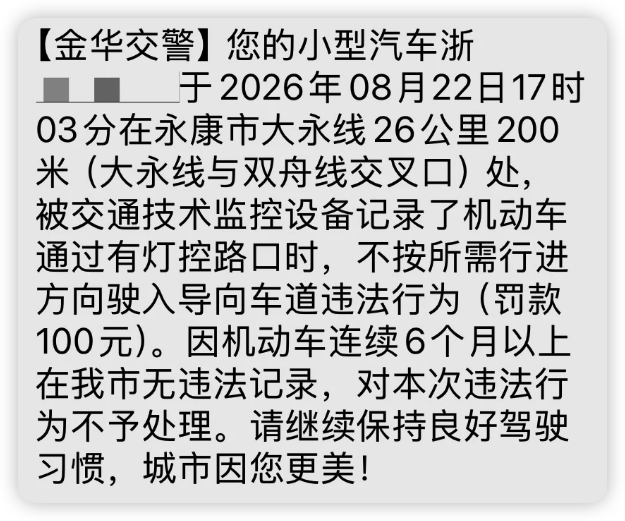
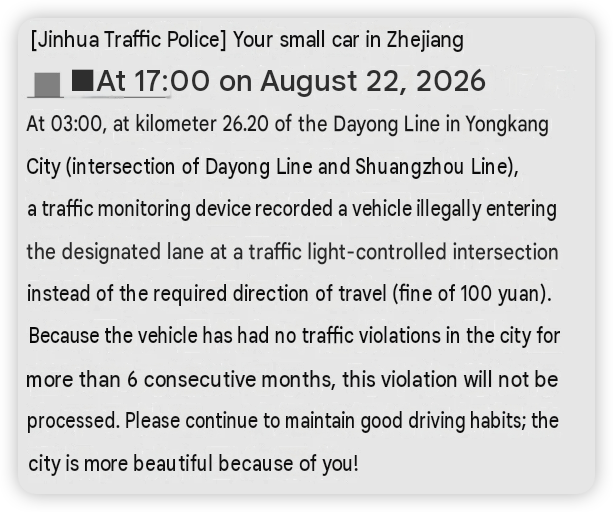
I got a text message from the traffic police this week that genuinely surprised me. It said I’d been photographed failing to follow a traffic sign or lane marking — and I immediately knew what it was: I’d driven straight ahead from a right-turn lane. My mistake, caught by a camera.
The message said the penalty would be a 100 RMB fine (~$15), no points deducted from my license. And then it said something unexpected: because I had no traffic violations in the previous six months, they wouldn’t be processing the penalty at all.
No fine. No points. Just a warning — because my record was clean.
Wait — You Can Just… Not Get Fined in China?
Yes, under specific conditions. China’s traffic police have what’s called the “first-offense warning” (首违警告) system: for a list of minor violations, if a driver has no recorded violations in the preceding six months, the penalty can be reduced to an official warning instead of a fine.
It’s part of a broader shift toward what Chinese officials call 人性化执法 — “humane law enforcement,” or enforcing rules with judgment rather than pure punishment. The idea: first-time minor mistakes shouldn’t cost you money if you’ve been a responsible driver. Habitual offenders still get fined.
What I Actually Did Wrong
Here’s the detail, for anyone who drives: I was in a right-turn-only lane and went straight through the intersection instead. In China that’s a “failure to follow lane markings” violation — one of the most commonly camera-caught offenses, because the cameras are specifically set up to watch lane discipline at intersections.
It’s a genuinely easy mistake to make, especially on roads you don’t drive daily. And in most countries, that’s a fine, full stop. The fact that the system checked my history first — and gave me a break because of it — is the part that stuck with me.
100 RMB Is a Lot of Crab
Here’s the thing about the money: 100 RMB (~$15) doesn’t sound like much in dollars, but in a small Chinese town it’s real money. It’s a week of takeout lunches. It’s several pounds of hairy crab in season — a genuinely nice dinner, saved.
So the warning wasn’t just a technicality. It saved a meaningful amount for a normal family budget — and it left me feeling more inclined to drive carefully, not less. Which is presumably the point.
Why This Kind of Enforcement Is Smart
I keep coming back to the design of this policy:
- It rewards good records. Six months of clean driving earns you one free pass. That’s a positive incentive, not just a punishment system.
- It targets the right people. Reckless drivers still get fined. Drivers who make one honest mistake get a warning.
- It costs the state almost nothing and buys a lot of goodwill — the message itself becomes a small moment of “oh, that’s fair,” which is rare feedback from a government system anywhere.
I’ve seen plenty of complaints about camera enforcement in China, and some of them are fair. But this one interaction did exactly what enforcement is supposed to do: it corrected my behavior and left me feeling like the system treated me like an adult.
FAQ: Traffic Fines and the First-Offense Rule in China
What is China’s “first-offense warning” for traffic violations?
For minor violations (like failing to follow lane markings), drivers with no recorded violations in the previous six months may receive an official warning instead of a fine, under police “humane enforcement” guidelines.
How much are traffic fines in China?
Most minor traffic fines run 100–200 RMB (~$15–30). Serious violations (speeding heavily, running red lights, drunk driving) carry larger fines and license points.
How do traffic cameras work in China?
China has extensive camera coverage at intersections, monitoring lane discipline, red-light running, and speeding. Violations are sent to drivers by text message, with photos attached.
Can foreigners drive in China?
Foreigners can drive in China with a valid Chinese license (obtained by converting a foreign license and passing a written test in some cases). The first-offense warning rule applies to all drivers with clean records.
Over to You
Does your country have anything like a “first-offense warning” for traffic violations — or is it always a fine? And what’s the smallest official interaction that ever surprised you by being reasonable?
I’d love to hear how traffic enforcement works where you live.
— Ying