My building’s underground garage has two sets of charging piles, and they tell completely different stories.
One set was installed by the developer. Each one has a QR code sticker and a small printed notice taped to the pillar beside it: scan to charge, charges apply. When our complex sold its parking spaces, these were part of the deal. A space with a charging pile built in cost ¥10,000 more than a space without one.
The other set, a few bays further along, belongs to owners who installed their own piles — after they had already bought a space that came with one.
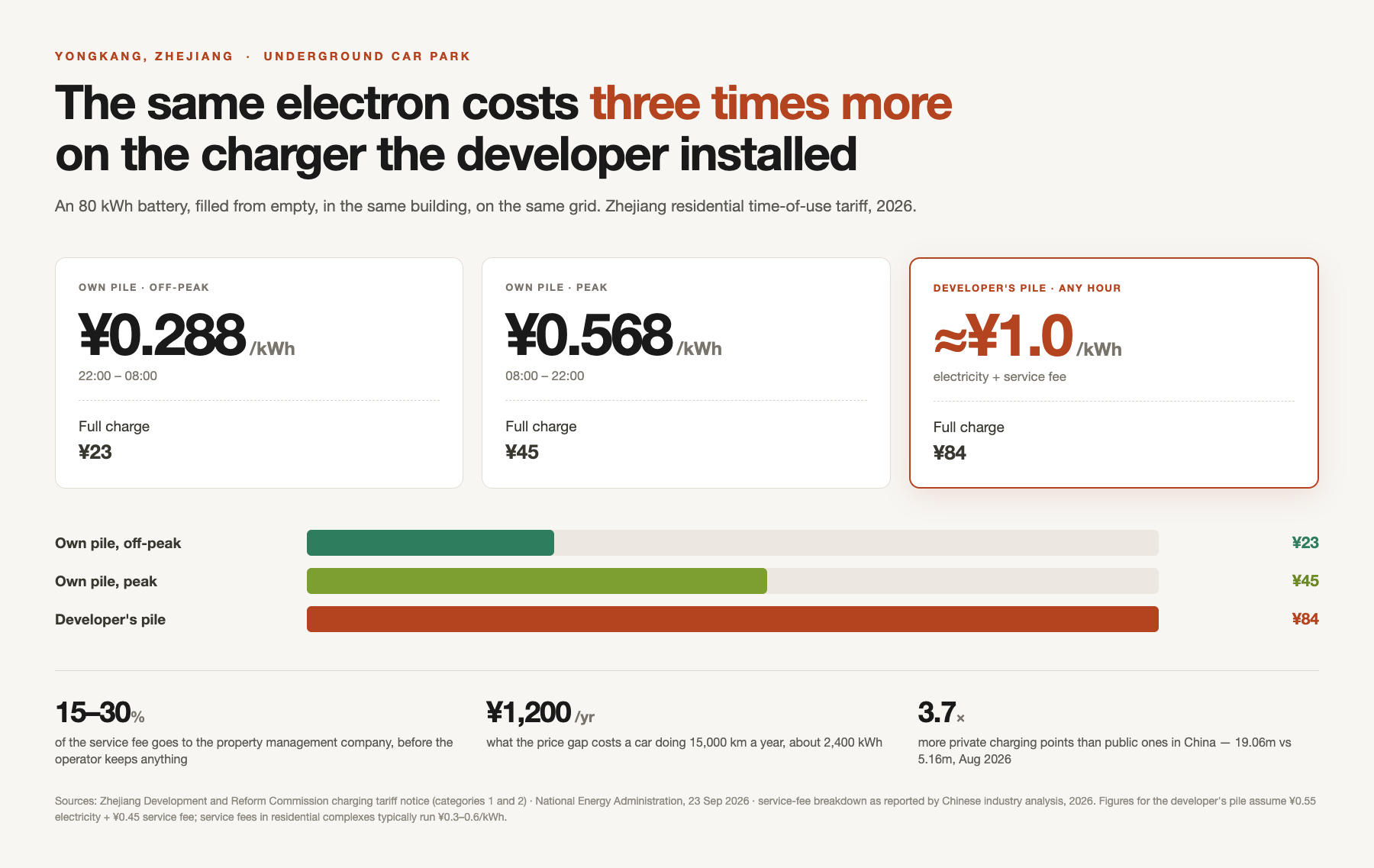
Short answer: it is cheaper to install your own. A pile you own runs on the residential time-of-use tariff, where off-peak power in Zhejiang costs ¥0.288 per kWh. A pile installed by the developer runs on electricity plus a service fee, and the service fee is set by an operator who has to give the property management company 15% to 30% of the revenue. You paid ¥10,000 for the hardware. You still pay the operator every night.
There is nothing irrational about what those owners did. They did the arithmetic. Most of the people who tell this story as “Chinese homeowners don’t appreciate what they’re given” have never seen the two bills side by side.
First, the Two Prices
Zhejiang’s development and reform commission publishes the electricity tariff for charging facilities in a document most drivers have never read. It splits charging into four categories, and the difference between two of them is the whole article.
A pile you install at your own home — or a non-residential customer billed at the residential rate — falls into category one. You pay the residential combined tariff, and you can choose flat or time-of-use pricing.
A pile installed in a residential complex and connected directly to the grid falls into category two. It also pays the residential combined tariff, but time-of-use pricing is mandatory: no flat rate option.
Here is the actual number table for our voltage level, under 1 kV:
| Zhejiang residential charging tariff | Peak (08:00–22:00) | Off-peak (22:00–08:00) |
|---|---|---|
| Flat rate, category one | ¥0.558 / kWh (no peak split) | — |
| Category one, time-of-use | ¥0.588 / kWh | ¥0.308 / kWh |
| Category two (complex garages), 1–10 kV | ¥0.568 / kWh | ¥0.288 / kWh |
So a car charged overnight at home sits at roughly half the daytime rate. An 80 kWh battery filled entirely in the off-peak window costs about ¥23. That is the single most important number in Chinese EV ownership, and it is why almost everyone charges at night.
Now the developer’s pile. Under the price-transparency rules that took effect nationally in January 2025, every charging bill has to be shown in two lines: electricity and service fee. The electricity line is pinned to the residential rate — nobody is allowed to mark it up. The service fee is set by the operator, with no government ceiling.
In residential complexes in China, service fees commonly land between ¥0.3 and ¥0.6 per kWh. One operator publicly broke down a ¥0.833 service fee: site rent 40%, equipment maintenance 30%, property management’s cut 20%, insurance and other costs 10%. Property commissions in residential complexes typically run 15% to 30% of revenue, and go higher in large, well-located complexes where the operator has no alternative site.
Add it up. An owner charging on the developer’s pile pays roughly ¥0.55 for electricity plus ¥0.4–0.6 in service fee. Call it around ¥1.0 per kWh against ¥0.288 at home. Several times the price for the same electron, in the same garage, a few bays apart.
Second, the Car Comes With a Free Pile
The second reason is that Chinese EV buyers usually do not need to buy a charging pile at all.
Most brands include a home charger with the car for the first owner: a 7 kW AC unit plus up to 30 metres of cable and the installation, free. The practice is common enough that its absence is newsworthy — Li Auto stopped including a home charger from May 2026, and that decision was covered as a change of policy rather than a promotion ending.
So the owner’s position at the moment the developer hands over the keys is this: I already have a pile, it came with the car, and it runs on the cheap tariff. The one in my space costs me a service fee every time I plug in, and the hardware is already paid off. Which one am I going to use?
There is a hardware argument too, and it is not marketing. A brand’s own pile talks to the car. It can schedule charging for the off-peak window automatically, read pack temperature and state of charge, and pre-condition the battery before a winter morning. The generic pile in the developer’s space can put electricity into the car and nothing else. There is no app, no schedule, no data.
That matters more than it sounds. The saving from off-peak charging only exists if the charge happens off-peak. A pile that cannot schedule is a pile you have to remember to plug in at 10 pm.
Third, ¥10,000 Buys the Box, Not the Electricity
This is where the misunderstanding usually happens, and it happened to my neighbours.
When the developer sold spaces with a charging pile for ¥10,000 more, that money bought the pile as a fixture. It did not buy free electricity, and it did not make the owner the operator of the pile. In most such arrangements the pile was installed by a third-party charging company under an agreement with the developer, and using it means scanning a code and paying that company, on that company’s terms.
In other words: pay once for the box, pay every night for the power. Owners who worked this out early treated the ¥10,000 as the price of a parking space with a socket already wired in — a convenience at resale — and then installed their own pile in the same space anyway.
Is it wasteful to have two piles in one parking space? Physically, yes. Economically, the second pile pays for itself in roughly a year of normal driving. A car doing 15,000 km a year at 16 kWh/100 km burns about 2,400 kWh. At a ¥0.5 per kWh gap between the two piles, that is ¥1,200 a year, every year, for as long as the owner keeps the space.
The Counter-Argument, and Where It’s Wrong
The standard defence of the developer’s pile is safety: “only the manufacturer’s pile is safe, third-party piles can damage your battery.”
That is half true, and the half that is false is the reason this matters.
China has a single national charging protocol. A compliant pile of any brand will not damage a battery, and installing a certified third-party pile does not void the warranty on the battery, motor or controller. What actually causes problems is bad installation — undersized cable, poor earthing, no dedicated circuit — not the logo on the box.
The other half is true, and it is about the piles that are already on the wall. Until recently, charging equipment in China ran on voluntary certification, with a low barrier to entry, and the market filled with cheap units that cut costs on insulation, protective circuits and flame-retardant housings. In a national spot check published in April 2025, inspectors sampled 112 batches of charging equipment from 112 producers across 16 provinces. 55 batches failed — a failure rate of just under 50%.
From 1 August 2026, that loophole closed. Electric vehicle supply equipment in China now needs CCC compulsory certification before it can be manufactured, sold, imported or used in business operation. Fixed AC piles, integrated DC piles and portable units are all covered. The certification tests insulation resistance, earth continuity, leakage-protection response time, short-circuit protection and flame-retardant housings, with the device required to cut power within milliseconds on a fault.
Which raises an uncomfortable question for anyone who bought a space with a pile installed in 2022: was that pile certified, and is it still being inspected?
Meanwhile, the Country Is Charging at Home
The scale of China’s charging build-out is often reported as a public-infrastructure story. It is really a private-driveway story.
As of the end of August 2026, China had 24.22 million charging points, up 39.6% year on year. Of those, 5.16 million were public and 19.06 million were private. Private piles grew 46.3% in a single year; public piles grew 19.5%.
Read that ratio again: there are 3.7 private charging points for every public one. The average Chinese EV owner is not queuing at a motorway service area. They are plugging in at 10 pm, in their own parking space, on the off-peak tariff.
That also explains the economics on the supply side. In an April 2025 investigation, CCTV’s finance programme reported that more than 80% of charging station operators were loss-making. The reason is not that service fees are too low. It is utilisation: the piles are busy for two or three hours a night and idle the rest of the day, while the equipment cost sits on the books regardless. Which is why operators push service fees up, and why the property company’s 15% to 30% cut ends up on the owner’s bill rather than the developer’s.
What This Looks Like in One Garage
Back to my building, then. Two sets of piles, a few bays apart, same concrete, same cars, same grid.
| Developer’s pile | Owner’s own pile | |
|---|---|---|
| Hardware cost | ¥10,000, bundled into the parking space | Free with the car (7 kW + 30 m cable) |
| Electricity | Residential rate, no markup allowed | Residential rate |
| Service fee | ¥0.3–0.6 per kWh to the operator | None |
| Effective cost | ~¥1.0 per kWh | ¥0.288 per kWh, off-peak |
| Scheduling | None | Automatic off-peak charging |
| Visibility | Nothing on your phone | Battery state, charge history |
| Certified under the 2026 CCC rules | Unknown | Yes |
Nobody organised this. No owner’s committee voted on it. Each household independently reached the same conclusion in the same way, which is what a price signal looks like when it is strong enough.
The developer’s piles are still on the wall. They work. They are simply the most expensive way to charge a car in the building that installed them.
FAQ: EV Charging in Chinese Apartment Garages
Why did the developer install charging piles at all?
Because piles sell parking spaces. A space advertised as “with charging pile” is easier to sell to a buyer who has just ordered an electric car, and the ¥10,000 premium is collected at the point of sale. Operating the pile afterwards is somebody else’s business — usually a third-party charging company that pays the property company a commission.
Is it legal to install your own pile if the space already has one?
In most complexes yes, subject to the property company’s approval and a grid connection application. The constraint is capacity, not paperwork: the building’s transformer has to have headroom, and in older complexes it often does not. That, rather than permission, is what actually blocks installations.
Do you need to own the parking space?
For a residential complex, yes in practice — the grid application requires the space’s ownership documents, and the property company will not approve a pile on a space you rent. This is one of the differences from building a house in the countryside, where the requirement is a rural homestead certificate and a stamp from the village committee instead.
Why is the service fee higher than the electricity?
Because the electricity line is capped at the residential rate and the service fee is not. The operator has to cover the equipment, the installation, maintenance, insurance and the property company’s commission out of that single line. With piles idle most of the day, the fee per kWh has to carry a fixed cost spread over very few hours.
Will the 2026 CCC rules make the old piles illegal?
No. Equipment already in operation before 1 August 2026 is not required to be withdrawn, but the operator must keep it compliant with product quality and consumer protection law and maintain it properly. In practice, old uncertified piles in residential garages are now a maintenance and liability question for whoever operates them.
Where I Got These Numbers
- Zhejiang charging tariff categories, peak and off-peak rates — Zhejiang Development and Reform Commission and Provincial Market Regulation Bureau, notice on optimising electricity prices for EV charging facilities
- Off-peak rate of ¥0.288/kWh for household piles in Zhejiang, and the ¥23 cost of an 80 kWh charge — Qianjiang Evening News, April 2026
- 24.22 million charging points at end-August 2026, split 5.16 million public and 19.06 million private — National Energy Administration, 23 September 2026
- CCC compulsory certification for EV supply equipment from 1 August 2026, and the scope of equipment covered — SAMR announcement No. 50 of 2024 and China Daily, 1 August 2026
- 112 batches sampled, 55 failing, just under 50% — CNR, 13 August 2026
- More than 80% of charging operators loss-making — CCTV Finance *Economy Half Hour*, April 2025, reported in Toutiao
- Property commission of 15% to 30% of charging revenue, and the breakdown of a ¥0.833/kWh service fee — Toutiao industry analysis
- Battery warranty not voided by compliant third-party piles, per the national charging protocol — CNR, 13 August 2026
- Currency converted at ¥7.1 to the US dollar, October 2026
Over to You
If you have an electric car, where does it actually charge at night — your own space, a shared pile, or somewhere you have to drive to? And if you have ever paid for a charging facility as part of a property purchase, I would like to know whether it turned out to be the one you use.
For readers outside China: does your building’s shared charger cost more than charging at home, and by how much?
— Ying